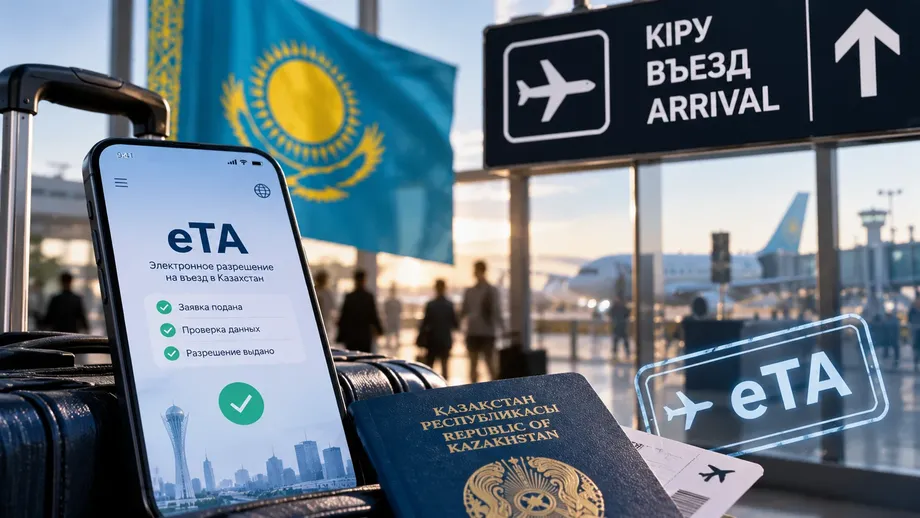
A new entry requirement with a phased start
Kazakhstan will begin introducing electronic travel authorization at Aktau Airport and four road checkpoints on November 1, 2026, before making it mandatory nationwide on July 1, 2027. The requirement covers travelers from countries whose citizens can enter without a visa, including members of the Eurasian Economic Union (EAEU), unless an exemption applies.
Contents
- A new entry requirement with a phased start
- How the pilot became a legal requirement
- The dates and checkpoints to watch
- Applications, passport checks and border decisions
- Why the fee accounts differ
- Who qualifies for an exemption
- Authorization does not reset the allowed stay
- EAEU travelers and business trips face new formalities
- Refusals, cancellations and unresolved procedures
- The Essentials
Government Resolution No. 890, dated October 10, 2026, sets out a free application process, a submission deadline of at least 72 hours before arrival and an authorization valid for 180 days. Travelers must use the same passport for their application and their border crossing. The requirement also covers transit through Kazakhstan.
The distinction between the rollout and enforcement dates matters. During the introductory stages, border officials will explain the requirement without refusing entry solely because a traveler lacks authorization. From July 1, 2027, its absence can become grounds for refusal at every checkpoint.
The authorization, known as ETA or eTA, does not replace a visa for people who need one, extend an allowed stay or guarantee admission. It adds an advance screening step for people who previously could travel without applying for a visa. Border authorities retain the final decision on entry.
The October timetable follows an earlier QazETA pilot and legislative changes that took effect in August. Earlier accounts gave different proposed fees and implementation schedules, making it essential to distinguish the platform launch, the legal basis for authorization and the later date when travelers can be turned away for lacking it.
How the pilot became a legal requirement
The Belarusian Embassy in Kazakhstan says in its consular entry notice that the QazETA digital platform launched in January 2026. Its notice describes ETA applications through the mobile app and says obtaining authorization during the pilot is recommended rather than compulsory.
The legislative foundation followed on June 24, 2026, when Kazakhstan signed Law No. 326-VIII. The law addresses digital services, personal data protection, road traffic and advanced transport technologies, while also creating the legal basis for electronic travel authorization.
An EY legal alert dated August 24, 2026, by Vladimir Fesenko, an EY partner responsible for individual taxation and workforce management, explains that the relevant ETA provisions took effect on August 25. It also records clarifications from Kazakhstan's Ministry of Internal Affairs that an initial informational stage was planned from that date.
Under those clarifications, a traveler without authorization would initially be advised to obtain it before a later visit, rather than refused entry for that reason. The alert explicitly described the arrangements as preliminary: the country list and final procedures had not yet been established when it was prepared.
Resolution No. 890 provides the subsequent checkpoint schedule. Its entry into force is tied to ten calendar days after its first official publication, a separate legal milestone from the November start of the rollout. The publication date is not specified in the account of the resolution.
The dates and checkpoints to watch
The rollout moves from a limited group of airports and road crossings to nationwide coverage, followed by mandatory enforcement. Travelers should distinguish those stages from the earlier dates when the platform and legislation became operational.
- January 2026: QazETA launches as a digital platform, with ETA operating in pilot mode.
- June 24, 2026: Law No. 326-VIII is signed, establishing the legal basis for ETA.
- August 25, 2026: The relevant legal provisions take effect; an informational implementation stage had been planned from this date.
- November 1, 2026: The phased rollout begins at Aktau Airport and the Urlyutobe, Aukhatti, Atameken and Nurly Zhol road checkpoints.
- January 1, 2027: Astana and Almaty airports join the rollout.
- March 1, 2027: The system extends to all remaining checkpoints.
- July 1, 2027: Authorization becomes mandatory at all checkpoints for travelers covered by the requirement.
The initial road crossings are in Pavlodar, Zhambyl, Turkestan and Zhetisu regions, respectively. An earlier proposed schedule described air travel from November, selected road crossings afterward, and rail and maritime travel by the middle of December. Those dates were subsequently removed from the foreign travel advisory that had carried them. They should not be confused with the October resolution's later timetable.
Applications, passport checks and border decisions
Applications must be submitted electronically through the digital platform for foreign citizens and stateless persons, with identity verification. The pilot uses the QazETA mobile app, available through Google Play and the App Store. QazETA also includes electronic visas, e-Residency and certificates confirming border crossings.
The 72 hour rule is a deadline for submitting an application, not a stated promise that every application will be approved within that period. Applying earlier gives travelers more time to deal with a refusal or a problem with their details, although the rules described do not specify a guaranteed processing time.
Internal affairs authorities issue the authorization in coordination with national security authorities. At the border, officials check its existence through the Berkut unified digital system. The passport presented must be the one used in the application, so travelers should not assume that authorization attached to an old passport can be used with a replacement.
The Ministry of Internal Affairs clarifications recorded in August envisaged authorization allowing multiple entries over 180 calendar days. That validity period is separate from the number of days a person may stay in Kazakhstan.
Kazakhstan's Embassy in Greece explained the limit of an approved authorization when describing the pilot:
The final decision on entry into the country is made by the authorized state body of Kazakhstan during border control.
Approval therefore does not remove other immigration requirements or prevent border officers from refusing entry on another applicable legal ground.
Why the fee accounts differ
The October resolution sets the application charge at zero tenge. That differs from earlier reports describing a possible charge of about 3,900 tenge, approximately 8 euros, for an advance application and 7,600 tenge, approximately 16 euros, for payment at the border.
Another earlier account gave the same indicative advance charge of 3,900 tenge but described a border application as costing twice that amount, which would be 7,800 tenge rather than 7,600. These were reported estimates, not a single consistent final tariff.
The migration law was also described as providing for an ETA fee, with revenue divided equally between financing the digital system and supporting tourism development. A legal provision allowing a fee and a later rule setting its current amount at zero can coexist. Neither establishes that a charge must be collected immediately.
For travel planning under the October arrangements, the stated amount is zero. The resolution does not say whether that amount may change later. Earlier references to payment at the border should not be treated as proof that travelers will be able to bypass the advance application deadline once enforcement begins.
Who qualifies for an exemption
The resolution provides 29 exemption categories, subject to supporting documents. The age exemptions cover children under 16 and people aged 65 or older. Other major categories include holders of a valid Kazakh visa, a temporary residence permit or a residence permit.
Transport exemptions are defined more precisely than a general exemption for anyone driving commercially. They cover drivers engaged in qualifying international transport, including transit, where freight vehicles have a permitted mass above six tonnes or a payload above 3.5 tonnes. Bus drivers qualify where the vehicle has more than 12 seats.
Air, sea and river vessel crews, along with train and locomotive crews, are also exempt. Diplomatic and official categories include holders of diplomatic and service passports, members of official delegations and representatives of the diplomatic corps accredited in Kazakhstan. Refugees and asylum seekers are among the listed categories.
For people exempt because of official or special status, government bodies enter details into the digital platform and internal affairs authorities verify the exemption. The amendments also add the Kurultai, Supreme Court and government apparatus to the list of inviting bodies relevant to exemptions.
An exemption is therefore not simply a traveler's personal declaration. Documentary proof and, for certain categories, government registration are part of the process. Although international freight drivers are exempt, the practical method for checking their eligibility at busy crossings has not been explained.
Authorization does not reset the allowed stay
The 180 day validity of an eTA is not permission to remain in Kazakhstan for 180 days. Existing limits continue to apply. For most covered nationalities, the general allowance is 30 days per visit, with no more than 90 days in any 180 day period.
The October account lists a 90 day allowance for citizens of EAEU countries and Turkey. Earlier reporting on the rules introduced in 2023 specifies that EAEU citizens may spend no more than 90 days in any 180 day period unless they have separate legal grounds for a longer stay.
Citizens of Iran and India have a shorter allowance: 14 days per visit and no more than 42 days in any 180 day period. The figures show why authorization validity and permitted presence must be checked separately. A valid eTA can still exist after a traveler has used the days available under the applicable stay limit.
Kazakhstan ended the practice of leaving and promptly returning to reset the permitted stay in 2023. Obtaining a new authorization should not be interpreted as restoring an exhausted stay allowance. The new system changes advance entry formalities, not the underlying limits on how long a person may remain.
EAEU travelers and business trips face new formalities
Including EAEU citizens makes the measure relevant to frequent regional travel, business visits and trips by foreign employees who do not need visas. The August ministry clarifications envisaged applying ETA to entry under visa exemptions regardless of the purpose of the trip.
The October rules retain the priority of ratified international treaties over domestic provisions. They do not explain how the authorization requirement relates to EAEU treaty provisions on freedom of movement. That is an unresolved point about how the measure will operate, rather than evidence that EAEU citizens are exempt.
A regional comparison illustrates that Kazakhstan is not the only country adding advance digital procedures. Reports describe Kazakhstanis traveling to Russia for work or study as having to apply through RuID at least 72 hours before crossing from July 1, 2026. The resulting Russian QR code is valid for 90 days, compared with Kazakhstan's stated 180 day authorization. The shared application deadline does not make the two systems equivalent in scope or legal effect.
For companies arranging travel, the practical distinction is between employees who qualify for an exemption, such as holders of a valid temporary residence permit, and visitors who need authorization. Airlines and other carriers will also need procedures to check readiness before travel, although the described rules do not set out a detailed carrier checking process or associated penalties.
Refusals, cancellations and unresolved procedures
Applications may be refused and issued authorizations cancelled on grounds connected to Article 48 of Kazakhstan's Law on Migration of the Population. The rules also address shortened permitted stays, administrative deportation and violations of the application procedure. Notifications are to be delivered through the digital platform.
The resolution does not describe a procedure for appealing an ETA refusal or cancellation. That absence should not be read as proof that no legal remedy exists elsewhere, but travelers are not given a specific appeal route in these arrangements. The rules also do not explain how an urgent correction would be handled shortly before departure.
The system's capacity during peak travel periods is another open issue. The phased introduction provides time to observe application volumes and border checks, but no performance figures or guaranteed service standards have been stated. Travelers should verify whether an exemption applies, submit applications before the minimum deadline and ensure their passport details match.
The next operational milestones are November 1, 2026, January 1 and March 1, 2027. The decisive enforcement date is July 1, 2027. Before then, the absence of authorization is not intended to trigger refusal during the introductory stages. Other grounds for refusing entry remain applicable throughout.
The Essentials
- Kazakhstan's phased eTA rollout starts on November 1, 2026, at Aktau Airport and four road checkpoints.
- Covered travelers must obtain authorization from July 1, 2027, including citizens of EAEU countries unless exempt.
- Applications are free under the October resolution and must be submitted at least 72 hours before arrival.
- Authorization is valid for 180 days, covers transit and must match the passport used at the border.
- The resolution lists 29 exemption categories, including specified age groups, residence document holders, diplomatic travelers and qualifying transport workers.
- Existing stay limits remain unchanged, and approval does not guarantee entry.
- Earlier fee estimates differ from the stated zero charge; appeal procedures and some operational details are still unexplained.