Afghanistan survive 142 overs to deny Bangladesh
Sediqullah Atal batted for 514 minutes and faced 332 deliveries for 111 as Afghanistan saved the Test against Bangladesh at Sheikh Zayed Cricket Stadium in Abu Dhabi. Set 479 to win, Afghanistan finished on 346 for eight, with Qais Ahmad unbeaten on 49 after hitting two sixes in the final over.
Contents
- Afghanistan survive 142 overs to deny Bangladesh
- How Bangladesh built a target of 479
- Atal turns a difficult start into a historic hundred
- Injury and patient partnerships keep the innings alive
- The final session turns on missed chances
- Qais and Ahmadzai consume Bangladesh's remaining time
- Litton's record performance ends without a win
- Shanto points to execution, Pybus to resilience
- What remains uncertain after the draw
- Key Points
Bangladesh needed seven wickets when Afghanistan resumed the final day at 132 for three. They took five across 92 overs, leaving the last two beyond their reach despite several opportunities in a tense final session. The 142 overs Afghanistan survived covered their entire second innings, rather than the final day alone.
Atal, playing only his third Test, became the first Afghanistan batter to score a century in the fourth innings of a Test. His dismissal at 281 for seven left roughly 23 overs for Bangladesh to finish the match. Instead, Yamin Ahmadzai occupied 85 deliveries for 19, Qais resisted for 80 balls, and Zia-ur-Rehman Akbar blocked the final 12 deliveries he faced without scoring.
The result was a draw, not a successful chase. Afghanistan remained 133 runs short of their target, but Bangladesh could not dismiss them before play ended. In Test cricket, surviving the allotted time can be enough to avoid defeat, even when the winning total is far away.
How Bangladesh built a target of 479
Bangladesh established control with a first innings total of 346. Tanzid Hasan contributed 83, Shadman Islam 67 and Litton Das 53. Afghanistan replied with 240, despite Rahmat Shah's 105 and Karim Janat's 62, giving Bangladesh a lead of 106.
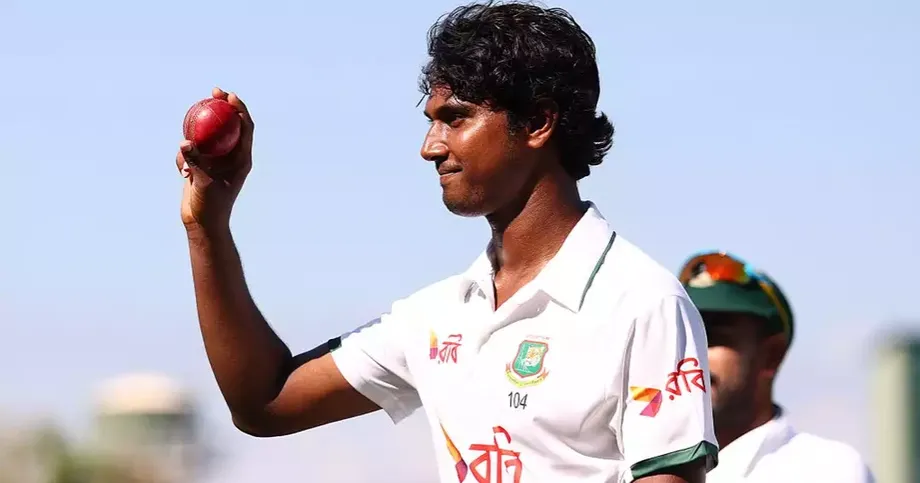
Hasan Mahmud took five wickets for 55 runs in that innings. His haul was also reported to include Bangladesh's first Test hat trick by a fast bowler, a distinction within a performance that put Afghanistan under pressure well before their final innings began.
Bangladesh then declared at 372 for seven, ending their innings voluntarily to leave time to bowl Afghanistan out. Litton made 102, captain Najmul Hossain Shanto scored 82 and Mushfiqur Rahim added 81. Adding that second innings total to the 106 run lead produced an advantage of 478, meaning Afghanistan needed 479 to win.
The declaration left roughly four and a half sessions for Bangladesh to take ten wickets. Afghanistan lost two wickets within their first seven overs, but Rahmat's 51 from 124 balls helped steady the innings. By the end of the fourth day, Atal was unbeaten on 35 and Afghanistan had reached 132 for three.
Atal turns a difficult start into a historic hundred
Atal entered the match with just 62 runs from his first two Tests. His 111 in Abu Dhabi therefore exceeded his previous Test aggregate by 49 runs. More important than the total was the time he consumed, keeping Bangladesh at work deep into the final session.
His fifty took 166 balls. He reached his century from 277 deliveries, with most accounts describing a pulled boundary off Hasan Mahmud in the 97th over. One account identifies Mehidy Hasan Miraz as the bowler, but the milestone, delivery count and significance of the hundred are consistently reported.
The innings contained nine fours and three sixes. Those boundary strokes accounted for 54 of his 111 runs, showing that a long defensive effort still included selected attacks. He struck Taijul Islam for sixes while otherwise refusing to be drawn into unnecessary risks.
Atal also needed reprieves. A defensive shot nearly sent the ball onto his stumps, and Litton missed a stumping opportunity with the batter on 70. A stumping occurs when the wicketkeeper breaks the wicket while the batter is outside the crease and is not attempting a run. Here, the failure to gather the ball cleanly allowed Afghanistan's central resistance to continue.
Afghanistan head coach Richard Pybus said Atal had worked to recover his form before the match and praised the young batter's preparation.
All credit to Sediq for really turning it around. It was an outstanding innings for him. He had been a little bit out of touch, actually, so he worked really hard on this innings.
Injury and patient partnerships keep the innings alive
Afghanistan suffered an early disruption when a throw from Hasan struck Hashmatullah Shahidi on the right knee. Shahidi left the field retired hurt, which allowed him to return later without the departure counting as a wicket.
Atal and Ikram Alikhil then shared a stand of 66 that occupied much of the morning. Ebadot Hossain eventually broke it shortly before lunch, using a short delivery that Alikhil gloved down the leg side. Litton dived to his right to complete the catch.
Reports differ on Alikhil's individual score, giving either 33 or 36. The partnership total and the manner of his dismissal are consistent. Bangladesh had taken only one wicket during the morning session, and Afghanistan reached lunch at 203 for four.
Ismat Alam's contribution was small in runs but substantial in time: four from 60 deliveries. Accounts place his first run on either his 44th or 45th ball. His resistance helped Atal negotiate the period after lunch, when Bangladesh took the second new ball in search of a breakthrough.
Mehidy dismissed Alam soon after Atal completed his hundred, with an edge deflecting off Litton's pad to Shanto at slip. Shahidi returned and attacked, including a six and a four off Taijul, before falling for 36 from 69 balls while attempting another big shot. Afghanistan went to tea at about 265 for six, with Atal still unbeaten on 105.
The final session turns on missed chances
Taijul finally removed Atal at 118.4 overs, the fourth delivery of the 119th over. An edge deflected off the batter's pad to Tanzid at short leg, a catching position close to the batter. Atal reviewed the decision, but UltraEdge, technology used to detect contact between bat and ball, confirmed the edge.
With Afghanistan at 281 for seven, Bangladesh needed three more wickets. The opening was genuine, but a sequence of escapes prevented them from converting it into victory.
- 118.4 overs: Atal was caught for 111 after his review confirmed an edge.
- 120.5 overs: Ahmadzai's inside edge rolled onto the stumps without dislodging the bails.
- 121.1 and 121.2 overs: Bangladesh had consecutive run out opportunities. Qais escaped the first, and Ahmadzai survived the second after a third umpire review.
- 122.4 overs: Qais regained his ground in time to survive a stumping attempt.
- 126.3 overs: A close catching chance from Qais went down at silly point.
- 130.5 overs: Qais survived another dropped catch at deep midwicket.
- 136.6 overs: Mehidy dismissed Ahmadzai, leaving five overs to take the last two wickets.
The deep midwicket drop came with Qais on 29. Most accounts identify Hasan as the fielder, while one names Tanzid. Either way, Qais added another 20 runs and remained at the crease until the match ended.
Ahmadzai's earlier escape was different from a fielding error. Although the ball touched his stumps, the bails stayed in place, so the wicket had not been broken and he was not out bowled.
Qais and Ahmadzai consume Bangladesh's remaining time
Qais and Ahmadzai added 45 for the eighth wicket from 110 deliveries, equivalent to 18 overs and two balls. That partnership absorbed most of the time Bangladesh had left after removing Atal.
Ahmadzai's 19 from 85 balls was reported as his career best. His value lay primarily in refusing to surrender his wicket while Qais mixed defence with attacking strokes. Mominul Haque finally ended the stand with a diving catch at short leg off Mehidy, leaving Afghanistan at 326 for eight.
Five overs remained, and Bangladesh still needed two wickets. Zia's contribution of zero not out from 12 balls illustrates why the score alone does not measure an innings in a match being saved. Every delivery he survived reduced the time available to dismiss Afghanistan.
Qais received treatment for a hamstring problem late in the innings. A detailed account places the break at 139.3 overs and says it lasted four minutes, drawing frustration from Shanto. The treatment is reported consistently, but the accounts do not establish that the discomfort was feigned.
In the final over, Qais struck Taijul's second delivery over long off for six, defended the next three and sent the last ball over midwicket for another six. He finished on 49 not out from 80 deliveries, one run short of a maiden Test fifty. The final stroke supplied the flourish, while surviving the remaining deliveries secured the result.
Litton's record performance ends without a win
Litton was named Player of the Match after scoring 53 and 102 and completing nine dismissals behind the stumps. His diving catch to remove Alikhil completed a combination no wicketkeeper had previously achieved in a Test: a century, a half century and nine dismissals.
The distinction concerns that combination, rather than nine dismissals being a standalone wicketkeeping record. South Africa's Denis Lindsay had scored 69 and 182 and completed eight dismissals against Australia in Johannesburg in 1966.
Litton's 155 runs across the two innings were central to Bangladesh's position. His missed stumping of Atal nevertheless became one of the costly chances in a match where opportunities were limited.
Shanto praised his wicketkeeper's batting and work behind the stumps, particularly in the demanding weather.
It was outstanding the way he kept wickets and played those two innings, especially in this weather. It is a great sign for our team that someone bounced back after two or three low scores.
Shanto points to execution, Pybus to resilience
Ebadot finished with three for 50 and Mehidy with three for 73 in Afghanistan's second innings. Shanto said the bowlers deserved credit for sustained work on a surface that remained good for batting, although the spinners found some assistance.
The Bangladesh captain placed the missed victory on opportunities his side failed to take rather than a lack of effort.
I think we gave our best but we didn't take the opportunities. In this kind of condition, these things probably made the difference. We should have taken ten wickets today. I think we ended up drawing the game due to the small mistakes.
Pybus, meanwhile, described a team managing the pressure of batting for a day and a half. He also acknowledged that Qais had chosen a more adventurous finish than the coach recommended.
Qais paid absolutely no attention to my advice whatsoever. I suggested to him to defend really strongly and with a lot of willpower.
The contrast captures Afghanistan's escape. Atal and Ahmadzai consumed deliveries through restraint, while Qais survived with a mixture of defence, risk and good fortune. Bangladesh created enough openings to threaten victory, but those openings did not become the ten wickets they needed.
What remains uncertain after the draw
Reports dated October 13, 2026, place the finish on Tuesday, while another account says Monday. There are also conflicting descriptions of Afghanistan's captain, with some naming Shahidi and others saying Rahmat led the team for the first time. These differences do not change the consistently reported result or Atal's central contribution.
Taijul's workload is another disputed detail: one account gives 48 overs for the innings, while another says he had bowled 58.4 overs before taking Atal's wicket. The figures cannot both describe the same second innings spell. Accounts also differ on whether Ahmadzai remained unbeaten, but the detailed closing sequence records his dismissal at 326 for eight before Zia joined Qais.
Shanto described the match as useful preparation for a West Indies series following Bangladesh's Australia series. No dates for those fixtures are given. The immediate lesson he identified was specific: on a surface that remains good for batting, a tired attack needs its fielders to convert rare chances.
Key Points
- Afghanistan finished on 346 for eight after surviving 142 overs, including 92 on the final day, in pursuit of 479.
- Atal scored 111 from 332 balls over 514 minutes, Afghanistan's first Test century in a fourth innings.
- Qais made 49 not out from 80 balls and hit two sixes in the final over.
- Qais and Ahmadzai's eighth wicket stand lasted 110 deliveries and added 45 runs.
- Bangladesh missed run out and catching opportunities after reducing Afghanistan to 281 for seven.
- Litton earned Player of the Match with 53, 102 and nine wicketkeeping dismissals.
- Ebadot took three for 50 and Mehidy three for 73, but Bangladesh could not take the last two wickets.