More than 4 billion baht in prevention funding at stake
A proposal to replace the Thai Health Promotion Foundation's dedicated alcohol and tobacco levy with annual state budget allocations has drawn opposition from academics and community networks, who warn that stronger financial scrutiny could come at the cost of reliable disease prevention funding.
Contents
- More than 4 billion baht in prevention funding at stake
- What would change under the amendments?
- The legal dispute turns on an existing exemption
- Official planning already identifies a budget weakness
- ThaiHealth is one part of a larger prevention system
- Alcohol campaign evidence comes with limits
- What the 6.13 baht benefit estimate measures
- Smoking trends and responsibilities are contested
- Community work extends beyond campaign advertising
- Reserve investments put accountability under scrutiny
- Safeguards, consultation and the transition ahead
- The Bottom Line
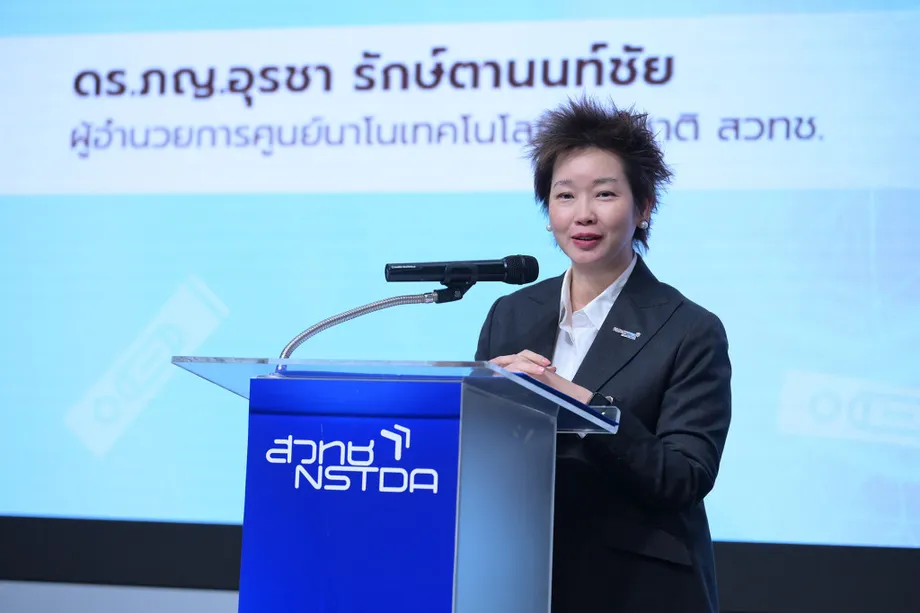
The dispute concerns roughly 4 billion baht a year for ThaiHealth, known in Thailand as สสส., and forms part of proposed changes affecting four institutions with combined levy revenue estimated at about 14 billion baht annually. The other recipients are public broadcaster Thai PBS, the National Sports Development Fund and the Older Persons Fund.
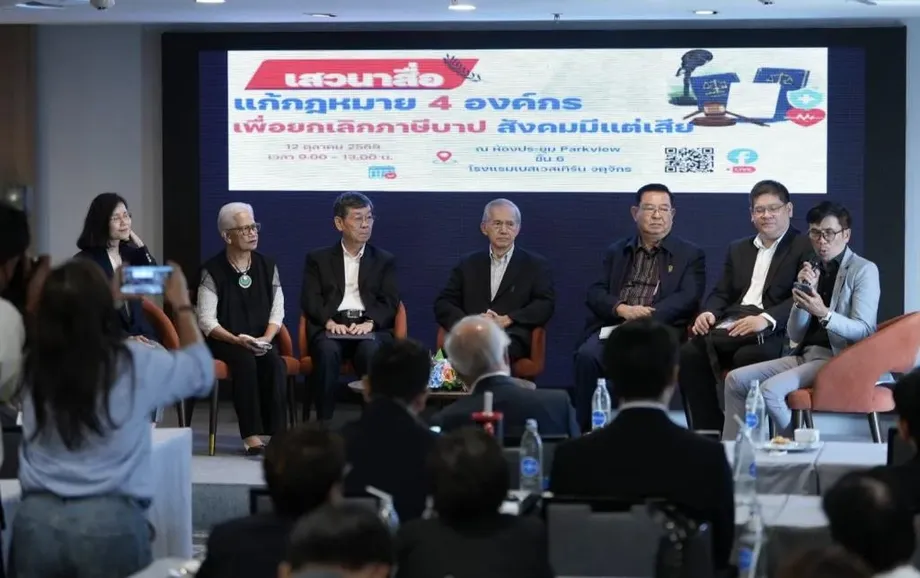
At a discussion on October 12, 2026, at the Best Western hotel in Bangkok's Chatuchak district, economists, legal scholars and health advocates urged policymakers to publish spending evaluations and repair weak projects rather than remove the financing mechanism. The discussion, moderated by Sanga Damapong, also examined consequences for children, people with disabilities and ageing communities.
Government spokesman Ekkapob Pianpises argues that bringing the money into the Treasury would make expenditure more transparent and subject to parliamentary budget scrutiny. ThaiHealth's defenders accept the need for accountability but dispute the claim that annual allocations would necessarily produce better results.
The central distinction is between how much money an institution receives and how securely it can plan to receive it. Even an unchanged allocation in the first year would leave unanswered how later governments would fund continuing projects and protect decisions from political pressure.
What would change under the amendments?
ThaiHealth was established under the Thai Health Promotion Foundation Act 2001. Its funding comes from an additional levy calculated at 2% of alcohol and tobacco excise taxes. This is not simply a share deducted from ordinary excise revenue: liable businesses pay an additional contribution that goes directly to the foundation.
According to the One Plan Plus network, the proposed amendment would repeal Sections 11 through 15 governing that collection mechanism and replace it with annual budget funding. The network identifies Anutin Charnvirakul and other lawmakers as sponsors. Related accounts also name Supachai Jaisamut among those proposing the four amendments.
Reports differ on how the initiative should be described. Some call it a government plan, while Ekkapob says the bills were submitted by Bhumjaithai Party MPs, not by the government. He nevertheless says their purpose matches the government's fiscal policy, including bringing public revenue into a common budget system.
The reported levy rates are 2% for ThaiHealth, sports and older persons, and 1.5% for Thai PBS. Rounded annual figures put each of the first three at about 4 billion baht and Thai PBS at no more than 2 billion baht. A separate estimate for fiscal 2025 places ThaiHealth at 4.1 billion baht. These are approximate figures, not identical audited totals, and legal caps mean the receipts cannot be calculated by simply adding the rates.
The legal dispute turns on an existing exemption
Supporters of the change invoke Section 26 of the State Fiscal and Financial Discipline Act 2018. Their argument is that revenue should enter the Treasury before Parliament determines expenditure priorities.
Euaree Engchanil, an associate professor at Chulalongkorn University's Faculty of Law, challenges the claim that the law requires existing dedicated funding mechanisms to end. She says Section 82 exempts earlier laws concerning additional taxes, fees and reserved revenue from certain provisions, and does not set an expiry date for those arrangements.
One Plan Plus makes the same argument about the relationship between Sections 26 and 82. In its view, replacing ThaiHealth's levy is a policy choice, not a necessary correction of an unlawful arrangement. This is a legal interpretation advanced by opponents, rather than a court ruling on the proposed amendments.
Euaree proposes an alternative: set funding limits according to each institution's responsibilities, return excess revenue to the Treasury, submit strategic plans to Parliament and assess value every three to five years. That would retain predictable financing while creating opportunities to reconsider the amount and purpose of public spending.
Official planning already identifies a budget weakness
The Department of Disease Control's national alcohol action plan for 2022 to 2027 identifies earmarked alcohol and tobacco revenue for ThaiHealth as a strength of Thailand's alcohol control system. It also lists inadequate ordinary budget allocations as a weakness and says the Budget Bureau has not supported requests from other agencies for health promotion activities.
That official assessment gives the funding dispute a concrete policy dimension. An existing government plan recognizes both the need for additional prevention resources and the role of ThaiHealth in supplying them. Replacing the mechanism would therefore require an explanation of how the identified shortfall would be addressed.
The plan cites alcohol consumption as accounting for 12% of disability adjusted life years in Thailand's 2014 burden of disease assessment. This measure combines years lost through premature death with years lived in poor health. It also cites an estimated alcohol related cost of 85.814 billion baht in 2017, equivalent to 0.56% of gross domestic product.
Its seven strategies cover access restrictions, driving after drinking, screening and treatment, advertising controls, tax and price measures, changes in social attitudes, and supporting systems. The breadth matters: ThaiHealth cannot independently deliver actions requiring tax decisions or law enforcement powers.
The plan sets 2027 targets including adult drinking prevalence of 23.1% and prevalence among people aged 15 to 19 of 8.8%, compared with respective 2017 baselines of 28.4% and 13.6%. These are targets, not recorded achievements. Its campaign budget line allocates 2 million baht annually for Buddhist Lent abstinence and National No Alcohol Day activities, totaling 12 million baht across six years, not the full cost of all associated work.
ThaiHealth is one part of a larger prevention system
A health financing analysis, published online on March 17, 2016, and appearing in an August 2017 journal issue, describes ThaiHealth as complementary to the Ministry of Public Health, the Universal Coverage scheme and local government financing.
Using National Health Accounts, the study estimates that prevention and public health represented 10.8% of total health expenditure in 2010. Within that prevention total, the ministry accounted for 32.9%, the Universal Coverage scheme for 23.1%, local governments for 22.8% and ThaiHealth for 7.3%.
The denominator matters. ThaiHealth's 7.3% was a share of prevention and public health expenditure, not all health spending. The figures are also historical and should not be treated as a current budget breakdown.
The study describes flexible grants lasting from one month to three years, with its table reporting a 2010 project grant budget of US$128 million. Its evidence included interviews with 12 stakeholders during research in June and July 2013. Interviewees recognized the foundation's ability to support new ideas and civil society, while also raising concerns about transparency and political pressure.
This earlier analysis complicates both sides of the debate. Dedicated funding does not automatically prevent political influence or weak oversight. At the same time, ministry services and community grants perform different functions, so moving money between mechanisms is not necessarily a straightforward substitution.
Alcohol campaign evidence comes with limits
Polthep Vichitkunakorn, director of the Centre for Alcohol Studies, cited a study published in BMJ Global Health in 2024 that examined 23 years of monthly alcohol sales data. It found the Buddhist Lent abstinence campaign was associated with consumption about 9.97% lower during Lent than in comparable Lent periods before the campaign.
That result applies to the campaign season, not an annual reduction of 9.97%. An association also should not be presented as proof that every change in consumption came from the campaign alone.
A separate Journal of Social Marketing analysis of national survey data from 2011 to 2014 found that people aware of the campaign were about 1.3 to 1.4 times as likely to reduce or stop drinking during Lent as those unaware of it.
Polthep also cited a 2025 survey finding that 8.6 million people reduced, paused or stopped drinking, including 4.5 million who abstained throughout Lent. Estimated household savings were 14.949 billion baht. The full Lent abstainers therefore represented about 52% of the larger group, calculated from 4.5 million divided by 8.6 million.
Those findings measure different things: sales, campaign awareness, reported behavior and household expenditure. They support examining the campaign's contribution, but cannot be added together as separate financial returns.
What the 6.13 baht benefit estimate measures
Surasak Chaiyasong, an associate professor and pharmaceutical researcher at Mahasarakham University, provided details of the evaluation of ThaiHealth's alcohol control work for 2018 to 2022. It combined national statistics and health databases with project information from 34 areas involving 1,662 people, plus a general population survey of 2,532 people in nine provinces.
The evaluation estimated benefits of 9.44402 billion baht against investment of 1.54012 billion baht, or 6.13 baht in economic and social benefit for each baht invested. The difference was approximately 7.904 billion baht.
About 64.9% of estimated benefits came from reduced drinking, 26.7% from fewer crashes involving drinking and driving, 6.9% from reduced illness and violence, and 1.5% from alcohol free ceremonies and spaces. This is a valuation of benefits to society, not cash returned to the Treasury and not a return for ThaiHealth as an entire institution.
The evaluation reported 21,234 fewer crashes involving drinking and driving across five years and cumulative deaths 5,403 below the baseline comparison. Heavy episodic drinking fell from 41.8% to 35.8%, a six percentage point decline. The researchers calculated that the plan's attributable contribution was approximately 30,700 fewer drinkers annually; the wider changes should not all be assigned to ThaiHealth.
The work also recorded 808 additional alcohol free traditional events, 566 schools and 1,644 communities, alongside five national policies or laws. Surasak recommended collecting outcome data from the beginning of future plans to make subsequent evaluations more precise.
Smoking trends and responsibilities are contested
Ekkapob questioned whether ThaiHealth's spending was worthwhile and said smoking had continued to rise over 25 years, alongside increased electronic cigarette use. Suwanna Ruangkanchanasetr, deputy director of the Tobacco Control Research and Knowledge Management Center, presented a different account, citing national statistics showing smoking prevalence falling from 32% to 16.7%.
Those endpoints represent a decline of 15.3 percentage points, or about 47.8% relative to the starting rate. One account described the relative decline as 48.5%, which does not exactly match the rounded figures. The competing claims require comparable survey years, age groups and definitions before they can be reconciled.
Suwanna also cited a 40% decline in electronic cigarette use among people aged 10 to 19 after February 2025, following stronger enforcement. This refers to a particular youth measure and period, not a 40% decline in all smoking nationwide.
Prakit Vathesatogkit, chairman of the Action on Smoking and Health Foundation Thailand, objected to using rising noncommunicable diseases as a reason to change ThaiHealth's funding. He described that connection in strong terms:
extremely dangerous
Prakit said the foundation cannot set tobacco taxes, close illegal online sales or enforce tobacco laws. He also said tobacco taxes had not increased for five years. Suwanna similarly argued that prevention requires taxes, legislation, enforcement and cessation services working together.
Roengruedee Patanavanich, an associate professor at Mahidol University's Ramathibodi medical faculty, cited tobacco company documents disclosed through US court proceedings as evidence of historical opposition to dedicated health taxes. That history does not establish industry involvement in the current bills. Any such connection requires additional evidence.
Community work extends beyond campaign advertising
ThaiHealth deputy manager Pairote Saonuam described support for local databases, community research, telephone smoking cessation services, school meals, disability employment, access to health entitlements and preparations for ageing communities. He also cited the Healthier Choice nutrition symbol, intended to help shoppers identify suitable food products.
Polthep said ThaiHealth supports 18 of 79 personnel working on alcohol and tobacco control within the Ministry of Public Health, approximately 23%. Their work includes legal support, advertising surveillance, research and provincial coordination. This suggests that some grants support government operations rather than only external campaigns.
Ticha Na Nakorn, former director of the Baan Kanchanapisek juvenile training center, argued that work with vulnerable children depends on sustained relationships. She described young people followed over several years until they could work and support themselves, and warned that health messages may miss the social reasons behind smoking, including fear of losing friends or acceptance.
One Plan Plus, a network operating in 18 provinces, connects the funding proposal to provincial development plans for 2028 to 2032. It says civil society needs resources to gather local evidence and bring vulnerable groups' priorities into plans, citing an April 23, 2026, area administration policy committee resolution and the 2022 royal decree on integrated area administration.
Vichai Chokewiwat, president of Thailand's senior citizens council association, said more than 23,000 organizations had participated in ThaiHealth supported work. Former deputy finance minister Pisit Lee-atham warned that ordinary ministry budgets are difficult for community groups and academics to access, particularly for new activities without an established government owner.
Reserve investments put accountability under scrutiny
ThaiHealth's reserve management has become a separate point of contention. Pairote said investments had been suspended and the money returned to bank deposits while legal questions were reviewed. The foundation maintains that the investments were lawful; that position is its explanation, not a reported final legal ruling.
Deputy manager Prakatsit Kayasith said reserves of approximately 1.5 billion to 1.7 billion baht were needed for grants paid in installments over several years. He said most reserve assets had been held in deposits or government instruments, with shares accounting for no more than about 10% to 12%, and that the money had been placed with the Bank for Agriculture and Agricultural Cooperatives during the review.
Prakatsit also said 40% to 50% of annual funding supports government mechanisms and about 30% supports nongovernmental organizations. These institutional figures need detailed disclosure to assess individual grants, recipients and results.
Ekkapob calls for scrutiny of roughly 4,000 projects and major recipients. Pairote counters that ThaiHealth publishes grant information, reports annually to Parliament and has evaluation arrangements separate from management. Passing through the annual budget process and being subject to any oversight are different issues; the debate should distinguish them.
Safeguards, consultation and the transition ahead
Proposals now range from preserving the levy with tighter controls to redirecting at least half of ThaiHealth's budget to local health services, as suggested by the Public Health Club of Thailand. ThaiHealth manager Pongthep Wongwatcharapaiboon proposes a statutory annual funding floor equivalent to at least 2% of alcohol and tobacco excise taxes, roughly 4 billion baht, if the mechanism changes.
Economist Nonnarit Pisloub proposed independent evaluations, wider access for good grant proposals and controls on conflicts of interest. His illustration that a 10% to 30% efficiency shortfall might be repairable was a policy argument, not a measured finding of ThaiHealth waste. Former deputy public health minister Somsak Chunharas similarly urged improvements without abandoning necessary public functions.
The International Network of Health Promotion Foundations supported continuing Thai prevention investment in a statement dated October 13, 2026. Established in 2000, the network has nine full members from six countries and six associate members from five countries, with ThaiHealth serving as its secretariat. It identified predictable resources, continuity, flexibility for innovation and a link between harmful products and prevention funding as key financing features, alongside strong governance.
The reported sequence and next dates are:
- September 30 to October 14, 2026: Parliament's public consultation window for the ThaiHealth amendment.
- October 7, 2026: Vichai publicly opposed the changes affecting all four institutions.
- October 12, 2026: The Bangkok health funding discussion took place.
- October 13, 2026: The international foundations network issued its statement.
- October 1, 2027: A possible commencement date examined in transition scenarios, not an established date of enacted legislation.
Transition scenarios include full replacement funding, partial allocations, higher ordinary excise taxes, temporary use of reserves or reduced responsibilities. Estimates suggest maintaining the four institutions' activities could require 14 billion to 15 billion baht annually in fiscal 2028. No final allocation or enacted outcome is established.
The financial distinction is decisive: abolishing an additional levy does not automatically move its proceeds into the Treasury. Replacement tax collection would be needed to retain that revenue. Without it, continuing activities would need support from general revenue, borrowing, reserves or cuts elsewhere. Any transition must settle both the revenue source and payment arrangements before existing funding ends.
The Bottom Line
- The proposed ThaiHealth amendment would replace its dedicated 2% alcohol and tobacco levy with annual budget allocations.
- Related amendments affect four institutions receiving approximately 14 billion baht a year combined.
- The government's spokesman supports Treasury control and parliamentary scrutiny; opponents warn about continuity and independence.
- The official alcohol action plan recognizes dedicated financing as a strength and insufficient ordinary budgets as a weakness.
- The 6.13 baht benefit estimate concerns a specific 2018 to 2022 alcohol control evaluation, not the foundation's total return.
- Alternatives include independent evaluations, funding limits, public disclosure and a statutory minimum allocation.
- Replacement revenue, final funding levels and an enacted commencement date are not established.