Fatal derailment disrupts Karachi to Peshawar service
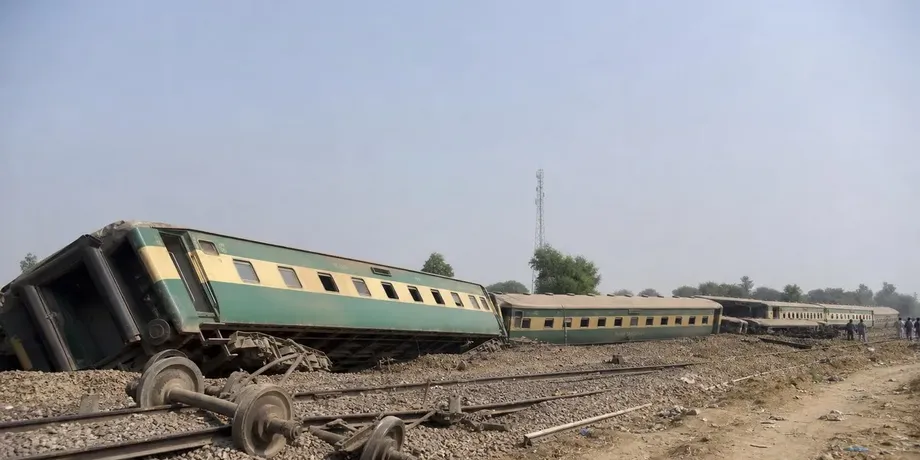
The Rehman Baba Express derailed near Sher Shah in Pakistan's Multan district, leaving passengers dead and about 30 injured as rescuers evacuated carriages and railway authorities suspended traffic on the affected section. Reports put the death toll between two and six, with police and Pakistan Railways spokesman Kaleem Akhtar giving an account of four deaths.
Contents
- Fatal derailment disrupts Karachi to Peshawar service
- Why the casualty figures differ
- Where and when the train left the tracks
- Rescue teams and hospital treatment
- Track closure and stranded passengers
- How the response unfolded
- What the inquiry still needs to establish
- A crash amid unresolved railway investment needs
- What to Know
The train was traveling from Karachi to Peshawar when it left the tracks early Tuesday morning. Several carriages overturned, and two reports say all 14 carriages derailed near Sher Shah bridge. Injured passengers were taken to Nishtar Hospital in Multan, while emergency teams worked to extract people trapped inside the train.
President Asif Ali Zardari and Prime Minister Muhammad Shehbaz Sharif directed an immediate inquiry. Both expressed grief and called for the best possible medical treatment for the injured. Police also said an investigation into the cause was underway, but no finding explaining why the train derailed has been announced.
The accident interrupted a service linking Pakistan's southern port city with its northwest. Alongside rescue operations, railway teams sent a relief train to clear the track, and another account described an additional train dispatched to carry stranded passengers onward to Peshawar.
Why the casualty figures differ
The accounts agree that passengers were killed, but they do not establish a single final death toll. An initial accident report sent to Federal Railways Minister Muhammad Hanif Abbasi recorded two deaths and multiple injuries, according to a Ministry of Railways statement described in reporting.
Police and railway spokesman Kaleem Akhtar were separately cited as confirming four deaths and 30 injuries. Akhtar said rescuers had recovered all four bodies and evacuated injured passengers from the train's 14 cars. Other reports gave higher death tolls.
One account put the number killed at at least five, with 30 injured, while another reported six deaths and 30 injuries. These figures should not be treated as a confirmed sequence of updates: their publication order and the times at which casualties were counted are not established.
The distinction matters for families seeking information. The ministry's initial figure, the railway spokesman's account and the higher reported totals describe the same derailment, but there is no final consolidated casualty statement reconciling them. The repeated figure of 30 injured is more consistent across reports, although a final hospital accounting has not been described.
Where and when the train left the tracks
The location is described as Sher Shah, near Multan in Punjab province, with one account placing the derailment close to Sher Shah bridge. Akhtar identified Sher Shah as the place where the Karachi to Peshawar train went off the rails. Other reporting uses the broader location of Multan district.
The descriptions of the train also vary in precision. The initial account says several carriages derailed and overturned. Two further accounts say all 14 carriages left the tracks. Akhtar's statement that injured passengers were evacuated from 14 cars does not, by itself, establish that every carriage derailed or overturned.
Reports generally place the accident early Tuesday morning. One specifically dates it to October 13, 2026; another carries an October 13 dateline without a year. The accounts without a full date do not independently confirm the year, so the precise calendar date requires clarification alongside the casualty totals.
None of the descriptions establishes the train's speed, the exact point where the derailment began or the condition of the track immediately before the accident. The reference to Sher Shah bridge identifies the vicinity, but does not establish that a bridge defect caused the crash.
Rescue teams and hospital treatment
Rescue 1122, police and railway teams responded to the accident. Emergency responders and paramedics were dispatched to the scene, where rescuers removed injured passengers from the carriages and provided initial medical aid. The ministry account described people trapped inside the damaged train.
Nishtar Hospital in Multan was identified as the destination for injured passengers. The initial account says the injured were shifted there, while the account describing the ministry statement specifies that seriously injured passengers were being transferred to the hospital. No breakdown of injury severity, admissions or discharges has been reported.
Passengers who escaped or were evacuated were described as waiting beside the railway line with their belongings while rescue work continued. That account records the disruption facing survivors, but it does not establish how many people were aboard or how many still needed onward transport.
Zardari and Sharif called for the best possible care for the injured. Sharif also directed that treatment be provided immediately. Those instructions establish the government's stated priority, but there is no detailed public account here of additional hospital resources, treatment outcomes or assistance for bereaved families.
Track closure and stranded passengers
Railway traffic was suspended on the affected section after the derailment. One report specifically says the up track was closed. That identifies a directional track affected by the accident; it should not be read as confirmation that the entire Karachi to Peshawar railway corridor had stopped operating.
A relief train was dispatched from Multan to help clear the line and restore service, according to the account of the ministry statement. Another report says it had reached the accident site. These descriptions cover different stages of the response, but neither provides a confirmed time for reopening the track.
A separate account says an additional train was dispatched to transport stranded passengers to Peshawar. Clearing damaged carriages and moving passengers are distinct tasks: the first restores the railway route, while the second allows survivors to continue their interrupted journey.
No confirmed departure time for that onward service, number of passengers carried or revised timetable has been given. The duration of the closure and the number of other trains delayed also remain unconfirmed. Dispatching recovery equipment does not itself mean the line has been declared ready for traffic.
How the response unfolded
The reported sequence begins with the train leaving the rails early Tuesday and proceeds through rescue, hospital transfers and efforts to restore railway operations. Exact times for those later stages have not been established.
- Early Tuesday morning: The Rehman Baba Express derailed near Sher Shah while traveling from Karachi to Peshawar.
- After the derailment: Rescue 1122, police, railway teams and paramedics responded, extracting injured passengers and providing medical aid.
- During rescue operations: Injured passengers were transferred to Nishtar Hospital in Multan.
- During the recovery effort: Traffic on the affected section was suspended, and a relief train was dispatched from Multan.
- Following the accident: Zardari and Sharif directed an inquiry, while police said an investigation was underway.
The casualty announcements cannot be placed reliably within that sequence. The two, four, five and six death figures therefore remain competing accounts rather than a verified progression from an initial total to a final one.
What the inquiry still needs to establish
The cause of the derailment has not been announced. Neither the presidential and prime ministerial directions nor the reported police investigation identifies a confirmed mechanical failure, track defect or operating error.
The inquiry must distinguish the point where the train first left the rails from the damage caused as carriages derailed or overturned. Track damage visible after an accident can be a consequence of the derailment, so the location and condition of damaged infrastructure alone would not settle the cause.
No inquiry deadline, named investigation panel or publication date for findings has been reported. There is also no confirmed account of the train's passenger total, carriage occupancy or last inspection. These gaps limit both the explanation of the accident and any assessment of how the rescue operation matched the number of people aboard.
A final casualty statement and a confirmed service restoration notice would answer the most immediate public concerns. Establishing responsibility requires the investigation's findings, rather than assumptions based on the scale of damage or the wider condition of Pakistan's railway network.
A crash amid unresolved railway investment needs
Pakistan's railway system has faced decades of underinvestment, aging tracks and outdated signaling. In 2023, ten carriages of another passenger train derailed in southern Pakistan, killing 30 people and injuring more than 90. That accident provides a concrete comparison, but it does not establish a shared cause with the Sher Shah derailment.
The reported 30 injuries in the Rehman Baba Express accident are fewer than the more than 90 recorded in the 2023 crash. The death totals cannot yet be compared precisely because the current accounts range from two to six. Passenger numbers are also unknown, preventing a comparison of the proportion of travelers harmed.
The accident follows ML-1 funding uncertainty described in December 2025. Main Line 1 is the principal Karachi to Peshawar railway corridor, with a branch to Havelian. The proposed project covers about 1,730 kilometers of track and includes modern signaling, track upgrades and changes to level crossings.
That earlier account placed the proposed cost at roughly $6.7 billion to $6.8 billion and Pakistan Railways' annual deficit at about 55 billion rupees. Those figures show the scale of the investment and financial pressures facing the network. They do not prove that a funding decision caused this accident or that a particular upgrade would have prevented it.
What to Know
- The Rehman Baba Express derailed near Sher Shah in Multan district while traveling from Karachi to Peshawar.
- Reported death tolls range from two to six; several accounts report 30 injured.
- Two reports say all 14 carriages derailed, while the initial account describes several carriages overturning.
- Injured passengers were taken to Nishtar Hospital, with seriously injured passengers specifically identified for transfer.
- Traffic on the affected section was suspended, and trains were dispatched for recovery work and onward passenger transport.
- Zardari and Sharif directed an inquiry. The cause, final casualty count and confirmed reopening time have not been announced.