A zinc transport pathway linked to immune escape
A study of molecular data from 258 people with colorectal cancer has identified a chain of events that connects zinc uptake inside cancer cells to a signal that stops macrophages from engulfing them. Blocking that signal with an antibody restored macrophage activity in laboratory experiments, pointing to a possible treatment target rather than an established therapy.
Contents
- A zinc transport pathway linked to immune escape
- What the 258 patient analysis found
- How zinc uptake becomes a stop signal
- Evidence from individual cells and tumor neighborhoods
- What the laboratory experiments established
- Why the pathway does not explain every tumor
- What the seven gene predictor can tell us
- What remains untested before treatment use
- Publication, support and next steps
- Key Points
The research, published in Science Advances on October 7, 2026, was led by Professor Seong-eun Kim of Korea University and Professor Kwon-il Kim of Kyung Hee University, with researchers from Harvard Medical School also participating. It links zinc transport proteins called SLC39 to CDX2, a regulator of gene activity, and then to CD24, a protein displayed on the cancer cell surface.
The team's Science Advances study goes beyond identifying a molecular association. It combines patient tissue analyses, data from individual cells, spatial mapping and experiments that changed the activity of specific genes. Together, those approaches suggest how a nutrient transport program can help create a tumor environment with fewer active immune defenses.
The researchers also developed a signature combining seven genes to predict responses to immunotherapy. A reported performance measure of 0.728 suggests useful discrimination, but does not mean the test correctly predicts treatment outcomes for 72.8% of patients. Neither the proposed treatment strategy nor the predictive signature is ready to be treated as a validated clinical tool.
What the 258 patient analysis found
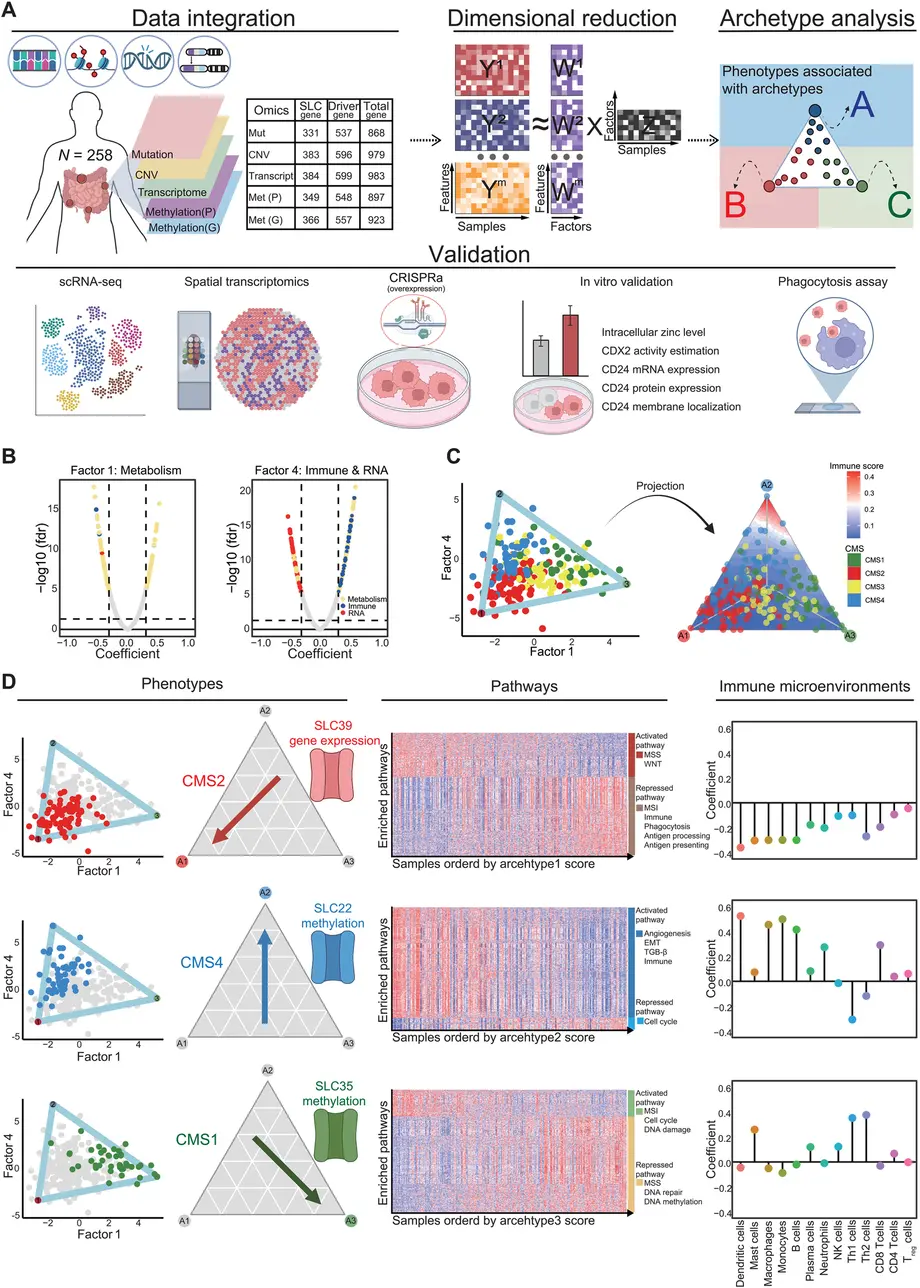
The initial analysis examined 258 colon adenocarcinoma samples from The Cancer Genome Atlas. Researchers integrated information on more than 300 solute carrier transporter genes and 500 cancer driver genes. The data covered gene activity, mutations, changes in the number of gene copies and DNA methylation, a chemical modification that can influence gene activity.
This combined approach identified three molecular groups organized around transporter programs. One group showed particularly strong expression of the SLC39 family, including SLC39A2, SLC39A4, SLC39A5 and SLC39A10. Its molecular profile indicated increased zinc transport and reduced representation of important immune cells.
The group largely matched consensus molecular subtype 2, or CMS2, a recognized colorectal cancer category associated with WNT signaling and an immune desert pattern. An immune desert is a tumor environment with relatively few infiltrating immune cells, rather than a complete absence of immune activity.
A useful distinction emerged: the association with immune suppression remained statistically significant after accounting for microsatellite stability. Microsatellites are short repeated DNA sequences, and their stability is one way cancers are classified. The result suggests that the zinc transport pattern was not simply another reflection of that existing classification.
How zinc uptake becomes a stop signal
SLC39 proteins move zinc into the cell's cytoplasm. Zinc is an essential micronutrient involved in many normal cellular processes, but the study examined what happens when cancer cells increase the transport machinery controlling its entry. The mechanism concerns zinc handling within tumors, not a demonstrated effect of eating zinc rich foods.
The proposed sequence begins with increased SLC39 activity and greater intracellular zinc. That is associated with greater activity of CDX2, a transcription factor that helps regulate which genes a cell uses. CDX2 then acts through a regulatory DNA region called an enhancer to increase CD24 production.
An enhancer can influence a gene even when it lies some distance away along the DNA sequence. Here, analyses of DNA organization and accessibility supported a connection between CDX2 and an enhancer controlling CD24. Data from 25 patients linked greater accessibility of that enhancer to zinc transport signals, CDX2 activity and CD24 expression.
The final step involves CD24 interacting with SIGLEC10 on immune cells. This interaction can suppress phagocytosis, the process by which macrophages engulf cells or other material. Calling CD24 a decoy captures the effect, but the underlying process is an inhibitory molecular signal, not a macrophage literally mistaking every cancer cell for a healthy one.
Evidence from individual cells and tumor neighborhoods
Whole tissue measurements mix cancer cells with immune cells and other tissue components. To establish where the proposed pathway was operating, the researchers examined gene activity in 174,547 individual cells from 26 patients with colorectal cancer.
The relationship between SLC39 zinc transport, CDX2 activity and CD24 expression was strongest in malignant epithelial cells, the cancer cells arising from the intestinal lining. Other cell populations showed minimal or weaker relationships. An additional analysis grouping similar cells helped address the sparse measurements that can occur when examining individual cells.
Spatial profiling added another dimension. Cancer cells displaying CD24 occupied neighborhoods alongside SIGLEC10 expressing immune cells, including macrophages derived from monocytes, resident macrophages and dendritic cells. The study associated these neighborhoods with programs that suppress engulfment and alter cell adhesion.
This makes the proposed mechanism broader than a change inside an isolated cancer cell. It connects a tumor's nutrient transport machinery to signals exchanged with nearby immune cells. Still, physical proximity and correlated gene activity do not prove every step by themselves, which is why the experiments that altered the pathway are central to the findings.
What the laboratory experiments established
Researchers increased the expression of SLC39A4 or SLC39A5 in a colorectal cancer cell line called LS174T. Both interventions increased intracellular zinc, measured with a fluorescent probe. They also increased CD24 at the gene and protein levels, including the amount located on the cell membrane.
CDX2 became more active and more concentrated in the nucleus, where it regulates genes, even though its total protein level did not change. That distinction matters: the mechanism involved changes in a regulator's activity and location, not simply making more of it.
The team also tested the pathway in NCIH508 cells, a model with a CMS2 like profile and relatively high expression of SLC39A5, CDX2 and CD24. Reducing SLC39A5 expression or deleting CDX2 lowered CD24 expression, supporting the proposed order of the pathway.
In experiments testing immune function, increased SLC39 expression reduced macrophage engulfment of cancer cells. Blocking CD24 restored that process. The research team, describing the functional result in the paper's abstract, wrote:
SLC39 overexpression increased intracellular zinc and CD24 levels and reduced macrophage-mediated engulfment, whereas CD24 blockade restored phagocytosis.
That result provides experimental evidence that CD24 contributes to the observed immune escape. It does not establish that an antibody targeting CD24 will shrink tumors or improve survival in people.
Why the pathway does not explain every tumor
The experiments also exposed an important limit. Increasing SLC39A5 in another colorectal cancer cell line, HCT116, produced a much weaker increase in CD24 than in LS174T cells, despite comparable increases in transporter expression.
The researchers suggested that lower baseline CDX2 expression in HCT116 could help explain the difference. Their conclusion was that the pathway depends on cellular context, rather than functioning equally across all colorectal cancers.
The study also distinguished CD24 from CD47, another protein associated with inhibitory signals to macrophages. Increasing SLC39A4 or SLC39A5 induced CD24 but did not induce CD47 transcription in the tested colorectal cancer cells. The zinc linked mechanism therefore appears to involve a specific immune escape program, rather than raising every inhibitory surface signal together.
Computational analyses of cell states associated the pathway with a CMS2 like cancer cell state, poorer survival and resistance to immune checkpoint blockade. Such analyses estimate relationships and possible transitions from molecular data. They should not be read as direct observations of an individual patient's tumor progressing through those states over time.
What the seven gene predictor can tell us
The research has a second potential application: helping identify patients whose cancers may resist immunotherapy. The paper describes a seven gene signature tested across five colorectal cancer cohorts. Clinical data from 166 patients were also reported as part of the assessment of treatment response.
The five cohorts and the 166 patients describe different aspects of the evaluation. They should not be added together or assumed to represent five separate groups of 166 people. The reported information does not establish that interpretation.
The signature's reported area under the receiver operating characteristic curve, or AUC, was 0.728. AUC measures how well a scoring system separates two outcome groups across possible decision thresholds. A value of 0.5 indicates no useful discrimination, while 1.0 represents perfect separation.
Against those reference points, 0.728 indicates predictive ability, but not certainty. It is not a percentage accuracy score and does not tell a patient their personal probability of responding. Clinical usefulness also depends on the threshold chosen, the number of incorrect predictions and whether performance holds up in the population where the test would be used.
The association with resistance offers a biological explanation for why the signature might work: it tracks a pathway tied to immune suppression. Establishing that a test improves treatment decisions, however, requires more than showing that its score is associated with past treatment outcomes.
What remains untested before treatment use
The antibody experiments support CD24 as a candidate target, but the work remains based on cell experiments and patient data analyses. Animal studies and clinical trials are needed to establish whether targeting the pathway is safe and effective in a living organism and, eventually, in patients.
Two specific questions are identified for further research: the toxicity of treatment directed at CD24, and whether it works better when combined with existing immune checkpoint inhibitors. Those drugs release inhibitory controls on immune responses, but combining treatments does not automatically produce a better result.
Professor Seong-eun Kim described blocking the pathway as a possible way to restore immune cells' activity against cancer and improve immunotherapy effectiveness. That is the proposed therapeutic direction, not a result demonstrated in patients. The planned work includes evaluation in animal models and consideration of antibody development targeting CD24.
The findings also provide no basis for patients to restrict dietary zinc or stop prescribed supplements. Changing a tumor's transport proteins is not equivalent to changing nutrient intake, and zinc has necessary roles in normal physiology. The study did not test dietary changes as a cancer treatment.
Publication, support and next steps
The paper appeared in Science Advances, volume 12, issue 41, with DOI 10.1126/sciadv.aeh2362. The research received support from the National Research Foundation of Korea and the Hyundai Motor Chung Mong-Koo Foundation.
The publication and announcement followed this sequence:
- October 7, 2026: The study was published in Science Advances.
- October 8, 2026: Korea University announced the findings and their possible treatment applications.
No start date for a clinical trial, patient recruitment deadline or schedule for animal study results has been announced in connection with these findings. The next scientific task is to determine whether interrupting the pathway can produce a useful treatment effect without unacceptable toxicity.
The study's strongest contribution is the connection it draws across several levels of evidence: transporter activity, gene regulation, signals between neighboring cells and macrophage function. Its limits are equally specific. The pathway varies between cancer models, the predictive signature is imperfect, and restored engulfment in a laboratory is not yet evidence of benefit for patients.
Key Points
- Analysis of 258 colorectal cancer samples identified a zinc transport pattern associated with reduced immune activity.
- The proposed pathway connects SLC39 zinc uptake to CDX2 activity, increased CD24 and inhibitory signaling through SIGLEC10.
- Blocking CD24 restored macrophage engulfment of cancer cells in laboratory experiments.
- Single cell analysis covered 174,547 cells from 26 patients and located the strongest pathway relationships in cancer cells.
- A seven gene predictor was evaluated across five cohorts, with a reported AUC of 0.728.
- The mechanism did not operate equally in every cancer cell model.
- Animal studies and clinical trials are still needed to assess treatment safety and effectiveness.