A palace site becomes Zutomayo's biggest stage
Zutomayo brought 22 songs, traditional court music and a festival of local food and crafts to Nara's Heijo Palace Site Historical Park for its largest production to date. The October 10 and 11 event, titled Bunkadenrai, drew a reported 70,000 visitors, although other accounts put attendance at 60,000 or 65,000. One report explicitly counted more than 70,000 across the concerts and the free festival area together.
Contents
- A palace site becomes Zutomayo's biggest stage
- What the attendance figures actually show
- Why ACAね chose this particular ground
- A two hour performance with few pauses
- A new song arrives just before the shows
- Free entry did not mean unlimited participation
- Local food connected the festival to Nara
- Yamaha makes traditional instruments audible in a new way
- Protecting the site while expanding the audience
- From an anonymous music project to a Dome ambition
- Key Points
The distinction matters: this was more than a concert audience gathering for an evening performance. The event combined ticketed shows with daytime workshops, food stalls, instrument displays and a free side stage. Organizers described it as the first attempt to hold a large music concert in the park's central Chodo in area, with cooperation from Nara Prefecture and other local bodies.
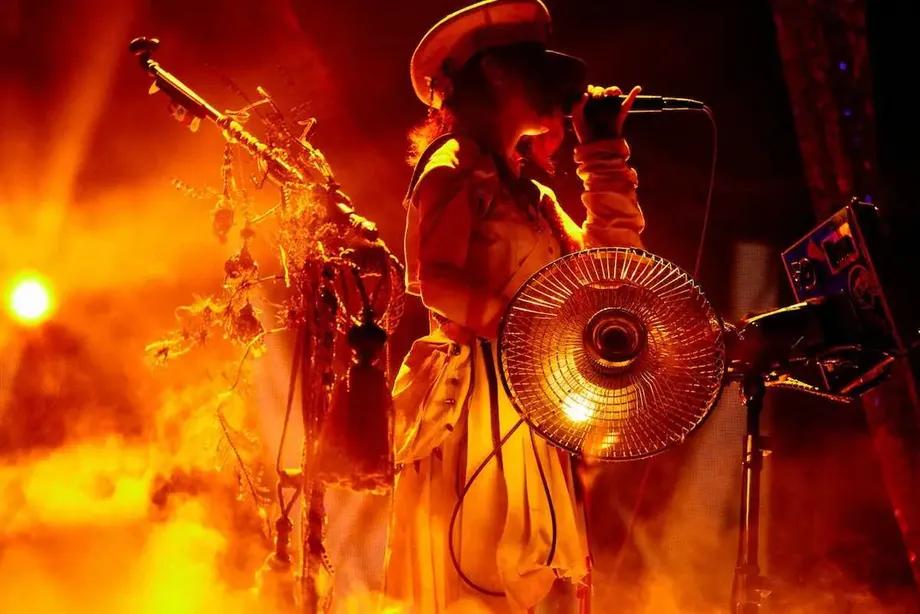
Official event pages and Yamaha's announcement date the program to October 10 and 11, 2026. The setting was a former imperial palace site with roughly 1,300 years of history, where surviving archaeological remains lie beneath the ground. Against the imposing reconstructed Daigokumon gate, vocalist and songwriter ACAね appeared wearing a fox mask as gagaku, Japan's traditional court music, accompanied her entrance.
Lighting, a shrine gate constructed onstage and arrangements using traditional Japanese instruments brought the group's nocturnal visual world into the historic landscape. Yet the most distinctive part of the production was how much happened beyond the stage: Zutomayo approached local businesses and craftspeople directly, consulted archaeological researchers and paid for the independently organized event without a sponsor.
What the attendance figures actually show
Reports differ on the size of the crowd. The figures range from 60,000 to more than 70,000 over two days, while a separate account says all 65,000 concert tickets sold out. Those figures should not be treated as interchangeable measures of attendance.
The clearest distinction comes from an account that places the combined audience for the concerts and free area above 70,000. A different account describes 65,000 as the total attendance, rather than simply the number of tickets sold. The 60,000 figure appears in another report of the two performances.
Before the event, organizers expected more than 30,000 visitors a day. Yamaha similarly forecast more than 60,000 across the weekend. Those were projections, not final counts. No final official attendance breakdown establishing concert admissions, festival visitors or unique individuals is given in the announcements.
The discrepancy does not change the reported scale of Zutomayo's largest production, but it limits the precision of the headline number. A visitor to the free area did not need a concert ticket, and a total across two days does not necessarily represent that many different people.
Why ACAね chose this particular ground
In an official organizing statement, ACAね and the Zutomayo staff explained that their approach was to learn about a place before creating a performance for it, rather than bring a completed show into an interchangeable venue. Heijo Palace Site had been selected as a destination during the planning of the preceding tour.
ACAね's interest centered on the traces of ordinary lives and feelings preserved in ancient writing. The statement names mokkan, wooden tablets used for written records, and the Manyoshu poetry collection as connections between people of the Nara period and people today. It also points to cultural exchange through Japanese missions to Tang China and the Silk Road.
That interest gave the event a more specific purpose than using an ancient gate as a striking backdrop. Workshops invited visitors to write on wooden tablets, while food and instrument displays drew on historical records and inherited craft techniques. The idea was to make the site's history something an audience could encounter through an activity, an object or a sound.
ACAね also acknowledged that her own school experience of history had often involved hurriedly memorizing political changes, conflicts and names. She hoped the concert could provide a reason to return to that history with genuine curiosity. Whether it produced lasting interest has not been measured, but the program offered several practical ways to begin.
A two hour performance with few pauses
The October 11 performance opened with Chikyu Sonzai Shinai Setsu and ran for two hours across 22 songs. The set included Aitsura Zenin Dosokai and Tadashiku Narenai, with another account also identifying Byoshin wo Kamu and TAIDADA among the songs performed. ACAね continued through the first 20 songs without a spoken interlude.
The stage combined references to ancient Nara with the band's familiar intensity. An account of the October 10 opening describes the gagaku piece Ryo o sounding as a Tesla coil discharged electricity. Masked musicians appeared with ACAね, and the performance also incorporated bon dancing and Nara Prefecture's mascot, Sento kun.
Reports describe a daytime high of 29 degrees Celsius, followed by a darker outdoor setting in which stage lighting and audience penlights shaped the atmosphere. Fireworks closed the event. These elements made the transition from daytime festival to evening concert part of the production itself.
ACAね, Zutomayo's vocalist and creative center, thanked the audience for making that shared experience possible:
Thank you so much for coming here and meeting me in this place.
She also spoke about the value of being in the same place at the same time, describing the soil, wind, temperature and insect sounds around the audience. Her remarks acknowledged practical inconveniences, including poor mobile connectivity, rather than presenting the festival as a frictionless spectacle.
A new song arrives just before the shows
The encore on October 11 ended with Akane Sasukoro, a song released without advance notice on October 8. It was also performed during the October 10 show. That placed new music alongside established favorites at a concert built around the transmission of older words, sounds and traditions.
The sequence of announcements and performances shows how the program developed:
- February, in the event year: organizers carried out an advance sound level test at the site.
- September 29, 2026: Yamaha announced its exhibition and forecast more than 60,000 visitors over two days.
- October 2 to 4: applications opened for the advance lottery for workshop and game participation tickets.
- October 7: organizers warned that workshop demand was expected to greatly exceed capacity.
- October 8: Akane Sasukoro was released by surprise.
- October 9: a separate wooden tablet workshop was listed at Tenpyo Mitsukikan.
- October 10 and 11: the festival and special concerts took place, with evening shows scheduled to begin at 17:30.
The event carried the full name LEGACY ZOMBIE LABO Bunkadenrai, Nara Heijo kyo. Reports describe it as a continuation of the group's arena touring projects. The palace site was therefore a planned destination in a longer creative sequence, rather than an isolated choice of venue.
Free entry did not mean unlimited participation
The official festival program listed Matsuri Area activities for 10:00 to 17:30 on both days, with free admission beginning at 9:30. People without concert tickets could participate, extending access beyond the evening audience.
Most workshops and games, however, required separate paid participation tickets. Organizers warned on October 7 that applications suggested demand would greatly exceed capacity for every activity, and that tickets sold on the day could disappear during the morning. Entry restrictions were also possible if the free area became too crowded.
The Nara National Research Institute for Cultural Properties offered a wooden tablet workshop for 1,500 yen, lasting about 10 minutes. Participants could learn about ancient tablets and use manyogana, an early method of writing Japanese sounds with Chinese characters, as a reference for their own lettering. Finished tablets could be taken home or displayed on a rice bale tower as part of the concert stage.
Soil scientist Kazumichi Fujii led activities involving soil crayons or polished mud balls, priced at 1,000 yen for adults and 500 yen for children of elementary school age or younger. Other options included an 800 yen miniature notebook activity with letterpress workshop Tan and a 2,500 yen ink making session with Kinkoen, a Nara business with 150 years of experience in the craft.
The free side stage, Hiru no Utage, offered daytime programming on both dates. Together, the activities created several routes into the event, though admission to the grounds did not guarantee a place in a workshop or access to every food item.
Local food connected the festival to Nara
More than 30 food stalls and workshops were reported across the event. The published menus show that local participation went beyond attaching the concert's name to standard festival food. Several products connected Nara ingredients, historical records or established businesses with Zutomayo's songs and imagery.
Nakamoto Sake Brewery offered an 800 yen cup of Nagaya o sake, described as a modern recreation informed by wooden tablets excavated from Prince Nagaya's residence site. The collaboration used an event label, but its historical connection came from the written evidence behind the brewing concept.
Other examples were more immediately familiar: tea rice balls from Omusubi Banshun cost 350 to 500 yen, while Tenobe Takadaya listed two Miwa somen noodle dishes at 900 yen each. A collaboration involving shaved ice shop Hosekibako and persimmon leaf sushi specialist Hiraso included a special syrup and sushi with black rice tied to the band's visual world.
The program also featured Yamato tea, local strawberries and milk, fermented foods, craft beer and Tenri ramen. Collaboration goods included Nara brushes, mosquito net fabric and footwear, giving local makers a presence beyond meals. Prices were published in advance but could change on the day.
Organizers cautioned that some businesses did not normally serve festivals and could supply only limited quantities. They directed visitors toward the concurrent Heijo kyo Autumn Sangaku Festa at Suzaku Gate Square, where additional food stalls were available. That cooperation helped make the wider park part of the experience.
Yamaha makes traditional instruments audible in a new way
Yamaha's September 29 announcement detailed a free exhibition combining traditional instruments with its Real Sound Viewing technology. The display centered on the gakubiwa, a lute used in gagaku whose musical tradition reaches back to its arrival in Japan during the Nara period.
Real Sound Viewing preserves and reproduces a musician's performance through instrument vibration, recorded signals and digital audio processing. For this exhibition, Yamaha planned to recreate a performance through an actual gakubiwa while synchronizing recordings of ryuteki, a transverse flute, and sho, a mouth organ.
The arrangements used Zutomayo's Byoshin wo Kamu and Kikai Abura. Yamaha named Yumiko Kiyota as the contributor for gakubiwa, ryuteki and the Real Sound Viewing arrangements, and Marika Nawa for sho. Naming the performers makes clear that the automated presentation was based on recorded musicianship, not music generated without players.
The exhibition also paired a specially decorated gakubiwa with a Pacifica electric guitar. Zutomayo's design team and Yamaha's Design Laboratory gave the instruments shared visual details, including matching designs on the lute's plectrum surface and the guitar's pickguard. The custom Pacifica Standard Plus was not for sale, and visitors were not permitted to play the special display instruments.
This was a concrete extension of the concert's central idea: music could connect inherited forms with contemporary songs without treating traditional instruments merely as scenery.
Protecting the site while expanding the audience
Organizers said unexpectedly strong demand led them to adjust the stage and venue layout to increase capacity. That expansion took place within a historic site, requiring discussions about noise, crowds, surviving remains and facilities rather than just ticket sales.
ACAね and the staff said they consulted relevant local authorities, carried out the February sound test and confirmed protective measures before receiving permission to use the area. They also learned directly from the Nara National Research Institute for Cultural Properties. Setup crews, removal crews and stall staff were to share the site's usage rules.
Visitors were instructed not to litter, smoke, use flames or damage flowers and plants. The statement acknowledged that sound and congestion could affect nearby residents, and named the park, Nara Prefecture, Nara City, Nara Prefectural Police and transport operators among those whose cooperation made the event possible.
The account of sponsor funding is also precise. Zutomayo said it organized and financed the event itself while receiving extensive cooperation. That does not mean the group worked alone, nor does Yamaha's participation establish that Yamaha financed the concert. No total production cost or final assessment of effects on the site is given.
The precedent was Zutomayo's independently produced performance at the Osaka Kansai Expo in September 2025, which reportedly attracted about 16,000 people. The Nara event expanded that approach into two concert dates and a broad daytime festival. Those audience figures are not directly comparable because the Nara total may include free area visitors.
From an anonymous music project to a Dome ambition
Zutto Mayonaka de Iinoni, usually shortened to Zutomayo, centers on ACAね and a changing group of supporting musicians. She keeps her face and personal background private, while animated videos featuring the character Nirachan give the songs a recognizable visual identity.
The project began in June 2018 with the YouTube video for Byoshin wo Kamu and made its major debut that November. The debut video has reportedly reached 150 million views. Yamaha's September announcement listed 3.41 million YouTube subscribers and more than 4.8 billion total song plays, figures that describe the scale of the group's online audience rather than concert attendance.
Zutomayo held its first overseas tour in 2024. Its stated next ambition is a Tokyo Dome concert, described as a goal for the following year rather than a confirmed booking. No date or ticket announcement is given.
ACAね's closing commitment focused on the full experience surrounding the music, not simply the performance. The vocalist said:
I want to give my all to everything you come into contact with.
At Nara, that ambition took a specific form: a concert linked to archaeological learning, local craft, food and traditional sound. The attendance total still needs a consistent definition, but the program shows how the group used its largest production to bring those encounters into one place.
Key Points
- Bunkadenrai combined October 10 and 11 concerts with a free festival at Heijo Palace Site Historical Park.
- Official schedules date the event to 2026 and locate the concert in the central Chodo in area.
- Reports give attendance figures of 60,000, 65,000 and more than 70,000; one explicitly includes the free area in its total.
- The October 11 show featured 22 songs over two hours and ended with the newly released Akane Sasukoro.
- Zutomayo said it organized and financed the event without a sponsor, with extensive local cooperation.
- Workshops, local food and Yamaha's traditional instrument exhibition connected the music with Nara's history and crafts.
- A Tokyo Dome concert is a stated ambition, not a confirmed event.