244 public interest judgments await action
Nepal's Supreme Court judgment enforcement authorities report that 244 public interest decisions remain unimplemented, covering rights and responsibilities that extend from overseas voting to environmental protection. Separate financial records attributed to the same directorate list more than Rs 31.75 billion in unpaid fines, while victims have received less than 5% of the compensation recorded as due to them.
Contents
- 244 public interest judgments await action
- What the enforcement directorate can do
- Lumbini faces a disputed pollution order
- An older heritage case shows the same pattern
- Overseas voting and Gurkha rights need practical steps
- A dialysis supplier is still waiting for payment
- What the unpaid penalties actually show
- The 91 case report identifies responsible offices
- A timeline of decisions and delayed action
- Proposals exist, but delivery dates are missing
- Key Points
Among the disputed decisions is an order to close or relocate polluting industries within 15 kilometres of Lumbini, the birthplace of Buddha. Other cases concern fair treatment for Gurkha soldiers, voting access for Nepalis abroad and payment for dialysis equipment already used by the government.
The delays are not simply a matter of courts waiting for ministries to answer letters. A government progress report describes orders moving between offices without producing the action they require. Some concern public land and groundwater protection and date back more than 15 years.
There are also limits to what the headline figures establish. The directorate's reported total of 244 pending public interest judgments differs from a government progress report identifying 91. The accounts do not explain whether those totals cover different periods, institutions or categories. They should not be treated as interchangeable measures.
The central distinction is between winning a case and receiving its remedy. An environmental order requires action against pollution. A voting judgment requires arrangements that allow ballots to be cast. A compensation ruling requires payment. Repeated correspondence can document an enforcement effort without delivering any of those results.
What the enforcement directorate can do
The Supreme Court's Judgment Execution Directorate is not an informal reminder service. Its official institutional description assigns it responsibility for implementing orders issued on public interest writ petitions, alongside coordination and supervision of other judgment enforcement work.
The directorate was established following a Supreme Court full meeting decision dated 2066/1/29 and a chief justice's decision dated 2066/2/27 in the Bikram Sambat calendar. Chapter 15 of the Supreme Court Rules, 2074, provides its legal basis. Rule 130 covers directions to subordinate courts and other bodies, coordination meetings, staff training and proposals for legal or policy changes.
Its powers also include reporting unresolved failures to a judicial bench when the responsible agency does not accept accountability. That matters because a ministry's failure need not remain indefinitely within an exchange of letters: the directorate has a formal route to return the problem to judges for an appropriate response.
The institutional description distinguishes civil, criminal and writ enforcement. It says Section 152 of the Criminal Procedure Code, 2074, and Section 230 of the Civil Procedure Code, 2074, generally place implementation of regular court decisions with the relevant district court. Public interest writ orders often require a different kind of action, involving policy, budgets or several government agencies.
The directorate itself identifies insufficient state activity as a weakness in criminal enforcement. Its account also traces concern over implementation through judicial reform studies and the judiciary's second strategic plan for 2066/67 to 2070/71. The problem therefore predates the latest disputed judgments and the present enforcement backlog.
Lumbini faces a disputed pollution order
Justices Kumar Regmi and Sunil Kumar Pokharel issued the Lumbini mandamus on Bhadra 11, 2082, following petitions from senior advocate Prakashmani Sharma, advocate Sanjay Adhikari and others. A mandamus is a court order requiring a public authority to carry out a legal duty.
The decision is reported to require polluting industries within 15 kilometres of the heritage area to close or relocate, with a two year implementation period. The southern reach is described as extending to the Indian border. The government reportedly cites that geographic issue while considering review of the judgment rather than proceeding with implementation.
Sharma argues that the government had already decided to remove the industrial area before the court intervened. He challenges the attempt to seek review as a response to an obligation the government had previously accepted.
Sharma, a senior advocate and petitioner in the case, said:
Even before the Supreme Court made the decision, the government had decided to remove the industrial area from Lumbini, the birthplace of Buddha.
He also says the World Heritage Committee is concerned about noncompliance and warns that Lumbini could lose its World Heritage status. That is his warning, not an announced removal decision. No committee decision establishing such an outcome or a scheduled removal process is identified.
The distinction between delay and an expired deadline also matters. The order reportedly allows two years, but the accounts do not establish whether that period has elapsed. They describe a dispute over implementation and possible review, without identifying a review ruling, a suspension of the order or a detailed relocation schedule.
An older heritage case shows the same pattern
The Lumbini dispute has a close precedent in the Supreme Court's published landmark decisions collection. Writ No. 3027 of 2059, Prakash Mani Sharma and others v. Cabinet Secretariat and others, concerned brick kilns in Kathmandu Valley and government decisions that had not been put into effect.
The judgment records closure decisions and instructions issued by several government bodies on dates spanning 2057 to 2059. It also records the petitioners' concern that brick kilns were less than two kilometres from the World Heritage areas of Bhaktapur and Changu Narayan, exposing both people and monuments to pollution.
Advocate Raju Prasad Chapagain cited an estimate of 89.90% for brick kiln contributions to total suspended particulate emissions in the valley. Total suspended particulates are airborne particles, including dust and soot. That historical estimate was presented in the case; it is not a current measurement of valley air pollution.
The court's central finding was administrative. Three years after government decisions, counsel could not explain which measures had been implemented, which had not, or when action would follow. The court found that environmental policies had remained on paper and drew the environment minister's attention to the failure.
The comparison with Lumbini is specific: in both cases, a petitioner sought judicial intervention over pollution near heritage sites after government action had already been promised. The older judgment shows that another decision alone cannot resolve a failure to carry out existing commitments.
Overseas voting and Gurkha rights need practical steps
On Chaitra 7, 2074, the Supreme Court issued directives in separate petitions involving advocates Yagyamani Neupane and Prem Chandra Rai to secure voting rights for Nepalis abroad. The order was not confined to migrant workers. It called for arrangements covering citizens overseas for different purposes.
The court also recognised that host countries have different laws and policies on foreign nationals voting from their territory. It instructed the government to pursue diplomatic engagement with those countries and, where necessary, companies employing Nepali workers.
Neupane, now also a Rastriya Swatantra Party lawmaker, says repeated requests have failed to produce implementation. He plans to seek answers through parliamentary committees, including the State Affairs Committee. No hearing date or operational timetable for overseas voting is identified.
A separate judgment concerns the Nepal, India and Britain tripartite agreement of November 9, 1947, governing Gurkha recruitment. Padam Sundar Limbu and other petitioners challenged provisions they considered discriminatory, including the use of Indian pay scales, under Nepal's Constitution, the Civil Rights Act and international human rights principles.
The petitioners also raised deployments against China and Pakistan, and in Sri Lanka in 1987, as concerns relating to Nepal's foreign policy and national dignity. Those were arguments advanced in the litigation, not findings that every disputed provision had been invalidated.
The decision, dated Magh 24, 2079, directed steps toward fair, contemporary and equality based service benefits while avoiding harm to Nepal's historic relationship with the United Kingdom. It called for expert research, consultation with affected groups and diplomatic initiatives informed by European Court of Human Rights decisions. The reported failure is inadequate follow through on those steps, rather than nonpayment of a single court specified sum.
A dialysis supplier is still waiting for payment
The health sector dispute illustrates a more direct financial obligation. Ayush Bista of Nepalgunj says Birang Trading Company invested Rs 470 million in dialysis equipment and facilities at locations including Jawalakhel, Seti Provincial Hospital, Nepalgunj Medical College, Pokhara Academy of Health Sciences and Mechi Provincial Hospital.
Hemodialysis filters waste and excess fluid from the blood when kidneys cannot perform that function adequately. The company went to court after the government used its equipment and infrastructure without providing the compensation and service payments it sought.
On Asar 18, 2082, the Patan High Court ordered the Ministry of Health and Population to provide compensation and payment for that use. This is a High Court case, separate from the Supreme Court public interest rulings, but it demonstrates the same gap between an order and its execution.
A ministry valuation committee assessed the equipment and facilities at about Rs 352.4 million. Documents are reported to record an agreement to provide Rs 210 million following Cabinet consideration and coordination with the Finance Ministry. Bista says even that amount has not been received.
The Rs 210 million figure is about 45% of the claimed Rs 470 million investment and about 60% of the committee's Rs 352.4 million valuation. Those comparisons explain the scale of the compromise he describes. They do not establish that the original investment, valuation and amount payable are legally identical.
Bista says he visits the enforcement directorate three or four times a month and follows its letters to the ministry. The ministry reportedly cites original files lost in fires during protests as a reason for delay. The chronology is unclear: the account dates the protests to Bhadra 23 and 24, 2080, without resolving that date. The directorate has instructed the ministry to reconstruct files if necessary and implement the order promptly.
What the unpaid penalties actually show
The consolidated enforcement figures are described as covering fiscal year 2082/83 through the end of Jestha. They list total recorded imprisonment of 165,881 years, two months and 10 days, with 41,197 years, 10 months and 29 days cleared and 122,904 years, 10 months and five days outstanding.
Those figures require caution. The reported total does not reconcile arithmetically with the reported cleared and outstanding amounts. The opening descriptions also refer more broadly to about 121,000 unserved years. These are cumulative sentence records across cases, not a count of prisoners or a measure of how many people are currently at large.
The fine figures are more consistent: Rs 43,211,728,610 recorded, against Rs 11,455,335,604 collected. That leaves Rs 31,756,393,006 outstanding, approximately 73.5% of the recorded amount.
Victim compensation shows a sharper failure. Of Rs 1.5838 billion recorded as due, only Rs 78.3 million, or 4.95%, had been cleared. About Rs 1.5055 billion therefore remained unpaid. Recovery of government amounts awarded in cases was lower still: Rs 37.9 million collected from Rs 2.3732 billion recorded, a recovery rate of 1.60%.
The broad description of Rs 34 billion in uncollected revenue should not be substituted for the fine balance. Fines, victim compensation and government recovery are different categories. In particular, compensation belongs to victims and should not be presented as ordinary state revenue.
The 91 case report identifies responsible offices
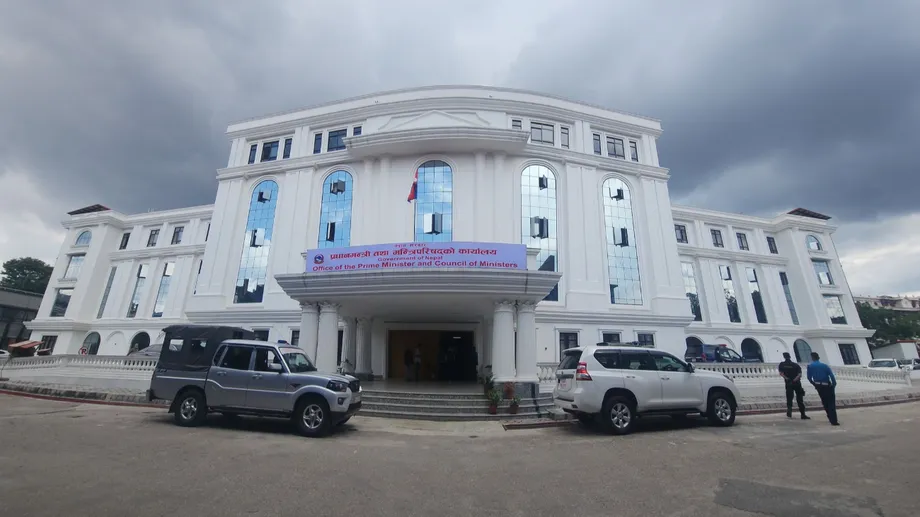
A separate implementation progress report from the Prime Minister's Office identifies 91 pending public interest decisions. It was prepared under the leadership of then chief secretary Suman Raj Aryal and law secretary Pushkar Sapkota and reportedly released on Shrawan 11.
The report assigns 20 pending decisions to the Home Ministry, 19 to the Prime Minister's Office and 15 to the Law, Justice and Parliamentary Affairs Ministry. Together, those entries account for 54 of the stated 91 cases, about 59%.
Other entries include 14 for the former Forest and Environment Ministry and eight for the former Federal Affairs and General Administration Ministry. The former Women, Children and Senior Citizens Ministry and various municipalities each have five, while Kathmandu Metropolitan City and the Attorney General's Office each have two.
The report describes correspondence being passed from the Prime Minister's Office to ministries, departments and branches without implementation. It identifies shortages of budgets, infrastructure and skilled staff, alongside repeated litigation and uncertainty over how some judgments should be carried out.
The 91 case list and the directorate's 244 case figure cannot be reconciled from the published descriptions. The ministry entries are useful for locating responsibility, but they do not establish that the larger backlog has fallen to 91 or that the difference represents completed judgments.
A timeline of decisions and delayed action
The cases span decades. Nepali dates below retain their Bikram Sambat month names and years to avoid treating them as Gregorian dates, a problem in some English descriptions of the Lumbini and Gurkha judgments.
- 2059 BS: The brick kiln petition challenges pollution and failures to enforce earlier government decisions.
- Jestha 12, 2066 BS: The Supreme Court issues a decision concerning implementation of the Rawal Commission report on public and government land.
- Poush 1, 2066 BS: A directive addresses groundwater extraction regulation in Kathmandu Valley.
- April 1, 2011: The court orders arrangements for prison maternity facilities and a study team within six months.
- Chaitra 7, 2074 BS: Directives seek voting arrangements for Nepalis abroad.
- Magh 24, 2079 BS: The Gurkha service benefits judgment calls for research, consultation and diplomatic action.
- Asar 18, 2082 BS: Patan High Court orders payment in the dialysis equipment dispute.
- Bhadra 11, 2082 BS: The Supreme Court issues the Lumbini pollution order, reportedly allowing two years for implementation.
A 2020 investigation had already identified 213 ignored decisions ordering government action, including 92 directed to the Home Ministry. Examination of documents in 33 directorate cases through information requests showed repeated reminders and delayed responses. Those historical figures are not directly comparable with the later totals.
One prison maternity case took four years merely to produce a study team intended to be formed within six months. Other examples concerned juvenile courts, pharmacy regulation, discrimination protections, brick kilns and sand extraction. More recent accounts also identify incomplete implementation concerning Phewa Lake protection and directives affecting sexual and gender minorities. These are specific unfinished obligations, not proof that every policy in those areas is absent.
Proposals exist, but delivery dates are missing
The government progress report proposes a shared digital tracking system connecting courts, ministries and the Attorney General's Office. It also recommends discouraging unnecessary or duplicate writ petitions and using monitoring committees and ministry officials to resolve practical uncertainty in judgments.
Chief registrar Bimal Paudel says implementation requires active participation from police, land revenue offices, local governments and other agencies. Directorate director general Gajendra Bahadur Singh proposes at least two days of specialised training for enforcement officers, reflecting the technical demands of collecting penalties and executing judgments.
These proposals address different failures: tracking can expose inactivity, training can improve execution, and coordination can settle responsibility. None alone establishes that a ministry has relocated an industry, enabled overseas voting or paid a creditor. The directorate's existing power to report failures to a bench remains another available mechanism.
No firm launch date is identified for the shared tracking system, training programme or overseas voting arrangements. Nor is there a dated parliamentary hearing, confirmed Lumbini review outcome or dialysis payment deadline. The next meaningful measure is completed action against each order, with unresolved accounting discrepancies corrected and responsibility made explicit.
Key Points
- The judgment enforcement directorate reports 244 unimplemented public interest decisions; a separate government report identifies 91, without explaining the difference.
- The Lumbini order reportedly requires polluting industries within 15 kilometres to close or relocate within two years.
- Overseas voting and Gurkha rights judgments require legal, administrative and diplomatic action that remains incomplete.
- A dialysis supplier says an agreed Rs 210 million payment remains unpaid despite a Patan High Court order.
- Reported unpaid fines exceed Rs 31.75 billion; only 4.95% of recorded victim compensation has been cleared.
- The published imprisonment totals do not reconcile arithmetically and need clarification.
- Digital tracking, staff training and coordination have been proposed, but firm delivery dates are not identified.