Camera Traps End Decades of Uncertainty
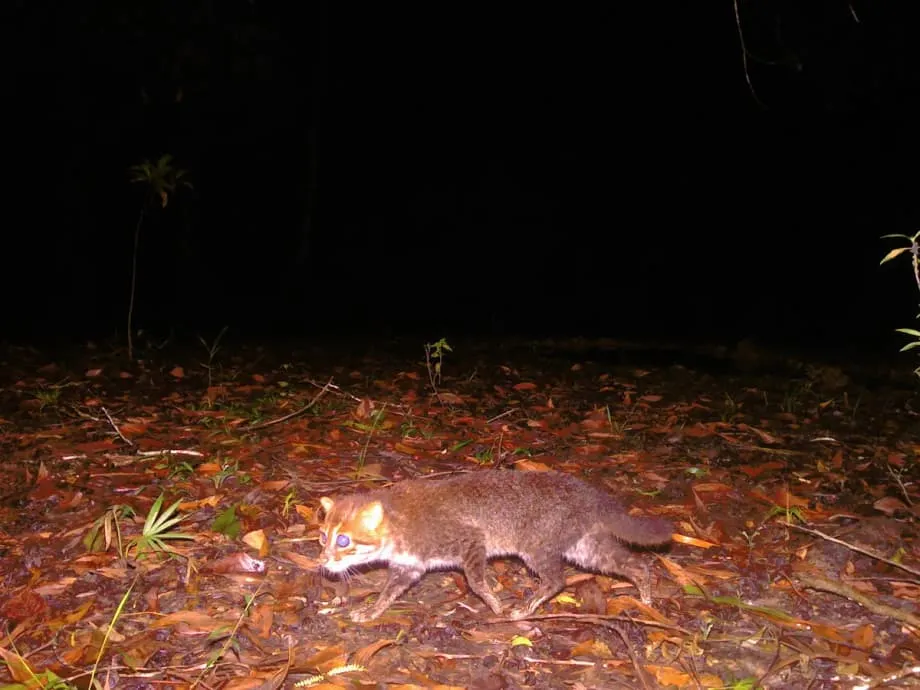
Twenty-nine camera detections in Princess Sirindhorn Wildlife Sanctuary have confirmed the survival of flat-headed cats in Thailand after nearly three decades without a documented sighting. Scientists from Panthera, the global wild cat conservation organisation, and Thailand's Department of National Parks, Wildlife and Plant Conservation recorded 13 detections in 2024 and another 16 in 2025. One image captured a female with her cub, showing that the rare cats are reproducing in the country's far south.
Contents
- Camera Traps End Decades of Uncertainty
- From the Last Record to Renewed Confirmation
- A Small Cat Built for Wetlands
- A Restricted Range and Much Still to Learn
- Reaching the Interior of the Swamp
- Months of Waiting Yield Repeated Records
- Why 29 Detections Cannot Yet Give a Population Size
- A Mother and Cub Change the Conservation Picture
- Protection Becomes the Immediate Priority
- The Bottom Line
Thailand's last confirmed record had been in 1995. By 2014, the absence of further evidence had led conservation authorities to regard the species as possibly extinct within the country. Local fishers occasionally reported trapping the unusual cats, but surveys had failed to produce confirmation.
The discovery was announced on Thailand's annual Wildlife Protection Day. Suchart Chomklin, Thailand's Minister of Natural Resources and Environment, linked the finding to sustained conservation work and cooperation with local communities.
For decades, the flat-headed cat has been classified as 'likely extinct,' but after years of sustained protection, strong scientific partnerships, and community stewardship, we can now celebrate its return to Thailand this National Wildlife Day.
Princess Sirindhorn Wildlife Sanctuary may hold Thailand's last remaining population of this species. Its survival gives conservationists an opportunity to protect a wetland specialist that is endangered across its range, while the photograph of a mother and cub adds evidence of breeding to the repeated records of adults.
As of January 20, 2026, researchers are moving from the task of finding these cats to understanding their population and assessing the threats around them. The cameras have established their presence, but the number of individual animals remains unknown.
From the Last Record to Renewed Confirmation
The gap between the 1995 sighting and the records from 2024 and 2025 explains why the rediscovery carries such weight. For much of that period, the cat's status in Thailand rested between occasional local reports and a lack of scientific confirmation.
The sequence of records and assessments shows how that uncertainty developed:
- 1995: The last confirmed sighting of a flat-headed cat in Thailand was documented before the recent rediscovery.
- 2014: Conservation authorities feared the species had disappeared from Thailand, and an assessment classified it as possibly extinct in the country.
- 2024: Camera traps recorded 13 detections in Princess Sirindhorn Wildlife Sanctuary.
- 2025: Cameras recorded another 16 detections, bringing the total to 29 across the two years.
- By January 20, 2026: The rediscovery had been announced, and scientists were conducting a threat assessment for the population.
Urs Breitenmoser, co-chair of the International Union for Conservation of Nature's Cat Specialist Group, was one of the reviewers of the 2014 assessment. He welcomed the new evidence.
Rediscovering flat-headed cats in southern Thailand is a remarkable find. It's good news for the end of the year!
Sixteen detections in 2025 compared with 13 in 2024 means the cameras recorded three more detections in the second year. Across both years, the repeated appearances suggest that cats were returning to the same areas, giving researchers a place to focus more intensive work.
A Small Cat Built for Wetlands
The flat-headed cat takes its name from its unusually flattened skull. Small, rounded ears sit far apart on its head, while large eyes face forward. That eye position helps it judge distance when hunting prey in water.
At an average weight of just 1.5 to 2 kilograms, the species weighs less than half as much as a typical domestic cat. It is the smallest cat in Southeast Asia and one of the smallest feline species in the world. Its small body helps it move through dense undergrowth.
Webbed feet are another adaptation to its watery surroundings. This uncommon feature among wild cats helps the animal move through waterlogged peat swamp forests, where stretches of open water lie between patches of land.
Flat-headed cats live almost exclusively in Southeast Asian wetlands, including peat swamps and freshwater mangroves. Their specialised way of life makes the condition of those habitats central to their survival. Agricultural expansion and the conversion of land to other uses are reducing the wetland environments on which they depend.
A Restricted Range and Much Still to Learn
Scientists place the flat-headed cat in the genus Prionailurus, a biological grouping that also includes the better known fishing cat and leopard cat. Despite those relatives, the flat-headed cat has an extremely restricted natural range: Borneo, Sumatra, the Malaysian peninsula and the extreme southern tip of Thailand.
The International Union for Conservation of Nature (IUCN) lists the species as endangered. Its estimated global population is approximately 2,500 adult individuals. That small worldwide total makes the survival of a population in Thailand meaningful beyond the country's borders.
Researchers still know relatively little about its biology and behaviour. No systematic study of its diet has been conducted, although scientists believe it feeds mainly on fish, frogs and shrimp. Its physical adaptations and close association with water fit that understanding of its likely food supply.
Flat-headed cats appear to be largely solitary, as many other small cats are. Females rear their cubs without male involvement, and the species typically produces just one offspring at a time. With so few young in a typical birth, rebuilding a depleted population can be slow and difficult.
Thailand's rediscovered cats therefore offer two connected opportunities: protecting a group of an endangered species and learning more about an animal whose basic habits remain poorly understood. Researchers believe the sanctuary's apparently concentrated population could make detailed ecological and behavioural studies more practical.
Reaching the Interior of the Swamp
Panthera and Thailand's Department of National Parks, Wildlife and Plant Conservation made the rediscovery through an ecological survey described as having launched the previous year. Their work targeted Princess Sirindhorn Wildlife Sanctuary, where protected peat swamp forests and wetland ecosystems offered suitable habitat.
Rangers and researchers faced chest-high water and tangled mangroves as they tried to reach the forest interior. Open water and scattered patches of land form a difficult mosaic, limiting progress to just 1 to 2 kilometres a day. Earlier surveys had largely stayed around the forest edges because reaching deeper areas was so demanding.
Rattapan Pattanarangsan, Panthera's conservation programme manager for Thailand, explained how the terrain restricts efforts to gather information about the cats.
There are two problems with gathering more information about how flat-headed cats are faring in the sanctuary – the first is the nature of the swamp forest terrain, with its complex mosaic habitat of open water and patches of land where rangers can move only 1-2km a day.
The team nevertheless placed camera traps in remote parts of the sanctuary. These cameras are activated by movement and can remain in position continuously, recording wildlife that passes while researchers are elsewhere. That makes them useful in places where regular travel is difficult.
Months of Waiting Yield Repeated Records
Researchers waited months before reviewing the camera footage, uncertain about what the equipment would capture. When they examined the images, they found repeated records of flat-headed cats rather than a single appearance.
The cats seemed to return to the same areas again and again. That pattern suggested a relatively concentrated local population, an encouraging feature for a research team working in terrain that takes considerable time to cross.
Panthera's team in Thailand believes the sanctuary population appears more concentrated than populations in Malaysia and Indonesia. A site where animals repeatedly use accessible camera locations offers strong potential for intensive research, even when getting to those locations remains difficult.
Princess Sirindhorn Wildlife Sanctuary could consequently become an important destination for researchers studying the species' ecology and behaviour. The repeated records give scientists a starting point for investigating how the cats use the wetland and how they survive there.
The same survey also illustrates why the cats could remain undocumented for so long. Previous searches were constrained by access to the forest interior, while cameras deployed in remote habitat could keep watching without a ranger remaining beside them.
Why 29 Detections Cannot Yet Give a Population Size
Flat-headed cats present a second research difficulty beyond the swamp itself: their coats lack the distinctive patterns that allow scientists to recognise individual tigers, leopards or clouded leopards in photographs.
Rattapan explained why this physical characteristic limits the methods researchers can use.
The second is the nature of the beasts themselves. Individual flat-headed cats cannot be identified by coat patterns, which prevents us from using photographic capture-recapture methods.
Photographic capture-recapture is a technique for estimating animal numbers by identifying individuals in pictures and then checking which of them appear again. Recognising the same animal across different photographs allows researchers to compare repeat appearances with records of other individuals.
For flat-headed cats, a camera may photograph the same animal several times without giving researchers a reliable way to recognise it. The 29 detections could include repeated appearances by a small number of cats, or they could involve more individuals. Scientists cannot yet say whether the sanctuary holds only a handful or potentially several dozen.
Without an estimate of abundance or population density, conservationists have less information for judging whether the group can survive over time and for designing targeted protection measures. The combination of difficult access and limited individual identification makes gathering that information especially challenging.
A Mother and Cub Change the Conservation Picture
The photograph of a female with her cub is particularly valuable because it documents reproduction within the sanctuary. Researchers now have evidence of a resident breeding population, alongside the repeated camera records.
The cub adds to the understanding of how these cats are using southern Thailand. Adults are surviving there and successfully producing young, rather than the records consisting solely of occasional animals arriving from neighbouring populations in Malaysia.
Wai Ming Wong, Panthera's small cat conservation science director, described the conservation significance of the rediscovery.
Rediscovering flat-headed cats in southern Thailand is an extraordinary moment for conservation. It shows that, where wetlands and river systems remain intact, even the most elusive and threatened carnivores can persist.
The mother's presence with her cub is especially encouraging for a species that typically has one offspring at a time. Each successful breeding event matters when the global adult population is estimated at approximately 2,500 and the species' wetland habitat is shrinking.
Thailand's finding also supports the value of sustained protection in an ecosystem under pressure. Protected habitat, scientific partnerships and community stewardship have helped create the conditions in which researchers could confirm the cats' continued presence. The rediscovery offers hope for other species thought to have disappeared, while directing attention to the practical work needed to keep this population alive.
Protection Becomes the Immediate Priority
Scientists are conducting a threat assessment for the newly discovered population. Conservationists regard stronger protection of the forest habitat as an immediate priority, particularly because this group may be the last remaining population in Thailand.
Wildlife trafficking is one concern associated with announcing the discovery. Public knowledge of the cats' presence also alerts people who might try to capture them illegally. Authorities and conservation teams therefore face the task of strengthening protection as attention turns to the sanctuary.
Habitat protection is equally central. Flat-headed cats depend on wetlands that are disappearing under agricultural expansion and land conversion. Their webbed feet, hunting adaptations and likely diet all connect their survival to the water and vegetation around them.
Conservationists want protection work to proceed promptly rather than wait for every research question to be answered. Further study can help establish population size and guide more targeted measures, while the threat assessment can inform action around the habitat already known to support breeding cats.
Princess Sirindhorn Wildlife Sanctuary now holds confirmed evidence of an animal that had gone undocumented in Thailand for nearly 30 years. The next task is to preserve that habitat and learn enough about its cats to protect both the adults and the young they are producing.
The Bottom Line
- Flat-headed cats have been confirmed in Thailand after the last documented sighting in 1995.
- Panthera and Thailand's Department of National Parks, Wildlife and Plant Conservation recorded 29 detections in Princess Sirindhorn Wildlife Sanctuary: 13 in 2024 and 16 in 2025.
- A female photographed with her cub provides evidence of a resident breeding population.
- The endangered species has an estimated global population of approximately 2,500 adults.
- Flat-headed cats weigh an average of 1.5 to 2 kilograms and have webbed feet suited to wetland habitat.
- Difficult swamp terrain and the absence of distinctive coat patterns prevent a reliable population estimate with the methods used so far.
- The sanctuary population appears more concentrated than populations in Malaysia and Indonesia, offering opportunities for further research.
- Scientists are assessing threats, including wildlife trafficking and habitat loss, as conservationists seek immediate protection for what may be Thailand's last remaining population.