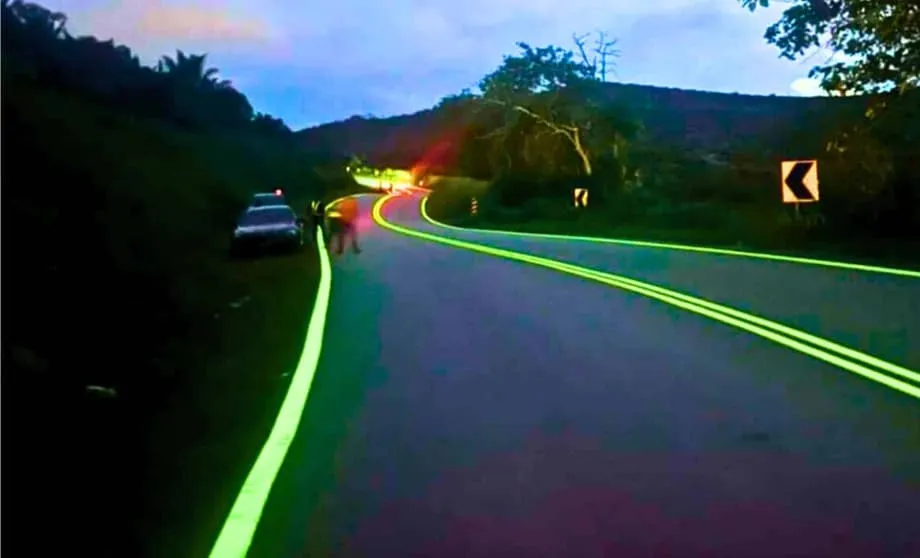
A Bright Idea Meets a Costly Reality
Malaysia's experiment with glowing road markings near Semenyih promised better visibility without electricity, but its price and short life brought plans for wider use to a halt. The special paint cost RM749 per square metre, compared with about RM40 for standard white road paint, while tropical weather and traffic caused its glow to fade much faster than expected.
Contents
- A Bright Idea Meets a Costly Reality
- How Paint Can Store Daylight
- Why the First Images Won Support
- Tropical Weather Wore Down the Glow
- The Price Gap Was Nearly Twentyfold
- November 2024 Brought the Decision
- Drivers Wanted Basic Repairs First
- Other Countries Faced Similar Problems
- Research Continues as Malaysia Turns to Lighting
- The Bottom Line
Deputy Works Minister Ahmad Maslan announced in November 2024 that the pilot had failed to meet the expectations of ministry experts. The government decided against a wider rollout, and proposed expansions in Selangor and Johor were discarded.
The Public Works Department had launched the trial in October 2023 on a road with two lanes near Semenyih. Its photoluminescent coating absorbed sunlight during the day and was designed to release a soft glow for up to ten hours at night. Officials hoped it would help drivers on rural roads where streetlights were scarce and power outages were common.
Malaysia records more than 6,000 road deaths annually, with many occurring on unlit highways. Against that backdrop, markings that could remain visible without a connection to the electricity grid seemed a promising addition to efforts to modernise road safety, particularly in underdeveloped areas.
Early enthusiasm centred on the prospect of clearer guidance after dark, including in rain and fog. The later decision turned on two practical problems: whether the coating could withstand everyday conditions and whether its benefits justified the cost of applying and replacing it.
How Paint Can Store Daylight
Photoluminescent paint uses compounds, typically strontium aluminate, that absorb energy from ultraviolet and visible light. The material stores that energy and releases it slowly as visible light after dark. In simple terms, daylight charges the coating, which then glows as the stored energy is released.
Ordinary reflective road paint works differently. It needs an outside light source, such as a vehicle's headlights, to make the markings visible to a driver. Photoluminescent markings emit their own light after charging, which made them attractive for remote places where installing electrical infrastructure would be expensive or impractical.
The Netherlands and Japan had tested similar materials more than a decade earlier, mainly on cycle lanes or short stretches of highway. Malaysia's pilot carried a more ambitious hope: officials wanted the markings to replace streetlights altogether in remote areas, reducing maintenance costs while improving safety.
The intended system would charge each day and guide drivers throughout the night without using grid electricity. Its appeal rested on that daily cycle and the prospect of avoiding the equipment and upkeep needed for conventional lighting.
Why the First Images Won Support
Photographs of luminous lines cutting through a dark landscape spread widely on social media when the Semenyih road first attracted attention. The initial public response was overwhelmingly positive, with drivers praising the clearer markings and urging the government to extend the programme to other rural highways and village roads.
One Instagram user captured the excitement surrounding the experiment:
Malaysian roads are really going to be lit, no pun intended,
Drivers highlighted the way the glow remained distinct in wet conditions. Early reports also described markings that held up well in rain and fog and stayed visible for hours after dark, when traditional markings often became difficult to see. Water can make standard reflective paint appear washed out, so visibility during bad weather was a major part of the trial's appeal.
For a brief period, the project was viewed as a triumph of modern engineering and a symbol of progress. Its reported visibility in fog was especially welcomed as a potential lifesaver in places where poor lighting was an everyday driving hazard.
Tropical Weather Wore Down the Glow
Malaysia's heat, humidity and torrential rain exposed a weakness in the coating. Researchers from the Malaysian Institute of Road Safety Research (MIROS), together with international studies, found that photoluminescent coatings degrade rapidly in tropical climates.
Intense ultraviolet radiation, constant moisture and the physical wear caused by traffic reduced the paint's luminosity faster than anticipated. The glowing effect began to fade within months. Lines that had initially looked bright and continuous became patchy and dull.
The paint needed reapplication much sooner than expected, often within 18 months. That replacement cycle weakened the central promise of a system that would need little maintenance and provide an economical alternative to electrical lighting.
The trial's early performance in rain and fog concerned how well drivers could see the markings at the time. Durability concerned how well those markings continued to work after repeated exposure to weather and traffic. A coating could offer useful visibility at first and still become costly to maintain as its light output declined.
The Netherlands had encountered a related problem on its N329 highway. Heavy rain made the light output inconsistent, leading engineers to suspend the trial temporarily. Malaysia's experience placed the same practical issue at the centre of its decision: the markings had to keep working through the conditions in which drivers needed them.
The Price Gap Was Nearly Twentyfold
At RM749 per square metre, the specialised paint cost nearly twenty times as much as conventional white road paint at approximately RM40 per square metre. Using those figures, the difference was RM709 for each square metre painted, and the specialised coating cost about 18.7 times the standard option.
That gap made large scale use financially unfeasible. The high initial price was compounded by the need to repaint markings that lost their glow sooner than expected.
Frequent replacement would turn the premium paid at installation into a recurring expense. The expected savings from avoiding streetlights were overtaken by the cost of the coating itself and the work needed to keep it effective.
The project's economic promise depended on more than a road glowing brightly on its first nights. The paint needed to remain useful long enough for lower electricity and lighting maintenance costs to offset its much higher purchase price. Rapid deterioration made that balance difficult to achieve.
November 2024 Brought the Decision
Ahmad Maslan, Malaysia's deputy works minister, told a parliamentary session in November 2024 that the pilot had fallen short of the ministry's technical expectations. Explaining why the government would not proceed with wider implementation, he said:
We tested it, but it didn't meet our experts' standards,
The announcement formally acknowledged that the experiment had failed. Plans to expand the technology in Selangor and Johor were dropped, bringing the brief period of optimism about the glowing road near Semenyih to an end.
The project moved from installation to cancellation in a little over a year:
- October 2023: The Public Works Department launched the pilot on a road with two lanes near Semenyih.
- Within months of installation: The glow began to fade, leaving markings patchy and dull.
- November 2024: Ahmad Maslan announced that the trial had not met ministry experts' expectations, and the government abandoned the wider rollout.
The cancellation reflected the combined effect of cost and durability. A material priced far above standard paint also required replacement sooner than hoped, making it difficult to justify spreading the experiment across more roads.
Drivers Wanted Basic Repairs First
Public sentiment shifted from excitement to frustration after the decision. Citizens and commentators argued that the government should give priority to basic infrastructure problems instead of expensive technology experiments.
Social media complaints focused on potholes, uneven road surfaces and poor drainage. For drivers raising those concerns, the immediate danger lay in the condition of the road as well as their ability to see it.
One commenter urged officials to experience the conditions themselves, writing:
Tell your officers to drive at night or in the rain,
The commenter then described the hazards that needed attention:
You'll see the real danger, bad visibility and potholes.
The criticism reflected a preference for practical improvements that would remain reliable through regular use and bad weather. Many people favoured a well maintained road with standard lighting over glowing markings that could begin losing their effect within months.
The change in reaction also showed why the trial had initially attracted so much interest. Better visibility was a real concern, but drivers expected any new solution to work alongside sound road surfaces and drainage.
Other Countries Faced Similar Problems
The Netherlands' Glowing Lines project, developed by construction company Heijmans and artist Daan Roosegaarde, also struggled with weather degradation. Following the problems that interrupted the N329 trial, the project was put on hold indefinitely.
In the United Kingdom, the Highways Agency had previously concluded that luminescent road paint would probably be unsuitable because of concerns about skid resistance and winter performance. Skid resistance describes how well a road surface allows tyres to maintain their grip, a basic safety requirement for any material placed on a road.
Those experiences highlighted different demands placed on the same technology. In Malaysia, intense sunlight, humidity, heavy rain and traffic wear damaged the coating. In the British assessment, grip and performance during winter were central concerns.
The technology's usefulness depended on the conditions where it would be installed. A marking had to provide sufficient visibility, withstand the local weather and remain suitable for vehicles travelling over it. Its purchase price also had to make sense once maintenance was included.
Research Continues as Malaysia Turns to Lighting
Scientists at Delft University of Technology and Japan's National Institute for Land and Infrastructure Management continue working to improve photoluminescent materials. Their aims include coatings that resist weather better, cost less to produce and last longer.
Some companies have found success by concentrating on places with less physical wear than busy highways. French manufacturer OliKrom has focused on cycle paths and pedestrian areas, where the coating faces less wear than on roads carrying heavy traffic.
Malaysia's immediate focus is shifting towards conventional measures. The Ministry of Works plans to install LED lights in areas prone to accidents and improve existing infrastructure. No installation timetable was given.
These measures offer better reliability and cost effectiveness for the country's current needs. The Semenyih experiment showed the difficulty of turning an appealing idea into infrastructure that can survive local conditions at an affordable price.
The lasting lesson is practical: daily charging and several hours of glow were only part of the task. The markings also needed to retain their performance through tropical weather and traffic, without requiring expensive, frequent replacement.
The Bottom Line
- Malaysia launched a photoluminescent road pilot near Semenyih in October 2023, using paint designed to glow for up to ten hours after absorbing daylight.
- The coating cost RM749 per square metre, compared with approximately RM40 for standard white road paint, a difference of nearly twentyfold.
- Tropical weather and traffic wear caused the glow to fade within months, with reapplication often needed within 18 months.
- Deputy Works Minister Ahmad Maslan announced in November 2024 that the trial had failed to meet ministry experts' expectations.
- The government dropped the wider rollout and proposed expansions in Selangor and Johor.
- Public criticism focused on potholes, uneven roads, poor drainage and the need for dependable lighting.
- Trials and assessments in the Netherlands and the United Kingdom also identified weather or performance problems.
- Research continues, including work on more durable materials and uses on cycle paths and pedestrian routes, while Malaysia plans LED lighting and improvements to existing infrastructure.