More licensed taxis and direct arrivals across the border
Singapore and Malaysia have agreed to let licensed taxis drop passengers anywhere in the other country and gradually raise their cross border taxi quotas from 200 to 500 vehicles each. The changes, announced alongside the 12th Singapore Malaysia Leaders Retreat, promise easier journeys across the Causeway and Second Link while keeping restrictions on where foreign taxis can collect passengers.
Contents
- More licensed taxis and direct arrivals across the border
- What changes at Larkin Sentral and Ban San Street?
- How much larger will the fleet become?
- Why demand and enforcement brought the rules into focus
- What direct drop offs mean for passengers
- Recognizing a licensed taxi and booking a ride
- Fares, insurance and accident claims
- What taxi drivers and their association say
- Road pricing equipment and action against illegal services
- Tourism buses and connections beyond Johor Bahru
- How the changes will be phased in
- What to Know
As of December 6, 2025, the two governments have not announced a start date. Implementation will be gradual, with transport agencies working through operating rules, enforcement measures, insurance safeguards and requirements for booking platforms.
The first increase will add 100 licensed taxis per country, with priority given to larger and premium vehicles. Those vehicles are intended to serve families, groups carrying luggage and business travelers seeking more space or comfort.
Passengers will gain flexibility at the end of a journey, but the return trip will still begin at an approved pickup point. A Malaysian taxi could take a traveler directly to a Singapore hotel, for example, while collecting the passenger for a journey back to Malaysia would require a designated location.
Authorities plan to add more of those locations over time, including points serving ride hailing and e hailing bookings. Both terms describe arranging a ride electronically, usually through an app.
The package also covers clearer vehicle identification, electronic road pricing equipment for Malaysian taxis entering Singapore, better insurance arrangements and stronger action against illegal services. Singapore and Malaysia are separately working toward closer alignment of rules for buses carrying tourists across the border.
Transport ministers Anthony Loke of Malaysia and Jeffrey Siow of Singapore have tasked Malaysia's Land Public Transport Agency and Singapore's Land Transport Authority with refining the details and putting reciprocal changes into operation. Their joint statement acknowledged demand for more flexible journeys and the need to curb illegal rides to protect safety and fair competition.
What changes at Larkin Sentral and Ban San Street?
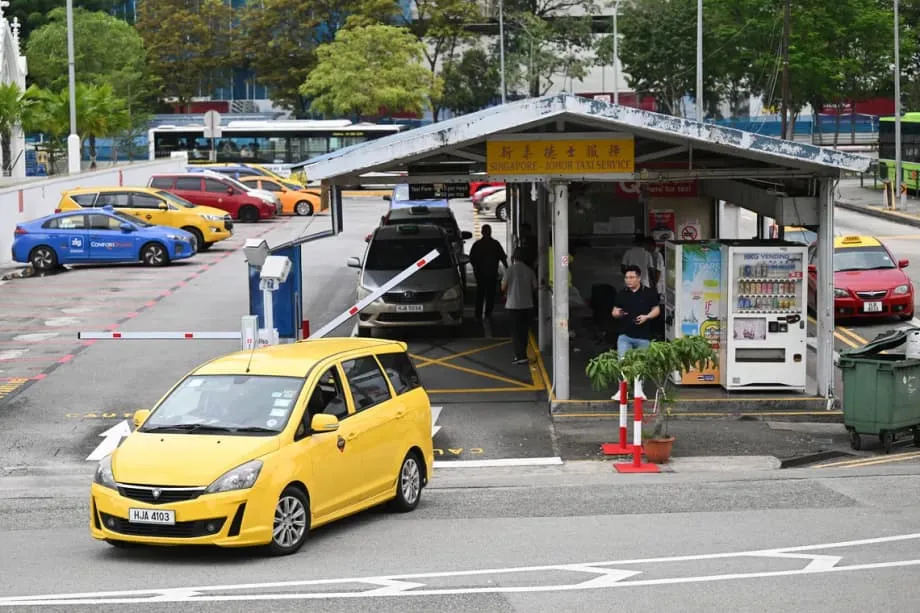
Singapore taxis traveling to Johor Bahru currently have to use Larkin Sentral Terminal for cross border drop offs and pickups. Malaysian taxis face the corresponding restriction at Ban San Street Terminal in Singapore.
The refreshed arrangements will remove the requirement to end those journeys at the terminals. A licensed taxi from Johor will be able to take a passenger to a particular address anywhere in Singapore. A licensed Singapore taxi will have the same freedom to complete a journey anywhere in Malaysia.
Larkin Sentral and Ban San Street will remain important staging points, especially for pickups. Foreign taxis will still be allowed to collect passengers only at designated cross border locations.
That restriction preserves the boundary between a permitted international journey and a domestic taxi service. Foreign taxis will not be free to circulate in the other country looking for local trips. Authorities say controlled pickups help prevent illegal local point to point services, protect domestic operators from unfair competition and reduce complications over insurance coverage.
How much larger will the fleet become?
Each country's quota will rise in stages from 200 licensed cross border taxis to a ceiling of 500. Together, the two quotas would increase from 400 to 1,000 vehicles, an increase of 600, or 150 percent, if the full expansion is completed.
The initial addition of 100 licenses per country would bring each quota to 300. Larger and premium vehicles will receive priority in that first stage, reflecting demand from passengers traveling in groups, carrying substantial luggage or making business trips.
Licensed drivers will gain a larger market and the ability to deliver passengers to the addresses they actually need to reach. More vehicles could also spread demand across a bigger legal fleet and reduce the attraction of private cars or unlicensed services.
The expansion will come with operating safeguards. Agencies must coordinate licensing, vehicle identification, pickup rules and insurance arrangements as capacity grows on both sides of the border.
Why demand and enforcement brought the rules into focus
Demand for legal cross border rides has surged since mid 2025. The increase coincided with tighter enforcement against illegal operators, following reports of Malaysia registered private cars appearing at locations including Changi Airport and Gardens by the Bay to carry passengers within Singapore.
Singapore authorities impounded more than 100 vehicles over several months for suspected violations. The enforcement activity highlighted the gap between demand for convenient rides and the supply of lawful services.
Commuters have long sought journeys that avoid a forced transfer at a terminal. Drivers have also wanted a larger market with clearer rules for operating legally. The new measures respond to both concerns while retaining controls intended to protect safety and fair competition.
The developments leading to the refresh can be traced through the following sequence:
- From mid 2025, demand for legal cross border rides surged as enforcement against illegal operators tightened.
- Over several months, Singapore authorities impounded more than 100 vehicles for suspected violations.
- Alongside the 12th Singapore Malaysia Leaders Retreat, the governments announced the taxi refresh and work on tourism bus arrangements.
- As of December 6, 2025, agencies were working on phased implementation, without an announced start date.
Singapore's Senior Minister of State for Transport Sun Xueling welcomed the alignment between the two countries, highlighting reliability, safety and shared service goals. She described the purpose of the measures:
These measures aim to make cross border travel more seamless, safe and efficient for all.
What direct drop offs mean for passengers
A traveler heading to a hotel in downtown Singapore or an industrial estate in Tuas will be able to finish the journey there, rather than changing vehicles at Ban San Street. A Singapore taxi carrying a family to Legoland Malaysia or a factory park in Johor will similarly be able to continue to the destination instead of ending the trip at Larkin Sentral.
Families with children, elderly passengers and people carrying bags or equipment stand to gain from fewer transfers. Direct arrivals also reduce uncertainty at night or during rain, when arranging the final leg from a terminal can be difficult.
Business travelers will be able to reach a meeting venue or hotel lobby without switching vehicles. Homes, offices and tourist attractions will also become possible destinations for licensed cross border journeys.
Return journeys will work differently. A passenger dropped at a hotel or home will still need to travel to a designated pickup location to board a foreign taxi for the trip back.
Authorities intend to make those locations more numerous and better distributed. The planned expansion includes points for app bookings, potentially making an approved location easier to reach from an airport, hotel or convention center. The details of those locations will be part of the operating arrangements still being developed.
Recognizing a licensed taxi and booking a ride
Licensed cross border taxis will need clear markings so passengers and enforcement officers can identify legitimate vehicles more easily. Measures under consideration include distinctive livery, tamper proof number plates with predefined prefixes and a rooftop topper.
Livery means the vehicle's identifying colors or markings. A plate prefix is a set of characters at the start of a number plate, while the topper is a sign mounted on the roof. Together, these features would make a licensed taxi easier to recognize at a glance.
Passengers should check that their vehicle is licensed for cross border travel and look for the specified markings once they are introduced. When a booking app provides a designated cross border option, travelers should use it and go to the pickup point listed for that journey.
Singapore and Malaysia are also developing a common regulatory framework for cross border ride hailing and e hailing platforms. The aim is to let platforms bring licensed taxis into their services under clear rules and allow illegal ride offers to be removed quickly.
Travelers will still need their travel documents and must meet the requirements for entry through the land border. Taxi arrangements do not change immigration checks or other checkpoint formalities.
Drivers will need clear guidance on approved pickup locations, app dispatch procedures and how to display or verify their cross border licenses. Training and outreach will help them use the required equipment, follow the new rules and explain the arrangements to customers.
Fares, insurance and accident claims
Fares will continue to reflect the time and costs involved in crossing the border. Authorities have said they will consult taxi associations to keep pricing viable for operators and fair for passengers, taking account of the different costs in Singapore and Malaysia.
Those costs include currency differences, fuel, maintenance, cross border licensing and insurance. Passengers should expect further clarity on how prices will be displayed, particularly for app bookings, when the platform rules are finalized.
Both countries also plan to improve insurance coverage for cross border taxis and speed up claims processing after accidents. A collision involving travel between two countries can bring two legal systems into the process, making recovery of costs more complicated for passengers and drivers.
Clearer coverage and faster claims handling are intended to reduce disputes over jurisdiction, help people recover costs promptly and shorten repair and recovery times. For drivers, stronger insurance arrangements would also reduce the risks of operating across the border.
Authorities are expected to clarify how information from booking platforms and vehicle systems could support a claim after an incident during a cross border journey. Those details will matter when passengers, drivers and insurers need to establish what happened and process a claim.
What taxi drivers and their association say
Singapore's National Taxi Association has backed the refresh. Direct drop offs and additional licenses offer drivers opportunities to serve groups and corporate customers who value space, comfort and a journey without a terminal transfer.
Yeo Wan Ling, adviser to the association and assistant secretary general of the National Trades Union Congress, linked the taxi changes to opportunities arising from the Johor Singapore Special Economic Zone. She also set out the association's position on protecting drivers during implementation:
The association welcomes the enhancements. They will, along with the Johor Singapore Special Economic Zone, open up larger market opportunities for Singapore cabbies, allowing more of them to tap the growing demand for cross border transport. The NTA will continue to work closely with the Ministry of Transport and the Land Transport Authority to ensure that principles of fair competition and a level playing field are upheld so that drivers' interests are protected as these changes are implemented.
Restrictions on foreign taxi pickups remain central to that balance. Licensed operators will gain more international business, while domestic services remain protected from foreign vehicles taking unauthorized local jobs.
Clear vehicle markings should make enforcement easier. Insurance improvements and electronic road pricing equipment will also form part of the conditions under which the larger fleet operates.
Road pricing equipment and action against illegal services
Malaysian taxis entering Singapore will be required to install the ERP2 onboard unit. Singapore is rolling out this next generation equipment for local vehicles to handle electronic road pricing, which charges vehicles for using roads covered by the system.
The device will support road pricing payments and may assist compliance checks at gantries. Officials have also pointed to the possible use of road pricing hardware and other telematics, meaning information collected or transmitted by vehicle systems, to support enforcement.
Vehicle data checks, combined with inspections at terminals and known pickup locations, could help authorities identify unlicensed activity while limiting disruption to legitimate journeys. The equipment may also help verify that vehicles are properly registered and operating within the licensed scheme.
Regulators are exploring stronger legal powers to require online platforms to remove unlawful ride offers quickly. A substantial share of illegal activity has moved to apps and social channels, making platform oversight part of the enforcement effort.
Visible markings, controlled pickups, technology and insurance safeguards are intended to work together. More legal capacity will be introduced alongside measures that make unauthorized services easier to identify and address.
Tourism buses and connections beyond Johor Bahru
Singapore and Malaysia also want to refresh bus links serving tourists and leisure travelers. Officials will work toward aligning the two countries' regulatory regimes for cross border buses, including services traveling beyond Johor Bahru.
Melaka, Desaru Coast and other popular destinations are among the places covered by that effort. A wider range of bus services, combined with better taxi connections at either end, could make land journeys easier to arrange for weekend trips and short holidays.
Tourism operators could benefit from smoother connections between major arrival points and final destinations. A family arriving by bus at a Johor shopping mall could use a licensed taxi for a short trip to a resort.
A visitor landing at Changi and seeking a direct journey to a resort in Desaru could look for an approved cross border taxi pickup point at the airport as the arrangements develop. Clear platform rules and better signage would make those journeys simpler to plan and book.
How the changes will be phased in
Malaysia's Land Public Transport Agency and Singapore's Land Transport Authority will work out the practical details and safeguards. The ministries have said they will move expeditiously, with changes introduced gradually.
Likely early steps include the first addition of 100 taxis per country, clearer identification features and an initial group of new designated pickup locations. App bookings for cross border rides will expand as the regulatory framework is finalized.
Passengers and drivers can expect updates explaining approved pickup points, the markings used on licensed vehicles and the insurance arrangements. The earliest changes could follow once operational checks and coordination between agencies are ready.
The refresh forms part of closer economic ties between Johor and Singapore, including the Johor Singapore Special Economic Zone. Alongside investment in public transport links and checkpoint upgrades, the taxi and bus measures are intended to keep one of the world's busiest land borders moving more efficiently.
What to Know
- Licensed taxis will be allowed to drop passengers anywhere in the other country, replacing the terminal only restriction.
- Foreign taxis will still collect passengers only at designated points, with more locations planned, including for app bookings.
- Each country's taxi quota will rise from 200 to 500 in stages, beginning with 100 additional licenses and priority for larger and premium vehicles.
- Identification measures under consideration include distinctive livery, tamper proof plates with predefined prefixes and rooftop toppers.
- Malaysian taxis entering Singapore will need the ERP2 onboard unit.
- Both governments plan better insurance coverage, faster accident claims and common rules for cross border booking platforms.
- Authorities are exploring stronger powers to remove illegal ride offers from online platforms.
- Tourism bus arrangements are also being reviewed, including services beyond Johor Bahru to Melaka and Desaru Coast.
- As of December 6, 2025, implementation will be gradual and no start date has been announced.