A crop at the center of food security and trade
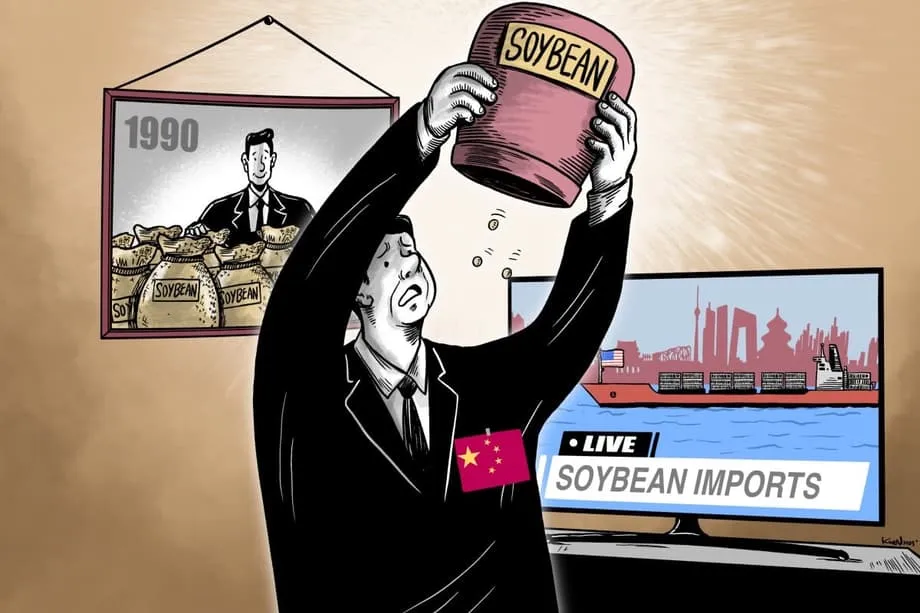
China imported about 105 million tons of soybeans in 2024, with roughly 71 percent coming from Brazil, 21 percent from the United States and close to 4 percent from Argentina. Those purchases show the scale of a challenge facing Beijing as of November 23, 2025: keeping food affordable while reducing exposure to trade disputes and disruptions abroad.
Contents
- A crop at the center of food security and trade
- How an exporter became the dominant buyer
- Why growing enough at home is so difficult
- Better seeds and shared fields
- Tariffs collide with the harvest calendar
- Angola and Russia enter a wider supply map
- How reserves help absorb shocks
- US farms lose sales as Brazil gains ground
- What households and markets will feel
- The Bottom Line
China buys roughly 100 million tons of soybeans annually, accounting for about 60 percent of global trade. Its purchasing decisions influence prices, shipping routes and planting choices across several continents. Soybeans are also a recurring flashpoint in its relationship with the United States.
The crop serves two essential purposes. Processors crush beans into soybean meal, a major ingredient in feed for pigs, poultry and aquaculture, and oil used in cooking. Reliable supplies therefore matter to both livestock producers and households buying everyday food.
Draft proposals for China's 15th five year plan call for more diverse agricultural import sources and better coordination between imports and domestic production. A new food security law requires self sufficiency in staple grains and brings food security into local economic planning.
Beijing's approach combines higher domestic output, reserves and a wider network of suppliers. China cannot meet its protein needs without steady soybean imports, yet it wants to reduce dependence on any single country or shipping route when political tensions or commodity prices rise.
That balance runs through the entire soybean economy. More domestic production would provide a cushion, but farmland is limited. Buying elsewhere can reduce exposure to one trading partner, but it also changes costs, seasonal purchasing patterns and the risks borne by farmers overseas.
How an exporter became the dominant buyer
China still exported soybeans in the 1990s. Over the following three decades, rising incomes, expanding livestock production and changes in trade policy turned it into a buyer of around 100 million tons a year.
After joining the World Trade Organization in 2001, China liberalized soybean imports and encouraged the construction of large crushing plants along its coast. Those plants converted imported beans into meal and oil, connecting overseas farms with China's growing demand for meat and cooking oil.
Domestic land policy helped shape that division of labor. China continued to prioritize rice, wheat and corn on its limited arable land. Imported soybeans, mostly genetically modified, supplied feed and oil markets. Locally grown beans, often preferred as conventional varieties, went into tofu, soy milk and other foods.
Foreign agribusinesses dominated global soybean trading during the 2000s. Price surges in 2003 to 2004 and again in 2007 to 2008 put many Chinese processors under severe pressure, while foreign companies acquired a larger footprint in the industry.
Chinese state owned businesses followed different strategies. COFCO and Chinatex partnered with international traders and expanded along global price cycles. Jiusan and Sinograin placed more weight on stockpiling and policy support for domestic production. The period often called the battle of the beans helped shape today's combination of commercial competition and national security planning.
Several dates trace how that system developed:
- 1990s: China was still a soybean exporter.
- 2001: WTO entry was followed by more open soybean imports and expansion of coastal crushing capacity.
- 2003 to 2004 and 2007 to 2008: Price surges squeezed Chinese processors and helped foreign firms expand their presence.
- 2018: Tariffs redirected Chinese demand toward Brazil.
- 2024: Soybean imports reached about 105 million tons.
- 2025: New tariffs made many US soybeans uncompetitive in China, increasing reliance on Brazilian supplies.
Why growing enough at home is so difficult
China must feed close to 20 percent of the world's population with less than 9 percent of its arable land and roughly 6 percent of its freshwater. Expanding soybean cultivation therefore competes with the land and resources needed for staple grains.
Yield differences make the challenge harder. Chinese soybean farms produce an average of about 1.99 tons per hectare, compared with around 3.38 tons in Brazil and 3.4 tons in the United States. On those figures, each hectare in either major exporter produces roughly 70 percent more soybeans than a hectare in China.
Chinese farm plots average about 0.65 hectares. Their small size complicates the use of modern machinery and raises production costs, particularly when compared with the much larger farms found in the Americas.
Zheng Fengtian, a professor at Renmin University who has studied Chinese agriculture for more than two decades, described the limits facing the country:
It seems necessary for China to be self reliant on soybeans, but it is impossible to actually achieve this.
Government ambitions remain substantial. China aims to raise self sufficiency in staple grains and beans to roughly 92 percent by 2033, while internal targets envision a 21 percent reduction in soybean imports by that year.
The United States Department of Agriculture projects the opposite direction for soybean trade, expecting Chinese imports to grow over the next decade. The competing projections show how much Beijing's plans depend on improving production while managing demand and protecting land for other crops.
Better seeds and shared fields
The Ministry of Agriculture and Rural Affairs has approved dozens of genetically modified corn and soybean varieties after trials conducted over several years, the first approvals at this scale in China. Beijing wants better yields, smaller losses to pests and more reliable production during supply shocks.
Genetically modified crops carry selected traits intended to improve how they perform. Insect resistance and traits supporting higher yields can help narrow China's production gap with Brazil and the United States, although widespread commercial planting will take time.
Most imported soybeans are already genetically modified and enter the feed and cooking oil supply chains. Domestic beans used directly in food have largely remained conventional. That pattern may continue even as planting of genetically modified varieties expands.
Public skepticism has slowed acceptance. Earlier food safety scandals and distrust of new technologies have contributed to those concerns. Regulators are responding with stricter biosafety reviews and clearer standards as they manage the gradual expansion.
Agronomists are also promoting soybean and corn intercropping in northern provinces. The approach grows the two crops together to obtain more beans from existing farmland, helping address the competition for space between soybeans and staple grains.
Government investment also covers breeding varieties that tolerate salty soils or drought and expanding high quality farmland. These measures can improve production, but they will take time to add millions of tons. China's strategy therefore combines agricultural changes at home with continued access to large overseas harvests.
Tariffs collide with the harvest calendar
The 2018 tariff conflict showed how quickly politics could redirect soybean shipments. Brazilian sales to China surged as US beans became less competitive. New tariffs in 2025 again priced many US cargoes out of the Chinese market, pushing buyers further toward Brazil.
Brazil's roughly 71 percent share of China's 2024 imports was already more than three times the US share of about 21 percent. Argentina supplied close to 4 percent. Moving away from the United States therefore meant buying more from a country that was already the dominant supplier.
The agricultural calendar complicates those choices. Brazil's main harvest runs from February to May, and its exports peak from March to August. The US harvest runs from September to November and traditionally supplies part of China's needs during the fourth quarter.
Chinese buyers have increasingly brought forward purchases from Brazil early in the year. US cargoes can then serve as a flexible option for reserves or quality blends when trade negotiations permit. Different harvest seasons help explain why some American supplies can remain useful even as their market share falls.
Public promises to buy large quantities of US soybeans have sometimes followed major political meetings, but commercial purchases have often lagged. During one recent purchasing window, Chinese buying amounted to only a few hundred thousand tons against pledges involving several million tons. Diplomatic commitments and the timing of profitable purchases have frequently moved at different speeds.
Chinese officials have sought to reassure households and markets about the country's ability to manage changing suppliers and tariffs:
China's food supply is fully secure, and our reserves are ample. We can adjust sourcing across many partners without affecting domestic stability.
Reserves give the government room to manage interruptions, while purchases from multiple countries provide alternative routes to supply. Seasonal availability, prices and negotiations still influence which cargoes arrive and when.
Angola and Russia enter a wider supply map
A subsidiary of CITIC has announced a $250 million plan to develop up to 100,000 hectares in Angola for soybeans and corn. The project aims to use modern machinery and irrigation, with roughly 60 percent of its output expected to go to China.
Angola has large areas of arable land that are underused by regional standards. Project sponsors have promoted potential yields far above current averages in Sub Saharan Africa. The venture forms part of a broader effort by Chinese state backed and private businesses to establish suppliers beyond Brazil, the United States and Argentina.
Similar arrangements are emerging with other African partners and Russia, which is seeking more agricultural export outlets to the east. For China, additional suppliers can provide a cushion against disruptions and offer different logistical and seasonal options.
Host countries could gain jobs, infrastructure and agricultural technology through these projects. Even successful ventures, however, would supply only a small fraction of China's annual soybean needs. The established exporters in the Americas will remain central to the market.
The objective is diversification rather than wholesale replacement. Angola's planned development illustrates both the ambition and the scale problem: a large investment in a new production area still has to fit into a purchasing system measured in about 100 million tons every year.
How reserves help absorb shocks
Researchers examining a decade of trade data found that tariff shocks and geopolitical disruptions weaken the resilience of China's grain imports. Resilience describes how well supply keeps moving during a disruption, how quickly it recovers and how effectively the system adapts afterward.
During the 2018 US China trade conflict, import prices rose, prices became more volatile, volumes dipped and the range of import sources narrowed. The Russia Ukraine war added further volatility, even without direct restrictions on Chinese trade.
Those pressures encouraged Beijing to expand reserves and coordinate stock releases to soften price spikes. Stored supplies can be released when imports become expensive or difficult to obtain, giving buyers and processors time to adjust.
Policymakers describe three capacities within this approach. Resistance means keeping imports flowing during a shock. Recovery means restoring normal flows quickly. Transformative change means developing a system better able to handle the next disruption, including a broader supplier network and more modern logistics.
China is pursuing all three through larger strategic stockpiles, stronger state purchasing and more flexible trading relationships. These measures improve stability, while weather, freight charges and political decisions beyond China's borders continue to affect the cost and availability of beans.
US farms lose sales as Brazil gains ground
US farmers have faced sharp declines in agricultural exports to China during tariff escalations. Soybean sales have sometimes fallen close to zero during important buying periods, leaving producers exposed when they would normally expect strong demand.
Analysts estimate that trade barriers and missed sales during harvest seasons have cost US farmers billions of dollars in recent years. Pressure has renewed calls for relief packages, while higher fertilizer, machinery and labor costs have squeezed farm margins further.
Small and medium farms have less room to absorb those shocks. A longer concern for the United States is the durability of lost business: once Chinese buyers strengthen relationships with competing suppliers, recovering market share can take years.
Brazil has been the largest beneficiary of China's purchasing shift. Its exports have repeatedly exceeded earlier trends to meet Chinese demand, and farmers have expanded the area planted with soybeans.
Environmental groups warn that some expansion risks further clearing in sensitive ecosystems, including parts of the Amazon and Cerrado. The gains from stronger soybean sales therefore sit alongside pressure on land use. Argentina's exporters, supported by tax changes, have also increased shipments of beans and soy products to China.
The effects reach beyond soybeans. Australian beef exports to China increased after Chinese regulators allowed US beef licenses to lapse. Canola trade has also shifted, with China reducing reliance on Canada and exploring more Australian purchases when political conditions and plant disease rules allow.
These changes distribute costs and benefits unevenly. Farmers who gain orders may expand production, while those losing access face weaker revenues. Freight, fertilizer and land markets also feel the effects as agricultural trade moves between countries.
What households and markets will feel
Chinese households encounter the soybean trade through cooking oil, pork, poultry and farmed fish. When soybean meal becomes more expensive, livestock and aquaculture producers pay more for feed, increasing the cost of producing food.
China's large reserves, broader sourcing and state guided purchases have contained domestic price swings during most shocks. Shipping bottlenecks, droughts in exporting countries and abrupt policy changes can still lift costs, with consequences for food prices closely watched by the public.
Global markets also respond to the timing of Chinese purchases. Buying earlier or later than usual can move prices. Changes in tariffs can redirect cargoes across oceans, affecting Brazil's currency, export margins through the US Gulf and Pacific Northwest, and freight rates on major routes.
China is likely to increase domestic soybean production through better seeds and intercropping while continuing to improve reserves. Imports will still supply the bulk of its needs. Brazil, Argentina and the United States during seasonal purchasing windows will remain important, alongside newer suppliers in Africa and Russia.
Beijing's central task is to keep that supply system stable and flexible without becoming too dependent on one partner. Domestic agricultural improvements, overseas investments and stockpiles are parts of the same effort, operating within limits set by land, water, crop yields and volatile trade politics.
The Bottom Line
- China buys roughly 100 million tons of soybeans annually, about 60 percent of global trade.
- Imports reached about 105 million tons in 2024, with Brazil supplying roughly 71 percent and the United States about 21 percent.
- Limited land and water, small farms and lower yields constrain domestic expansion.
- Beijing aims to reduce soybean imports by 21 percent by 2033, while the USDA projects growth over the next decade.
- New genetically modified varieties, intercropping and improved farmland form part of China's production strategy.
- Tariffs have pushed more purchases toward Brazil, although different harvest seasons preserve a role for US supplies.
- A $250 million project in Angola and relationships with other African countries and Russia seek to broaden supply options.
- Reserves and flexible purchasing help manage shocks, while farmers, ecosystems and consumers bear the costs of changing trade flows.
- China will remain dependent on imported soybeans even as it increases domestic production and diversifies suppliers.