A 500 yen payment that leaves nearly 450 yen missing
Small shops across Japan are finding South Korean 500 won coins in their tills after transactions that should have brought in 500 yen. Restaurants, gas stations, convenience stores and public baths have reported recent cases, with busy cashiers sometimes discovering the wrong currency only when they count the day's takings.
Contents
- A 500 yen payment that leaves nearly 450 yen missing
- Why the coins are easy to confuse
- Lunch service leaves little time to inspect change
- Accidental payments and deliberate deception
- The vending machine abuse that prompted redesigns
- What the 2021 coin changed
- Why older 500 yen coins still circulate
- How Japanese law treats intentional misuse
- Checks that shops and travelers can use
- Key Points
The difference in value is far greater than the difference in appearance. A Japanese 500 yen coin is worth roughly $3.40, while a Korean 500 won coin converts to about 53 yen, or $0.36. At those approximate exchange values, accepting 500 won for a 500 yen purchase leaves a shop about 447 yen short, commonly rounded to around 450 yen. The business receives only about one tenth of the expected value.
Japan's shopkeepers face two problems at once: accidental mix-ups between similar coins and deliberate attempts to obtain goods or change by passing off the cheaper coin. Some customers may have received a Korean coin as change themselves and unknowingly handed it on. Other incidents have raised suspicions because the same customer returned or several wrong coins appeared close together.
Japanese customers have been identified in several cases. Shopkeepers who do not want to unfairly blame travelers from Korea point to those incidents as a reason to focus on the payment itself, rather than a customer's nationality.
The recent increase in reports comes alongside a much older vulnerability. Japan redesigned its 500 yen coin in 2000 and again in 2021 to make counterfeiting and machine abuse harder. Those changes reduced machine fraud, but a shop counter still relies on a person noticing which coin has been handed over. No nationwide total for the recent incidents or combined losses was given.
Why the coins are easy to confuse
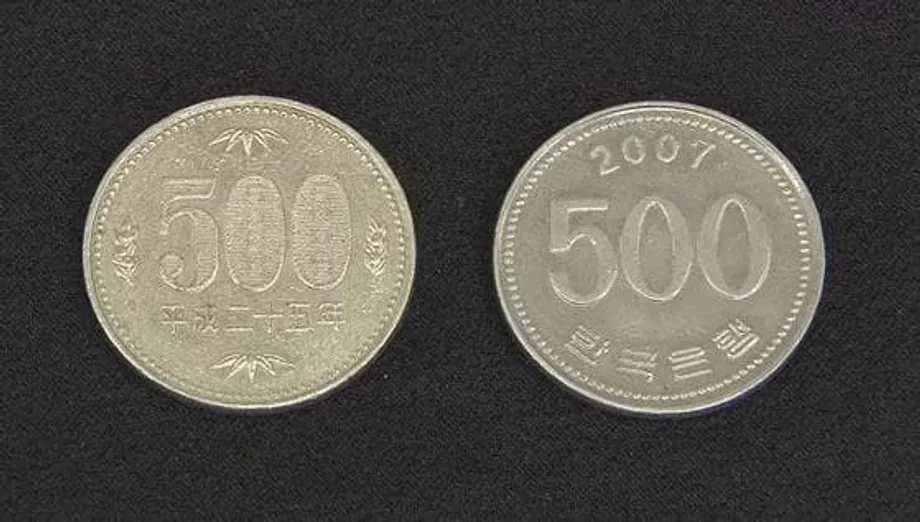
Japan introduced its 500 yen coin in 1982 to replace a banknote of the same value. South Korea's 500 won coin, also widely used in everyday purchases, happens to have the same diameter: 26.5 millimeters.
The weights are close, too. The old Japanese 500 yen coin weighs 7.0 grams, the Korean 500 won coin about 7.7 grams, and Japan's latest 500 yen coin, issued in 2021, 7.1 grams. A cashier handling money quickly may struggle to notice a difference of less than a gram, particularly when several coins arrive together.
Older Japanese 500 yen coins and the current design remain legal tender, meaning they can still be used to pay. Several genuine designs therefore circulate at the same time. Staff cannot simply expect every valid 500 yen coin to have the appearance of the newest version.
Both countries' coins were once made from cupronickel, an alloy of copper and nickel. Their similar material, size and weight helped make the older Japanese coin vulnerable to abuse in vending machines during the 1990s. At today's counters, the immediate problem is often simpler: a quick glance at a similar-looking coin during a rush.
Lunch service leaves little time to inspect change
Takashi Ito, a 69-year-old udon restaurant owner in Tokyo's Shinjuku district, described losses that he often discovered only while balancing the till at the end of the day. During lunch service, he said, handling payments quickly leaves little time to study a coin's edge or lettering. His eyesight adds to the difficulty.
Ito described how closely the coins resemble each other and how often he had experienced the problem:
The sizes and weights of the two coins are almost the same, so it is hard to identify them. I have suffered similar losses about 15 times over the past 10 years.
His experience shows why even occasional incidents can become a recurring cost. A wrong coin accepted in seconds may remain unnoticed for hours, by which time the customer has left and the restaurant has little opportunity to correct the payment.
A ramen shop owner in Fukushima Prefecture said he traced one incident to a Japanese customer. He suspected the person had used the tactic before and described the loss as a shock while ingredient prices were rising.
The Fukushima owner explained who had made the payment and why he suspected deliberate behavior:
When I checked who paid with the 500 won coin, it turned out to be a Japanese person, not a Korean. The customer looked like a repeat offender.
Gas stations and public baths have reported similar cases. Cash remains common in those businesses, and staff often manage several tasks at once. A customer puts coins in a tray, the payment goes into the drawer, and the next transaction begins. The wrong coin may surface only during a later count.
Accidental payments and deliberate deception
A customer can pass along a 500 won coin without realizing it. Someone may receive one as change elsewhere, overlook the different lettering and later spend it as though it were yen. Tourists can become confused at crowded attractions, while elderly customers may have difficulty identifying coins in dimly lit shops.
Shopkeepers become more suspicious when a customer repeatedly appears with the wrong currency or several suspect coins arrive during the same busy period. Establishing what happened depends on the circumstances of the payment, including whether the customer knew the coin was worth much less than 500 yen.
A shortfall of around 450 yen can matter to a business working with tight margins. For a bowl of ramen or a gasoline sale, several incidents can wipe out a day's profit on those items. Rising ingredient costs add pressure for restaurant owners already trying to keep prices manageable.
Banks do not exchange won for yen through a standard coin deposit. A shop cannot resolve the problem by including the Korean coin with its ordinary Japanese cash takings. When the coin has remained mixed into the drawer until evening, the business may also have lost its chance to identify or speak to the customer.
Japan's recovery in tourist traffic after travel restrictions eased has brought crowded counters and more opportunities for mistakes. Shopkeepers nevertheless describe cases involving both residents and visitors. Their practical concern is how to check payments consistently without treating honest customers unfairly.
The vending machine abuse that prompted redesigns
Criminals exploited the resemblance between the coins in the 1990s by altering Korean 500 won pieces. They shaved or drilled them to bring their weight closer to that of the old Japanese 500 yen coin, then put them into vending machines.
Some used a machine's return lever to obtain genuine 500 yen coins after inserting the altered foreign currency. Others bought inexpensive items and kept the change. In either case, a coin with a much lower value could be used to extract goods or Japanese money from the operator.
Police seized about 14,000 Korean 500 won coins in 1997 in connection with that wave of machine fraud. Operators had to recalibrate machines, changing the checks used to recognize acceptable coins. The government also changed the coin itself.
Japan's successive responses, and a later counterfeit problem, developed over several decades:
- 1982: Japan introduced the 500 yen coin to replace the banknote of the same value.
- During the 1990s: Criminals shaved or drilled Korean 500 won coins for use in Japanese vending machines.
- 1997: Police seized about 14,000 Korean 500 won coins tied to that abuse.
- 2000: Japan redesigned the 500 yen coin to resist machine tampering.
- Around 2010 to 2012: Counterfeit 500 yen coins circulated in the Tokai region and fooled some parking meters and cash handling systems.
- 2021: Japan introduced a new 500 yen coin with additional security features.
The Tokai incidents involved fake Japanese coins made to imitate genuine yen features. The more recent shop complaints concern real Korean coins accepted as Japanese currency. Both can cost businesses money, but the objects being used are different: a counterfeit yen coin in the former cases and a genuine foreign coin in the latter.
What the 2021 coin changed
The Ministry of Finance's 500 yen coin announcement describes the newer design and its security features. Information on the features was published by the ministry and the Bank of Japan following coordination with makers of cash handling equipment.
The 2021 coin retains the diameter of 26.5 millimeters and weighs 7.1 grams. Its bicolor clad structure uses three layers of metal, creating a design with two colors that is difficult to copy at scale. The security measures target both counterfeit production and attempts to fool machines.
The edge has helical ridges with two different pitches, described as a world first for a coin produced in large quantities. In simpler terms, the slanting grooves around the edge use two different spacings, providing another feature that machines and people can check.
Micro lettering appears on the inner rim. The large zeros in the number "500" also contain latent images, details that become visible as the viewing angle changes. Those images shift between "JAPAN" and "500YEN" when the coin is tilted.
Coin security and equipment acceptance had to develop together. Machines across Japan required hardware and software updates to recognize the 2021 design. During the first phase of the rollout, complaints were common about machines that temporarily refused the new coin. Acceptance improved as operators completed their updates.
The redesigns curbed machine fraud, yet they leave a different task at staffed counters. A machine can repeatedly check physical features, while a cashier may have only a moment to look at a payment before serving the next person. Better coin design helps, but staff still need to recognize foreign currency among genuine yen coins.
Why older 500 yen coins still circulate
Japan kept both current and older 500 yen coins valid to help cash payments continue smoothly. That matters particularly in rural areas and among older residents who depend on coins for everyday purchases.
The Ministry of Finance has warned that older 500 yen coins remain legal tender. It also cautions the public against claims urging people to exchange old coins for new ones for a fee. Owners of older coins do not need to pay someone to replace them simply because a newer design exists.
Officials have concentrated on public information and equipment updates rather than withdrawing the older coins from use. For businesses, this means employees must recognize more than one legitimate Japanese design while also watching for similar foreign pieces.
Neighborhood restaurants, public baths and rural gas stations remain places where small cash payments are common. Keeping valid coins in circulation supports those transactions, while making careful checks at the counter a continuing part of handling money.
How Japanese law treats intentional misuse
Japanese criminal law treats deliberate deception at a counter differently from taking value through an automated machine. Knowingly handing a cashier a 500 won coin as though it were worth 500 yen can be pursued as fraud.
Fraud, in this situation, means deceiving a person into providing goods, services or money. When someone instead uses a foreign coin in a vending machine, laundromat, parking meter or another automated device to obtain value, police can treat the act as theft from the machine's operator.
Both types of conduct can lead to arrest, prosecution and serious penalties. Repeated behavior makes prosecution more likely. Surveillance video, a series of similar incidents and recovered coins can help support a case.
An honest mistake is usually handled differently at the shop. Owners say a clear explanation and a corrected payment often settle the matter immediately. When deliberate deception is suspected, they are encouraged to keep the coin, record the time and other details, and contact police.
The legal issue centers on what the person knowingly did. A customer's nationality does not resolve whether a payment was a mistake or an attempt to obtain something through deception.
Checks that shops and travelers can use
Some shops already separate all 500 yen pieces into a cup or dish and inspect them again before closing the drawer. Others put a small lamp or magnifier near the register, helping employees with weaker eyesight see the lettering and edges.
A genuine Korean 500 won coin kept near the till can provide a comparison. Training with actual coins helps staff notice differences in the numeral style, lettering, color tone and surface sheen more readily than looking at photographs alone.
Businesses and customers can reduce the risk with a few practical routines:
- Keep a genuine 500 won reference coin taped near the register so staff can compare its appearance with yen.
- Improve lighting and separate 500 yen coins during rushes, then check them between waves of customers.
- Use a magnifier where needed, especially for staff who have difficulty seeing small details.
- Learn the 2021 coin's two colors, helical edge ridges, micro lettering and changing images in the zeros.
- Practice identifying differences in the numerals, lettering and surface sheen using real examples.
- Post a polite notice in Japanese, English and Korean asking customers to hand coins to staff and wait for confirmation.
- Where practical, encourage IC cards or mobile payments for purchases of a single item priced at 500 yen. These replace the exchange of physical coins.
- Travelers should check change at the counter. Anyone given a 500 won coin in Japan should avoid spending it as yen, keep it for later exchange or as a souvenir, and alert the shop so staff can check the cash kept for change.
Polite checks can prevent accidental payments as well as make deliberate deception harder. Better lighting, short training sessions and consistent sorting habits give staff another chance to spot the wrong coin without substantially slowing service for honest customers.
Key Points
- Restaurants, gas stations, convenience stores and public baths in Japan have reported more Korean 500 won coins being accepted as 500 yen.
- A 500 won coin is worth about 53 yen, leaving a shop roughly 450 yen short on a 500 yen transaction.
- Both coins measure 26.5 millimeters across, and their similar weights can make quick checks difficult.
- Cases involve both Japanese customers and visitors, with accidental mix-ups and suspected deliberate misuse.
- Police seized about 14,000 Korean coins linked to machine abuse in 1997. Japan redesigned its 500 yen coin in 2000 and 2021.
- The 2021 design added a layered metal structure, two colors, special edge ridges, micro lettering and latent images.
- Older Japanese 500 yen coins remain legal tender, and the ministry warns against demands to exchange them for a fee.
- Intentional deception at a counter can be treated as fraud; taking value from a machine can be treated as theft.
- Lighting, reference coins, staff training and careful payment checks can help shops avoid losses.