A 600 Year Journey From Tax Route to Archaeological Find
A wooden cargo ship that sank around 1420 has been raised from the seabed off Taean on South Korea's west coast, bringing up physical evidence of how the early Joseon kingdom supplied its capital. Known as Mado 4, the vessel carried tax grain and official goods from the southwest toward Hanyang, the city now called Seoul.
Contents
- A 600 Year Journey From Tax Route to Archaeological Find
- How Rice Kept the Government Running
- What the Labels and Ceramics Reveal
- A Difficult Coastal Passage to Hanyang
- Two Masts and an Unexpected Repair Material
- Recovering a Hull Preserved in Layers
- Why Preservation Will Take About 15 Years
- Mado 5 Could Reach Further Back Into Goryeo History
- Why So Many Ships Lie Off Taean
- A Working Example of the Joseon Supply System
- Key Points
The National Research Institute of Maritime Cultural Heritage led the recovery after a decade of research and conservation at a site first detected in 2015. Mado 4 is the first fully excavated Joseon era ship recovered in the country. Its surviving hull measures about 12 meters long and 5 meters wide, or approximately 39 feet by 16 feet.
Wooden cargo tags connect the voyage to a grain depot at Naju in South Jeolla Province and to Gwangheungchang, a major state warehouse at Mapo on the Han River in Hanyang. Rice containers, ceramics and the ship's structure allow researchers to examine the vessels that kept the government supplied, alongside the written records describing that work.
The hull also preserves two unexpected details: positions for twin masts and repairs made with iron nails. Researchers identify the nails as the first confirmed use of metal fasteners on a traditional Korean vessel, challenging earlier scholarship that shipbuilders of this period relied on wooden joints and pegs alone.
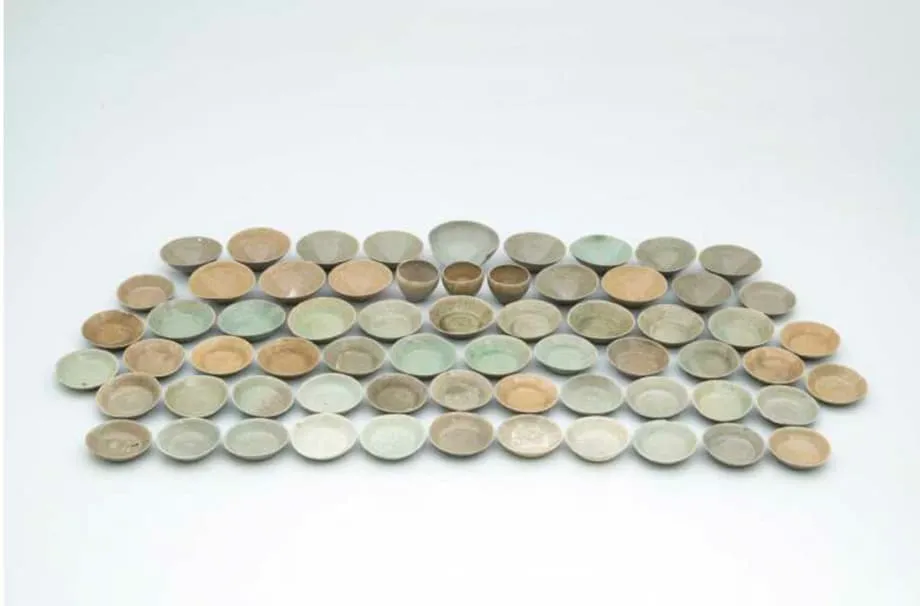
Nearby discoveries extend the story further back. Archaeologists recovered 87 celadon objects associated with a possible Goryeo era wreck, provisionally called Mado 5. Dated to roughly 1150 to 1175, the ceramics could help identify Korea's oldest known shipwreck if the objects and surrounding remains are confirmed as a single wreck site.
How Rice Kept the Government Running
Rice was central to state finance in early Joseon. Many households paid taxes in grain, known as segok, which officials collected at regional warehouses before arranging transport to the capital. Grain supplied offices, paid soldiers and fed laborers, making the movement of rice a basic task of government.
The transport system, called joun, combined sea and river routes with seasonal schedules and official supervision. It organized ships, crews, manifests and sailing times. Wooden tags and registers helped officials track consignments as they moved between provincial depots and warehouses serving the capital.
Mado 4 provides the first physical evidence of a segok transport ship tied directly to that system. Its cargo and route place it within an administrative network carrying tax rice, tribute ceramics and other official consignments, rather than a private commercial voyage.
An official at the National Research Institute of Maritime Cultural Heritage described the ship as evidence of how the early government carried out its daily work:
This is not just a ship. It is the physical infrastructure of the Joseon state coming back to light. It reveals how an early bureaucracy moved food, goods, and information over long distances.
The recovered vessel makes that infrastructure something researchers can measure. Its timbers show how a freight carrier was built and maintained, while its cargo labels connect the ship to named government facilities. Together, those details turn a description in historical records into a specific journey with a departure point, destination and administrative purpose.
What the Labels and Ceramics Reveal
More than 120 artifacts had already been brought up during the investigation. The cataloged finds include 63 wooden cargo tags and 152 pieces of buncheong ware, a type of Korean ceramic, intended for royal service and high officials. Other finds include containers that once held state rice.
The wooden tags bear inked information identifying the departure and destination. They name Naju and Gwangheungchang, linking a provincial grain depot to one of the capital's major landing and storage facilities. At Gwangheungchang, tax grain could be counted, processed and distributed.
Some ceramic pieces carry markings connected to the Naeseomsi, the royal office responsible for food and drink for the court. Those markings add another administrative link to the route recorded on the cargo tags. Rice, labeled consignments and ceramics prepared for government use show several parts of the state supply system traveling together.
Timber beams used to brace the cargo were also recovered. Along with the rice containers, they show practical arrangements for keeping a heavy load stable and protecting grain from water during travel through tidal seas. Stowage mattered because movement inside a loaded vessel could make an already difficult passage more dangerous.
The crew's routines are not directly recorded. The surviving equipment nevertheless suggests disciplined loading and careful storage, work that supported the ship's wider purpose of delivering food and goods to the capital.
A Difficult Coastal Passage to Hanyang
The route from Naju took the ship along a coast of strong tides, rocky passages and shallow water. Taean's narrow channels and reefs posed particular dangers. Currents could change quickly, while poor weather reduced visibility and made hidden hazards harder to avoid.
Official vessels commonly followed coastal routes, stopping for shelter and resupply. Islands and channels offered places to pause, but those same passages could trap a ship when currents shifted. Navigating close to land therefore offered practical advantages while keeping vessels near rocks, shallows and fast water.
Researchers believe these conditions likely caused Mado 4 to sink. Sand and silt subsequently covered the remains, helping protect the hull on the seabed. The exact circumstances of the loss have not been established.
Mado 4's destination also explains why this difficult route mattered. Gwangheungchang stood at Mapo on the Han River, where goods arriving by water could enter the capital's storage and distribution system. A successful voyage connected agricultural production in the southwest with the people and offices that depended on grain in Hanyang.
Two Masts and an Unexpected Repair Material
Mado 4's twin mast arrangement offers a rare view of early Joseon shipbuilding. Earlier Korean ships often had a single mast. On this vessel, the mast positions appear to have been near the bow and the center, spreading the force of the sails across two points.
Two masts can provide a flexible sail arrangement without relying on one tall mast. Researchers associate the layout with greater speed and control in rough water. For a ship carrying heavy rice and ceramics through narrow channels, balancing the vessel under different loads would have been useful.
The arrangement also gave a captain more ways to adjust the sails. In strong tides, a crew could reduce or lower a forward sail while keeping the main sail working to maintain progress. Reversing the arrangement could help the vessel turn. Adjustments of this kind could help control the bow, respond to crosswinds and reduce the space needed to change direction.
Iron nails found in repaired sections provide a different kind of evidence about the ship's working life. The main structure still used wooden joints, numerous small pegs and horizontally laid planks for strength. Metal appeared in later repairs, showing that traditional construction methods could be combined with another material when damage needed attention.
A split plank or an opening seam could be reinforced with nails by a smith and shipwright. The repairs suggest practical adaptation during service and broaden the evidence for the materials available to craftsmen in the early fifteenth century. They also give researchers a way to reconsider assumptions about how Korean vessels were maintained.
Recovering a Hull Preserved in Layers
Archaeologists investigated Mado 4 for years before lifting the hull. During earlier work, they recovered artifacts and covered exposed timbers with sand to protect them from currents and organisms. That protection helped keep vulnerable wood sheltered while the investigation continued.
In the most recent campaign, teams recovered 107 wooden structural components before raising the remaining hull. On the starboard side, the right side of a vessel when facing forward, planking survives up to 11 layers high. That degree of survival gives researchers substantial evidence of the ship's shape and construction.
The surviving structure allows close study of how timbers were joined and how the hull could flex under load. Its dimensions, about 12 meters by 5 meters, provide a physical framework for examining the relationship between the cargo space, the planking and the mast positions.
Tool marks, timber studies and the repaired sections will provide further opportunities to compare the ship with written accounts of Korean shipbuilding. Mado 4 brings construction, cargo and administrative labels together in one archaeological site, allowing researchers to study the vessel's working role as well as its design.
Why Preservation Will Take About 15 Years
The raised wood now faces a lengthy conservation process in Taean. Timber that has remained underwater for centuries needs careful treatment after recovery because drying can cause it to warp or crack.
Desalination comes first. Long baths draw salt and minerals out of the wood. Conservators then stabilize the timbers so they can eventually dry without losing their shape. Treatment can include controlled humidity and gentle chemicals that replace water within the wood's cellular structure.
The National Research Institute of Maritime Cultural Heritage estimates that full restoration of the hull will take about 15 years. The slow timetable is consistent with other large maritime conservation projects, where protecting the original material takes precedence over a quick display.
Visitors can already see selected artifacts at the Taean Maritime Museum. Its special exhibition, The Nation's Ship That Sailed the Sea, opened in September 2025 and is scheduled to continue through February 2026. Cargo tags, ceramics and rice containers give the public a direct connection to the voyage while treatment of the hull proceeds nearby.
Mado 5 Could Reach Further Back Into Goryeo History
The survey associated with the Mado 4 recovery also located evidence of another possible wreck in nearby waters. Sonar mapping and underwater dives found two bundles of celadon ceramics, a wooden anchor and a log used to support cargo.
Researchers date the 87 celadon items to the mid twelfth century, roughly 1150 to 1175. The group includes plates, bowls and cups, with some pieces carrying pressed relief designs. Forms resembling spinning tops and conical hats are associated with styles of that period.
The cargo composition suggests tableware that may have been intended for officials of middle or lower rank, along with staples such as grain. Goryeo celadon was prized across East Asia, and the find offers a possible view of how such goods traveled alongside everyday supplies.
Archaeologists refer to the potential site as Mado 5. If confirmed as a single wreck, it would be the oldest known shipwreck found in Korea, predating Mado 4 by more than two centuries. A full excavation could use the wooden anchor and associated timbers to help reconstruct the vessel's size and construction.
The surrounding corridor has already produced Mado 1, Mado 2 and Mado 3, which date to the early and middle thirteenth century. The newer ceramics point to organized movement of goods through the Mado strait even earlier, before Joseon unified and systematized coastal transport.
Why So Many Ships Lie Off Taean
Taean's maritime archaeology reflects the same geography that once challenged its sailors. The west coast is shallow, and channels between islands funnel tidal water into strong currents. Hidden rocks and shifting sandbars add further hazards, especially during bad weather.
Sailors who stayed near the coast for safety still had to pass through narrow waterways where small navigation errors could have serious consequences. After a sinking, however, sediment could quickly cover a wreck and help preserve wood and cargo. The conditions that endangered ships also helped protect traces of them.
Historical accounts describe the Mado strait as a common stopping place for tribute and tax vessels. Ships could take shelter, transfer goods or wait for a storm to pass. Records note that around 200 ships went down in the Taean region between 1392 and 1455.
Local fishers found a wreck in 2007, bringing renewed attention to the area's underwater heritage. A discovery that year yielded a large quantity of Goryeo celadon. More than a dozen shipwrecks have since been documented in a corridor that supported state finance, court culture and domestic distribution across centuries.
The main dates place the discoveries within a much longer history:
- Roughly 1150 to 1175: The production period assigned to the celadon associated with the possible Mado 5 wreck.
- Early and middle thirteenth century: The periods associated with Mado 1, Mado 2 and Mado 3.
- 1392 to 1455: The period during which historical records note around 200 ship losses in the Taean region.
- Around 1420: Mado 4 sank while carrying tax grain and official goods toward Hanyang.
- 2007: Local fishers found a wreck, and a discovery off Taean yielded a large quantity of Goryeo celadon.
- 2015: The Mado 4 site was first detected.
- September 2025 to February 2026: The scheduled run of The Nation's Ship That Sailed the Sea at the Taean Maritime Museum.
A Working Example of the Joseon Supply System
Mado 4 connects several kinds of historical evidence that are often studied separately. The tags identify a route, the cargo shows what the state transported, and the hull reveals the construction and repairs of a ship carrying out that work.
The twin masts suggest attention to speed and maneuverability on difficult coastal routes, where official vessels needed to keep schedules. Iron repairs show a practical approach to maintenance, combining established wooden joinery with metal reinforcement where it was needed.
Further examination of timbers and tool marks can help researchers check written sources and refine the chronology of materials and methods. Study of the nearby Goryeo ceramics could add another chapter to the same coastal corridor's history, extending the record of organized maritime transport further into the past.
Key Points
- Mado 4 sank around 1420 and has been raised off Taean after a decade of research and conservation.
- It is the first fully excavated Joseon era ship recovered in South Korea and provides physical evidence of the joun tax transport system.
- Its cargo tags connect Naju with Gwangheungchang in Hanyang, now Seoul.
- Finds include 63 wooden cargo tags, 152 pieces of buncheong ware, rice containers and cargo braces.
- The hull had twin masts and iron nails in repaired sections, the first confirmed metal fasteners on a traditional Korean vessel.
- The surviving hull measures about 12 meters by 5 meters, with starboard planking preserved up to 11 layers high.
- Full restoration is expected to take about 15 years. Selected artifacts are on display in Taean through February 2026.
- Nearby, 87 celadon objects dated to roughly 1150 to 1175 may belong to Mado 5, potentially Korea's oldest known shipwreck if confirmed.