New rules cover children in every private car seat
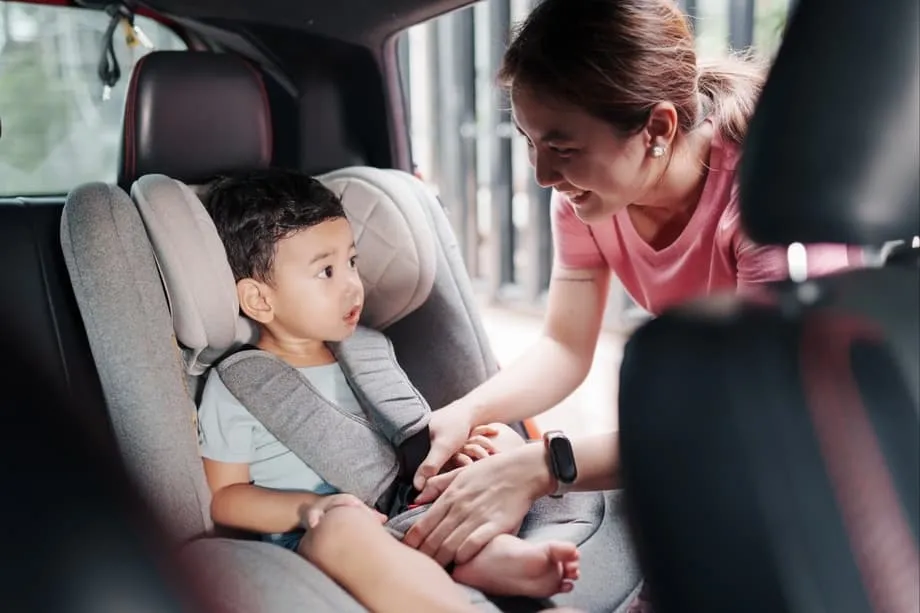
Hong Kong will require children under eight who are shorter than 1.35 metres to use an approved child restraining device in private cars from November 1, 2025. The requirement covers both front and rear seats, with drivers responsible for making sure children are properly secured before setting off.
Contents
- New rules cover children in every private car seat
- How the age and height thresholds work
- Why an adult belt can fit a child badly
- Which devices qualify
- Portable equipment and vehicle compatibility
- How to choose, install and maintain a seat
- Penalties and the two statutory defences
- Taxis, public transport and other vehicles
- School runs, carpools and family preparations
- International practice and official support
- At a Glance
The change, introduced through the Road Traffic (Safety Equipment) (Amendment) Regulation 2024, aims to reduce deaths and serious injuries among children. Drivers who fail to comply face a fixed penalty of HK$230. Serious cases can go to court, where the maximum fine is HK$2,000.
Children who have reached their eighth birthday or are at least 1.35 metres tall may use an adult seat belt or a suitable child device. For the mandatory child device rule to apply, a child must meet both conditions: being under eight and shorter than 1.35 metres.
Private cars accounted for about 43 percent of accidents in which children under eight were injured or killed in 2021, rising to around 60 percent in 2024. That is an increase of about 17 percentage points. The figures help explain why the government is extending protection for young passengers.
International and local studies indicate that correctly fitted restraints can greatly reduce the risk of death or serious injury. In head on collisions, the reduction can be roughly 70 percent. A suitable seat or booster helps direct crash forces towards stronger parts of a child's body while keeping the head and torso better supported.
With the requirement starting on November 1, families, caregivers and drivers need to check children's measurements, choose approved equipment and understand how it fits their vehicles.
How the age and height thresholds work
The law gives drivers two measurements to check: age and height. A child who is under eight and below 1.35 metres must use an approved child restraining device. Once either threshold is reached, an adult seat belt is permitted, although a suitable child device remains an option.
The requirement applies wherever the child sits in a private car. Moving a child from the front passenger seat to a rear seat does not change the driver's duty. If a child needs a device and is not secured in one, the driver must not drive the car.
Families should measure children without shoes, using a flat surface against a wall. For a child near the 1.35 metre threshold, continued use of an approved booster or safety seat is encouraged because the way the belt fits the body remains central to protection.
An adult belt fits properly when its lap section sits low across the hips, its shoulder section crosses the middle of the chest, and the child can sit back with knees bending comfortably at the edge of the seat. If those conditions are not met, continued booster use helps position the belt correctly.
Children with larger builds may outgrow a seat with a harness earlier than other children. They may still need a booster, with or without a high back, until the adult belt fits their hips and shoulder properly.
Why an adult belt can fit a child badly
Adult seat belts are designed around adult shoulders and pelvises. On a smaller child, the lap section can ride up onto the abdomen instead of resting across the hips. During a crash, that position increases the risk of internal injuries.
The shoulder section can also cross a child's neck instead of the chest, increasing the risk of head and neck injuries. A suitable child restraint changes the belt's position and supports the head and torso in ways an adult belt alone cannot provide for a smaller body.
A child who is unrestrained continues moving forward at the vehicle's speed when the car stops suddenly, including at urban speeds. A correctly used device helps spread the forces through stronger parts of the skeleton and keeps the head within a safer space during front and side impacts.
For infants and toddlers, a seat facing the rear protects the head and neck by spreading crash forces across the child's back and the seat shell. Families should keep children facing the rear for as long as the seat's permitted size range allows.
Short journeys also require restraints. Crashes commonly occur close to home and at urban speeds, so a familiar route or a quick pickup does not remove the need to buckle up.
Which devices qualify
The Transport Department recognises several types of child restraining devices that meet specified safety standards. Families can choose from seats facing the rear for infants and toddlers, seats facing forward for older toddlers and young children, boosters with high backs, and boosters without backs for larger children.
Portable options include approved seat belt adjusters, wearable safety restraint vests and foldable boosters. Every device must meet a recognised standard and carry permanent markings confirming compliance. The product's label and instructions must also match the child's size.
Recognised standards include European ECE R44 and ECE R129, the United States standard FMVSS 213, the Australian and New Zealand standard AS NZS 1754, and relevant Japanese and Chinese standards. The recognised framework also includes specified British and European requirements.
ECE R44 and ECE R129 labels identify approved weight or height ranges and testing categories. Products certified to FMVSS 213 or AS NZS 1754 carry permanent markings and manuals explaining correct use. Families should avoid buying a device if its compliance label is missing or unreadable.
The Transport Department's child restraint guidance provides examples, selection advice, standard labels and diagrams showing correct belt routing. Its advice helps families check both the product's approval and how it should be used.
Portable equipment and vehicle compatibility
Seat belt adjusters and wearable restraint vests can improve belt fit on short, occasional journeys and provide better protection than travelling without a restraint. They generally offer less protection from side impacts than a full child safety seat or a booster with a high back.
For frequent journeys, a device with side bolsters and head support provides better protection. Foldable boosters can be useful for occasional trips, while a spare portable device may help when collecting a friend's child or dealing with an unexpected change of plans.
Many modern child seats use ISOFIX, an anchorage system that connects the seat to compatible fittings in the car. Families should ask the retailer or supplier whether a particular model is approved for their vehicle and follow the installation manual.
Some infant seats can also clip into a compatible stroller, making transfers easier. Convenience still depends on choosing compatible equipment and checking that the seat is correctly attached whenever it is returned to the car.
A second base or a portable booster can help households using more than one vehicle. Each arrangement still needs to suit the child, the particular device and the car in which it will be used.
How to choose, install and maintain a seat
A child's height and weight should guide the purchase, with age used only as a rough guide. Every product specifies a suitable range. A device that is too large may position the belt incorrectly, while one that is too small may leave the head and torso inadequately protected.
Children commonly progress from a seat facing the rear to one facing forward, then to a booster with a high back, and finally to an adult belt when it fits correctly. Parents should check the limits on the product label rather than change devices simply because a child has reached a particular birthday.
Before the first trip, read the manual, fit the device firmly and perform a tug test where the belt passes through it. The installed seat should move only a small amount. Use tether anchors where provided and check that all anchors and tethers are secure before setting off.
For an ISOFIX installation, both plastic guides should be seated and both latches must click fully into place. If a lap and shoulder belt secures the child seat, route and lock it as the manual directs, then check the installation again after a short drive.
Secondhand seats should be avoided unless their full history is known. A collision can damage a device internally even when its shell appears intact, and parts may stretch or warp. Manufacturers usually advise replacing a seat after a crash.
Cleaning also needs care. Follow the manual for covers and straps because strong chemicals can weaken materials. Accessories that were not supplied with the product can interfere with its performance in a crash and should not be added.
If a child falls asleep, check the harness tension and head position before moving off. Stop to make any necessary adjustments during the journey. Loosening the harness for comfort allows more forward movement in a crash.
Penalties and the two statutory defences
Police may issue a HK$230 fixed penalty notice when a driver allows a child to travel without the required device or seat belt. Serious cases, including repeated failures to comply or cases involving injury, can be taken to court, where a fine of up to HK$2,000 may be imposed.
The legal duty rests with the person driving. Parents, relatives and other caregivers should therefore agree on the necessary equipment before a journey, particularly when a child will travel in someone else's car.
The Transport Department has highlighted two statutory defences. A driver will not be guilty if the driver reasonably believed the child was at least eight years old or at least 1.35 metres tall. A defence also applies when a child was transported in an emergency and there was no time to arrange a suitable device.
Those provisions address limited circumstances. Routine journeys should be planned around having the correct restraint available. Keeping a portable booster or wearable restraint vest can help drivers prepare for unexpected pickups, provided it meets approved standards and suits the child.
Taxis, public transport and other vehicles
The new child device mandate applies to private cars. It does not extend the same requirement to taxis, franchised buses or other public transport. Existing seat belt obligations continue to apply.
Where belts are fitted, passengers, including children who meet the belt fit threshold, must buckle up. Parents using taxis may wish to carry an approved portable booster or wearable restraint vest to improve a child's belt fit.
Existing legislation also contains a longstanding rule for certain other vehicles. A child aged two or less travelling in the front passenger seat of a private light bus or a goods vehicle must use a child restraining device.
Trips booked through ride hailing services are covered when the vehicle is a private car. Drivers on those platforms should be prepared to refuse a journey when a child needs a restraint and a suitable device is unavailable.
School runs, carpools and family preparations
Families should confirm children's measurements and obtain suitable devices before November 1. Grandparents and other caregivers need to know how to fit the equipment, adjust harness height and route the belt correctly.
Carpools require enough suitable devices for every child who needs one. Planning seat assignments in advance helps drivers avoid reaching pickup time without the right equipment. Spare devices for visiting relatives, or a portable booster kept in the boot, can make changes easier to manage.
Schools and activity centres that depend on private car transport should review their pickup arrangements. A policy that children travel only when suitable restraints are available removes pressure on drivers to make exceptions during busy collection periods.
The main dates and developments are:
- 2021: Private cars accounted for about 43 percent of accidents involving children under eight who were injured or killed.
- 2024: That share reached around 60 percent. The Road Traffic (Safety Equipment) (Amendment) Regulation 2024 provided the basis for the new requirement.
- October 30, 2025: Families and drivers are preparing for the approaching start date.
- November 1, 2025: The new child restraint requirement takes effect in private cars.
International practice and official support
Hong Kong's change brings its rules closer to practices in the European Union, Japan, Singapore and several mainland Chinese cities. European countries regulate child restraints by height and weight under ECE rules, while Japan, Singapore and several mainland cities require seats or boosters until specified age or height thresholds are reached.
The United Kingdom introduced similar rules in 2006. Hong Kong's threshold of eight years of age or 1.35 metres follows a common approach of using a child's age or size to determine when an adult belt may be used.
Recognition of European, American, Australian and New Zealand standards, alongside relevant Japanese and Chinese standards, gives families a broad range of compliant products. The practical task remains choosing one that fits the child and can be installed correctly in the vehicle.
The Transport Department has said it will work with Police and the Road Safety Council on publicity and education. It is also coordinating with the Consumer Council to improve product information for the public.
Parents and drivers are encouraged to follow installation instructions and consult retailers or manufacturers when uncertain. Official updates and educational posts are available through the Transport Department's social media, and enquiries can be made through its hotline on 2804 2600.
At a Glance
- The new requirement starts on November 1, 2025, under the Road Traffic (Safety Equipment) (Amendment) Regulation 2024.
- Children under eight who are shorter than 1.35 metres must use an approved child restraint in private cars, in front or rear seats.
- Children aged eight or above, or at least 1.35 metres tall, must use an adult belt or a suitable child device.
- Drivers are responsible for compliance and face a HK$230 fixed penalty or a court fine of up to HK$2,000 in serious cases.
- Statutory defences cover reasonable belief about age or height and emergencies leaving no time to arrange a device.
- Approved options include child seats, boosters, belt adjusters and wearable restraint vests. Portable devices generally offer less side protection than full seats or boosters with high backs.
- Taxis and public transport are outside the new child device mandate, while existing seat belt rules remain applicable.
- Ride hailing journeys in private cars are covered. Transport Department enquiries can be made on 2804 2600.