Movie memories bring visitors through historic doorways
Hong Kong is opening some of its best known film locations to visitors, connecting scheduled heritage tours with a new exhibition that recreates the world of Twilight of the Warriors, Walled In. The attractions range from University Hall, a Gothic Revival mansion dating to the 1860s, to Kowloon Walled City Park, where a free exhibition is planned to run for three years.
Contents
- Movie memories bring visitors through historic doorways
- University Hall opens a window on several eras
- A coffin home tells a story of migration
- What is planned for Yau Ma Tei's former police station?
- Kowloon Walled City returns through recreated film sets
- Beyond the galleries, a neighborhood visit takes shape
- Local box office successes give tourism fresh momentum
- Different visitors need different stories
- Historic interiors need limits on access
- Japanese interest and a practical route through the city
- Macau links and cultural events could extend visits
- Key Points
As of October 20, 2025, the Former Yau Ma Tei Police Station is also preparing to welcome the public later in the year. Plans include a recreated report room, access to old cells and photo opportunities using augmented reality, technology that adds digital images to a view of the real world.
The openings form part of a broader effort to bring travelers into Hong Kong's neighborhoods and cultural sites. Authorities identified nine new tourism hotspots and experiences in 2025, with culture, history and several film connections at their center. The approach gives visitors reasons to look beyond the skyline and shopping malls and spend time around local businesses.
Recent cinema successes have helped create that opportunity. A Guilty Conscience earned about HKD 115 million in 2023, Twilight of the Warriors, Walled In took about HKD 112.9 million in 2024, and The Last Dance finished 2024 above HKD 150 million. Arrivals from Japan rose by roughly 35 percent between January and August 2025, alongside strong interest in the city's film settings.
City agencies, universities, museums, heritage managers and tour operators are working together to arrange access. Some programs offer free guided walks in Cantonese and English, while special opening days, advance registration and timed admission help manage demand. The central attraction is straightforward: visitors can connect a familiar screen scene with a real building, then learn the history beyond the camera frame.
University Hall opens a window on several eras
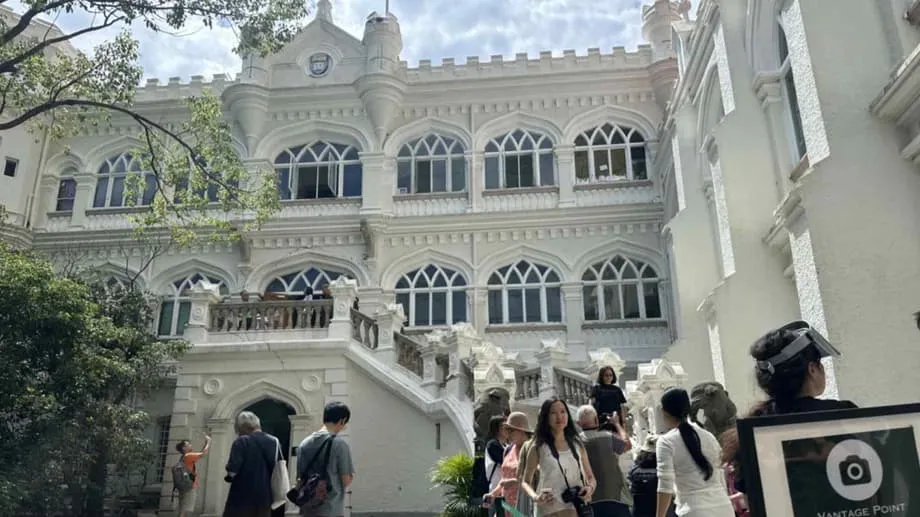
University Hall at the University of Hong Kong offers more than a recognizable movie backdrop. The mansion began as a trader's residence in the 1860s, later became a monastery and now serves as a student hall. Its architecture and changing uses bring together different periods of the city's history.
The building appeared in the 1990 film Kawashima Yoshiko. During special open days, visitors can enter areas normally reserved for residents and hear how filmmakers used its corridors and staircases to create atmosphere. Guides also explain how the building developed across its time as a home, religious institution and university residence.
Places are limited, and visitors must register in advance when tours are announced. Small groups help protect delicate interiors while allowing people to inspect architectural details that would be difficult to appreciate from outside. Because the building remains a student residence, access is arranged around its continuing everyday use.
A coffin home tells a story of migration
The Tung Wah Coffin Home combines a film connection with a history rooted in families separated from their ancestral homes. The complex, a declared monument, once safeguarded coffins and relics while families waited for their return to those homes.
Its purpose offers a direct way to understand the migration patterns that shaped Hong Kong. People could move away for work or a new life while retaining strong ties to the places their families came from. The coffin home served those connections at a deeply personal moment.
Recent productions have used its quiet courtyards and timber halls for dramatic scenes. Tours explain both the choices made by filmmakers and the institution's social history, giving visitors two connected stories to follow. The setting becomes more meaningful when a familiar image is placed alongside the experiences of the families the complex served.
University Hall and the Tung Wah Coffin Home show why these programs rely on scheduled access. The appeal comes partly from entering places that are usually restricted, but their roles as a residence and a protected heritage site require careful management.
What is planned for Yau Ma Tei's former police station?
The Former Yau Ma Tei Police Station is scheduled to open to the public by late 2025. Familiar to viewers of Hong Kong crime films, the compound is set to become another place where screen memories meet the city's institutional history.
Visitors will be able to step through a recreated report room and look into old cells. Planned augmented reality photo spots will add actors and props to the frame, allowing people to create images that combine the historic setting with digital elements.
Displays are planned around classic police films, along with a souvenir corner. The compound is also being considered as a possible permanent home for the Police Museum. Tickets and tours will be offered through a new program presenting the heritage of Hong Kong's disciplinary services.
Exact schedules and capacity rules had not been announced as of October 20. Those details are expected closer to the launch, so visitors planning an autumn or winter trip will need to check the opening arrangements before including the station in their route.
Kowloon Walled City returns through recreated film sets
Kowloon Walled City, A Cinematic Journey is the largest new attraction for travelers drawn by Hong Kong films. The free exhibition brings replica sets from Twilight of the Warriors, Walled In into the park occupying the former Walled City's footprint.
Eight galleries are integrated into blue brick structures around the Yamen, the park's restored administrative building. Visitors enter through the South Gate and encounter detailed recreations of small businesses, including a traditional barber, a streetside cafe, a fish ball workshop, a grocery, a dental clinic and a Chinese medicine hall.
The route continues through a narrow alley interior to a rooftop space using light and shadow, where a short film plays. Together, the spaces turn the film's production design into something visitors can walk through, rather than view only on a screen.
The exhibition is planned to run for three years. Admission uses timed sessions and free tickets, with small group sizes to control the flow through the displays. Optional guided tours explain both the making of the film's settings and everyday life in the original community.
Kowloon Walled City was known for its maze of lanes, wiring strung by hand and busy informal economy. It was also home to a close community. Following the Sino British Joint Declaration, authorities cleared the area and resettled more than 33,000 residents in the early 1990s.
The exhibition brings those human experiences into a visit often prompted by the film. Recreated shops show the kinds of work and daily routines that helped sustain the neighborhood, while the galleries recognize the craft involved in bringing that world back to the screen.
Beyond the galleries, a neighborhood visit takes shape
Kowloon City's film attraction is linked to experiences outside the park. The City in Time project uses augmented reality to let travelers compare today's streets and squares with earlier views by holding up a phone.
Its historical scenes include connections to the former Kai Tak Airport and the vanished Walled City. The digital layer gives visitors a way to picture places that have changed or disappeared while standing in the district where those histories unfolded.
Curated food walks introduce Kowloon City's Thai community and Chiu Chow eateries. A visit can therefore continue from recreated businesses in the exhibition to restaurants and shops serving the neighborhood today. The wider tourism effort aims to direct spending toward small shops, craftspeople and eateries that keep these areas active.
The geography of the new programs stretches from Central and Western District to Kowloon City. Rather than treating each film location as an isolated stop, the approach connects buildings with nearby streets, food and local heritage. For visitors, that makes the attraction part of a longer neighborhood experience.
Local box office successes give tourism fresh momentum
Hong Kong's film tourism rests on a cinema tradition that reached audiences across Asia and beyond. During the 1980s and 1990s, the city produced hundreds of films a year and helped shape action, crime and comedy genres. Directors, stars and stunt teams became household names.
Production slowed in the 2000s as costs rose and the local market became smaller. Recent successes have brought renewed energy, providing recognizable films around which visitor experiences can be built. Regulatory changes have also altered the landscape for filmmakers, while cinema remains central to the city's cultural identity.
A Guilty Conscience crossed HKD 100 million in 2023 and ended its run at about HKD 115 million. Twilight of the Warriors, Walled In earned about HKD 112.9 million in 2024 and attracted attention at Cannes. The Last Dance finished that year above HKD 150 million, setting a record for a Cantonese language title.
The Last Dance's total was more than HKD 35 million above the approximately HKD 115 million earned by A Guilty Conscience. Those figures help explain the renewed attention to local cinema and the opportunity to connect successful films with places visitors can explore.
The developments span several periods:
- 1860s: University Hall's building began life as a trader's residence.
- 1980s and 1990s: Hong Kong produced hundreds of films annually during its cinema's golden era.
- 1990: University Hall appeared in Kawashima Yoshiko.
- Early 1990s: More than 33,000 Kowloon Walled City residents were resettled during clearance of the area.
- 2023: A Guilty Conscience passed HKD 100 million and finished at about HKD 115 million.
- 2024: Twilight of the Warriors, Walled In earned about HKD 112.9 million, while The Last Dance finished above HKD 150 million.
- 2025: Authorities identified nine new tourism hotspots and experiences, with the Former Yau Ma Tei Police Station scheduled to open by late in the year.
Streaming platforms and social media make Hong Kong films easier to discover from abroad. Travelers can arrive already familiar with scenes set among Central's streets, stairways along the slopes and the tong lau shophouses of Sham Shui Po. Linking those settings with their screen appearances adds another way to explore the history carried by the buildings.
Different visitors need different stories
Research on travel inspired by films and heritage identifies four broad types of visitor. Their interests range from finding exact camera angles to enjoying a historic building with little reference to cinema.
- Vigorous Followers seek every connection to a favorite film and want guides to match scenes with precise viewpoints.
- Curious Investigators enjoy film connections but prefer the site's real history to lead the visit.
- Versatile Explorers value both the screen story and the heritage story and move easily between them.
- Purposeful Avoiders want a heritage experience with little or no film content.
A tour designed around those differences can begin with a building's origins, identify where a scene was filmed and then explain the work of craftspeople nearby. Each layer gives visitors something useful without requiring everyone to share the same enthusiasm for a particular title.
QR codes on signs could offer more film trivia or architectural detail. Audio guides could provide separate tracks for cinema and community history, while printed information would support people who prefer to explore independently. Multiple languages would make those choices accessible to more visitors.
Hong Kong's programs already include practical measures such as free guided tours in Cantonese and English, timed sessions and advance registration. Those arrangements make visits easier to organize while helping sites manage numbers.
Historic interiors need limits on access
Many locations involved in the programs are declared monuments or graded historic buildings. Their floors, plaster and timber can suffer when too many people pass through without controls. Managers are using small groups, timed entry and rules for indoor spaces to reduce pressure on the buildings.
Visitors can expect restrictions on bags, food and drink, along with requests to turn off flash photography where it could affect surfaces or disturb others. Guides explain why particular corridors are closed and how features such as staircases have survived generations of use.
Action films also create a safety concern when visitors attempt to recreate scenes on stairways or rooftops. Guides set boundaries and encourage photographs that can be taken safely. Signs and staff help protect visitors while respecting residents, university communities and people who continue to work in these complexes.
Controlled access allows more people to experience these places while preserving their fabric and everyday functions. The ability to enter a familiar film setting depends on keeping that setting fit for future visits.
Japanese interest and a practical route through the city
Arrivals from Japan increased by roughly a third, about 35 percent, between January and August 2025. The growth has accompanied the success of Twilight of the Warriors, Walled In and interest in the recreated sets at Kowloon Walled City Park.
Japanese travelers have long made trips around screen settings, including railway journeys connected with anime and visits to coastal towns associated with television. Hong Kong's dense streets, vintage neon signs and layered markets offer visual detail that can turn a film walk into a day of photography.
Tourism officials are tailoring cultural itineraries that combine film locations, neighborhood food and art events. Partnerships with festivals and galleries add reasons to stay longer. More tours on weekends and public holidays, together with more information in Japanese and Korean, would make short visits easier to arrange.
A sample day can begin at Tai Kwun in Central, the former police compound now housing art spaces and cafes among restored granite and red brick buildings. A walk to PMQ on Hollywood Road brings visitors to studios in former police quarters, another example of historic buildings finding new uses.
University Hall can be added if a special opening falls on the day of the visit, with registration completed beforehand. The trip to Pok Fu Lam brings together architecture, religious history and film memories. Lunch in Sheung Wan or Sai Ying Pun offers a choice of classic noodle shops and newer cafes before a harbor crossing on the Star Ferry.
Kowloon City can fill the afternoon. Visitors can reserve an exhibition session, walk through the park's arches and pavilions, then try Thai dishes or Chiu Chow fish balls at nearby shops that have served the district for decades. The Avenue of Stars in Tsim Sha Tsui provides a waterfront finish, with plaques and handprints honoring film legends against a skyline familiar from many productions. The Former Yau Ma Tei Police Station can join the route after its planned opening.
Macau links and cultural events could extend visits
Hong Kong and Macau officials have been meeting to develop joint promotions that encourage travelers to spend time in both cities. The Hong Kong Zhuhai Macau Bridge supports that effort by linking the destinations with Zhuhai.
Ideas under discussion include cruise routes calling at both harbors, sports events rotating between venues and greater cooperation between the film industries. The aim is to make it easier to book a single itinerary covering two cultures in a weekend, supported by clear information about transport, visas and tickets.
Art events add another reason to combine attractions. Art Basel returns each spring with a program extending across the city, including film activities and collaborations with M plus and Tai Kwun. A traveler could pair a day at an art fair with an evening screening and a heritage visit the following morning.
Coordinating calendars with Macau could encourage longer stays and spread spending among more neighborhoods, shops and small venues. For Hong Kong's cinema attractions, the opportunity is to become part of a broader cultural trip while retaining the local stories that make each stop distinctive.
Key Points
- Hong Kong identified nine new tourism hotspots and experiences in 2025, including attractions connecting film, culture and neighborhood history.
- University Hall and the Tung Wah Coffin Home offer scheduled access linking screen appearances with their architectural and social histories.
- The Former Yau Ma Tei Police Station is scheduled to open by late 2025, with exact visiting arrangements still to be announced.
- Kowloon Walled City, A Cinematic Journey is a free exhibition planned for three years, with eight galleries, timed admission and optional guided tours.
- Recent local hits earned about HKD 115 million for A Guilty Conscience, HKD 112.9 million for Twilight of the Warriors, Walled In and more than HKD 150 million for The Last Dance.
- Arrivals from Japan rose about 35 percent between January and August 2025, alongside interest in Hong Kong film settings.
- Small groups, advance registration and visitor rules help protect historic interiors and respect people using the sites.
- City in Time, neighborhood food walks, art events and proposed Macau promotions connect film attractions with wider cultural visits.