A national technology hub looks beyond Korea
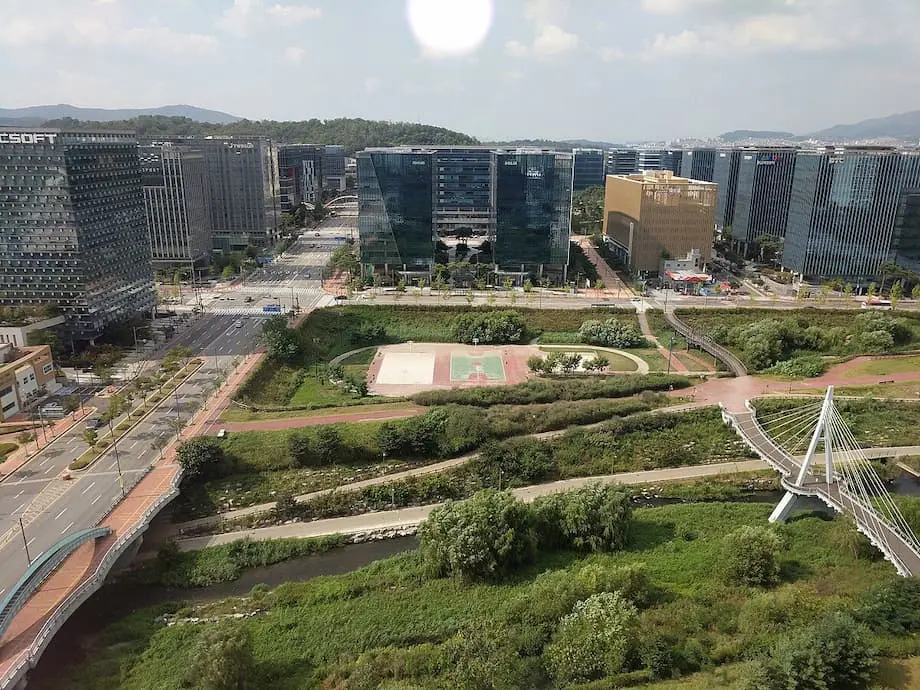
Pangyo Techno Valley in Seongnam brings together more than 1,800 startups, research laboratories and major technology companies across 661,000 square meters. Opened in 2011, the district a short subway ride south of Seoul has become one of South Korea's most concentrated technology centers. Its next challenge is turning that domestic strength into a larger international presence while competing with Seoul's Gangnam for workers and investment.
Contents
- A national technology hub looks beyond Korea
- Why Gangnam is attracting founders
- Faster experiments and a clearer story
- Small companies need experienced neighbors
- COMEUP applications show demand for overseas access
- Investment programs build local connections
- A livelier district builds on gaming strength
- AI, robotics and biotech widen the picture
- Global plans start before the overseas launch
- At a Glance
Naver, Kakao, Samsung Electronics, SK Hynix, HD Hyundai, AhnLab, Nexon, NCSoft and 42dot maintain operations there. Thousands of engineers work in a walkable district that serves as a testing ground for the country's digital economy. The concentration has earned Pangyo the nickname Silicon Valley of Korea.
Official figures cited for the district put small and medium businesses at roughly 91.5 percent of companies, big technology businesses at 3.6 percent, and public or government organizations at 4.9 percent. The mix brings young companies close to established corporate partners, although founders still face limits in access to international capital, experienced mentors and global talent.
Hyoungchul Choi, chief executive of logistics software company Portologics, founded his business in Pangyo five years before September 2025. He values its concentration of companies while urging caution about the California comparison.
Pangyo is absolutely Korea's most concentrated hub for software, gaming, platforms, and AI. The nickname is convenient, but we should not overstate our global influence. Silicon Valley is not just about density, it is built on decades of international capital flows, risk taking culture, and its ability to attract talent worldwide. We are not there yet.
California's Bay Area developed through research universities, defense contracts, deep pools of venture capital and generations of founders who started more than one company. Pangyo has grown quickly and become nationally important. Its international ambitions now depend on building connections and experience alongside its physical concentration.
Why Gangnam is attracting founders
Gangnam's Teheran Street has become a strong draw for startups seeking investors, employees and faster access to business networks. Venture capital firms, incubators and growing companies occupy neighboring buildings, allowing informal meetings to turn into investment discussions and making it easier to meet potential recruits.
Janice Sa, a principal at Z Venture Capital who has worked in Pangyo for more than a decade, describes a change in where young companies want to locate.
With giants like Kakao, Naver, Nexon, and NCSoft all in one place, the title still makes sense. Back then, startups were flocking to Pangyo. Today, many are heading back to Gangnam. Young developers and engineers still gravitate toward Gangnam, and most venture capital firms are packed along Teheran Street. For hiring and fundraising, that makes Gangnam the easier choice.
Pangyo is about 15 minutes away, yet its position outside Seoul, in Gyeonggi Province, matters. Many support programs follow municipal boundaries. Founders seeking international initiatives and a denser network of startup services find more of them inside the capital.
A person working at a Pangyo technology company, whose name was not given, described the district's advantage as proximity to businesses doing related work.
When you are working in tech here, collaboration comes easier, everyone is just around the corner. Seoul is more diverse. Yeouido is Korea's Wall Street, perfect for fintechs, while Gangnam draws startups of every kind.
Yeouido's financial concentration suits financial technology companies, while Gangnam attracts a wider range of startups. Pangyo offers a deeper concentration of particular technology industries. Founders can draw on both places by developing products and building teams in Pangyo while meeting investors and customers in Seoul.
Faster experiments and a clearer story
Korean startups also face pressures that an office move cannot resolve. Investors encouraging international expansion describe a domestic market approaching saturation in categories ranging from consumer applications to software for businesses. Winning customers abroad requires faster testing, a willingness to change direction and a clear explanation of why a product matters.
A Kakao Ventures investor, discussing lessons from investments across national borders, pointed to the speed of American startup activity.
American startups tend to succeed and fail much faster, which fuels constant experimentation and a high rate of talent movement. Speed is a startup's greatest strength, so I try to have open conversations with founders about how to turn failure into opportunity.
The same investor described a weakness that can surface during a brief investment pitch: founders may explain their financial calculations and strategy more readily than the human purpose of their business.
Many Korean founders are sharp on numbers and strategy, but stumble on a simpler question: What is your story? Business is still about people connecting with people. Without a clear, authentic narrative, it is hard to stand out.
A company's story connects the problem it wants to solve with the people who need its product. It helps employees understand their purpose and investors understand why the business could grow. For companies entering the United States, Japan, Europe or China, that explanation must connect a specific customer need with a credible expansion plan.
Founders often have minutes to make an impression. Explaining the problem, the first opening into a market, the team's advantage and the plan for expansion can help a company secure another conversation. When several teams can build similar products, a memorable explanation can open doors for businesses with working technology and evidence of customer demand.
Small companies need experienced neighbors
Pangyo's large share of small and medium businesses supports close networks and opportunities to test products with nearby companies. A pilot project, for example, lets a startup try its technology with a potential customer before pursuing a larger commercial agreement.
Smaller companies can also have fewer experienced founders and mentors nearby who have already taken a business through later stages of growth. Those people can pass on practical knowledge about entering another country, recruiting senior managers and navigating foreign regulatory reviews.
Pangyo's corporate anchors offer potential customers and partners, while its startups provide new products and technical ideas. The district's challenge is to make those relationships useful beyond initial meetings, particularly when a company needs specialist advice or introductions overseas.
International connections matter because domestic success and foreign expansion require different preparations. A startup may need to adapt its product, understand unfamiliar customer expectations and find people who know the rules in its destination market. Local engineering strength gives it a base, while experienced partners can shorten the learning process.
COMEUP applications show demand for overseas access
Seoul's flagship COMEUP startup festival redesigned its Stars program for 2025 around more direct support for overseas expansion. A record 559 teams applied for 20 places offering acceleration tailored to the United States, Japan, China and Europe.
Those figures amount to nearly 28 applicants for each place. Interest was strongest in North America and Japan, and artificial intelligence led the applicant pool by sector. The pattern points to the destinations where participating founders saw promising opportunities for investment and early customers.
The program's focus includes adapting products for local markets, studying those markets and introducing companies to investors abroad. Regionally focused support can help founders work through differences that a general expansion plan might overlook, including how customers buy a product and which business partners can reach them.
Many Korean startups previously concentrated on becoming strong at home before exploring other countries. The demand for COMEUP's overseas tracks suggests that ambitious teams are preparing for international business earlier. If that approach continues, it could change how companies in Pangyo and Seoul plan their products, hiring and fundraising.
Partner houses in destination markets are part of this effort, giving startups more direct access to local networks. Their value lies in connecting founders with people who understand the customers, investors and commercial practices of a particular place.
Investment programs build local connections
The Gyeonggi Center for Creative Economy and Innovation runs a weekly Investor Relations event inside the Pangyo Startup Zone. Investor Relations, often shortened to IR, gives companies an opportunity to explain their businesses and funding needs to potential investors.
The events also seek to connect promising companies with TIPS operators. TIPS is a national program that combines private investment with government support for technology startups at an early stage. These connections can help founders reach both capital and guidance as they develop their businesses.
Recent participants have worked on IT solutions serving markets across borders, systems for checking autonomous driving technology, robotics software and health technology. The range shows a pipeline extending beyond Pangyo's established gaming businesses toward technologies requiring substantial research and engineering.
INNOX and the innovation center have also operated an open innovation program. Such partnerships connect established companies with startups working on new products or technologies. This program offered initial investments totaling 2 billion won and a growth track covering awards, standards and support for overseas showcases.
Competition for the program was intense. The partners plan a new space for founders in a Pangyo building, placing selected startups near mentors, investors and corporate partners. That planned proximity follows the same principle that helped build the district: people can develop working relationships more easily when they meet regularly.
A livelier district builds on gaming strength
Seongnam's Pangyo Contents Street project addresses another part of the competition for talent: what the neighborhood offers beyond office hours. The city launched the project for a pedestrian corridor stretching 750 meters, with play, festival and relaxation zones funded with 4.47 billion won.
The plan draws on Pangyo's gaming heritage and cultural activity to attract visitors and keep the area lively after work. For young engineers and designers choosing where to work, neighborhood life can matter alongside commuting time and office costs.
Gaming remains a major anchor. Gyeonggi Province accounts for more than a third of South Korea's gaming professionals, and recent figures show it contributing a large share of national gaming sales and exports. That concentration gives the wider region a strong position in an industry with customers around the world.
Pangyo's gaming companies also help attract international publishers, esports teams and content creators. Their activity can bring users and revenue into the local economy while keeping the district visible outside Korea.
A timeline shows the district's development and the initiatives surrounding its latest growth ambitions:
- 2011: Pangyo Techno Valley opened in Seongnam.
- About five years before September 2025: Hyoungchul Choi founded Portologics in Pangyo.
- 2025: COMEUP redesigned its Stars program around support for specific overseas markets, attracting 559 applicants for 20 places.
- By September 30, 2025: Local efforts included weekly investor events, corporate partnerships, the launched Pangyo Contents Street project and plans for further research and startup facilities.
AI, robotics and biotech widen the picture
Artificial intelligence now occupies a central place in many new startup pitches. Local universities and laboratories supply people trained in machine learning, while companies working on robotics, autonomous mobility and industrial software are gaining attention alongside healthcare and life sciences businesses.
Korea's manufacturing and materials expertise can help founders in these fields. Their work can require a combination of software, physical products and research, bringing different skills into a district long associated with online platforms and games.
BioPlus illustrates that wider direction. The company selected a site in Pangyo 2nd Techno Valley for a headquarters and integrated research and development center focused on HUGRO, its patented bioactive material based on combinations of growth factor peptides for skin therapeutics.
Peptides are short chains of the building blocks of proteins. BioPlus plans to connect its research with global commercialization from Pangyo, working with academic partners to accelerate development of technologies for health and biology. Its planned center links materials research with the data and clinical validation needed to develop such products.
Success abroad in AI, robotics or biotechnology would give younger companies a wider range of examples to follow. It could attract regulatory specialists and product managers experienced in taking medical devices or AI tools for businesses into foreign markets.
Growth in these sectors can also draw specialist investors from Tokyo, Singapore and Silicon Valley. That would add different kinds of expertise and capital to a district whose best known anchors have largely been platforms and gaming companies.
Global plans start before the overseas launch
Choi identifies three constraints on Korean startups seeking international growth: a domestic market smaller than the United States, Europe or China; less developed ties with global investors; and language or regulatory differences. Each affects the people, money and preparation a company needs.
A smaller home market limits how far a business can grow through domestic customers alone. Weaker investor connections mean founders spend more time establishing trust and finding capital across borders. Language and sector rules can require bilingual staff and advisers familiar with the destination country's requirements.
Founders can prepare early by combining Korean engineering teams with sales and product leaders in their target markets. They can also work with prospective customers abroad, test prices and assess how to sell before committing to a larger launch. COMEUP's regional programs are among the efforts intended to make those connections more accessible.
Choi described both the strengths of Korea's approach and the resources needed to expand internationally.
Unlike in the U.S., where founders often leap into risk and pivot fast, startups here tend to balance ambition with discipline, building proof at home before going abroad. The outcome is dependable engineering, but without the same move fast, break things energy that defines Silicon Valley. What holds Korean startups back from going global? Three key factors are the small size of the home market, weaker global investor ties, and language or regulatory hurdles. Breaking through needs early global partners, deliberate go to market resources, and leaders who think cross border from day one.
Pangyo's strengths and Gangnam's appeal suggest a model built around connections between the two places. Seongnam can remain a center for products, engineering teams and corporate partnerships, while Seoul supplies dense networks of investors, recruits and customers. Making that arrangement work requires founders and support organizations to connect the activities deliberately.
As of September 30, 2025, no opening dates were given for the planned INNOX founder space or BioPlus research center. The broader measure of Pangyo's progress is shifting toward international results: startups reaching unicorn status, exits involving buyers or markets abroad, and a steady flow of global talent. Local concentration has established the district's importance; the next test is how effectively its companies operate beyond Korea.
At a Glance
- Pangyo Techno Valley opened in 2011 and houses more than 1,800 startups, laboratories and technology organizations across 661,000 square meters.
- Roughly 91.5 percent of its companies are small and medium businesses, compared with 3.6 percent classified as big technology businesses and 4.9 percent as public or government organizations.
- Founders and investors describe Gangnam as an increasingly attractive location for recruiting and fundraising.
- COMEUP Stars 2025 received 559 applications for 20 places focused on overseas markets, with AI leading by sector and interest strongest in North America and Japan.
- Weekly investor events, TIPS connections and the INNOX partnership seek to connect Pangyo startups with funding, advice and international opportunities.
- Pangyo Contents Street covers a planned pedestrian corridor of 750 meters, backed by 4.47 billion won.
- Gaming remains a major strength as Pangyo expands into AI, robotics, autonomous mobility, industrial software, healthcare and biotechnology.
- BioPlus plans a headquarters and research center in Pangyo 2nd Techno Valley focused on HUGRO.
- International expansion requires stronger investor relationships, preparation for language and regulatory differences, faster experimentation and a clear business story.