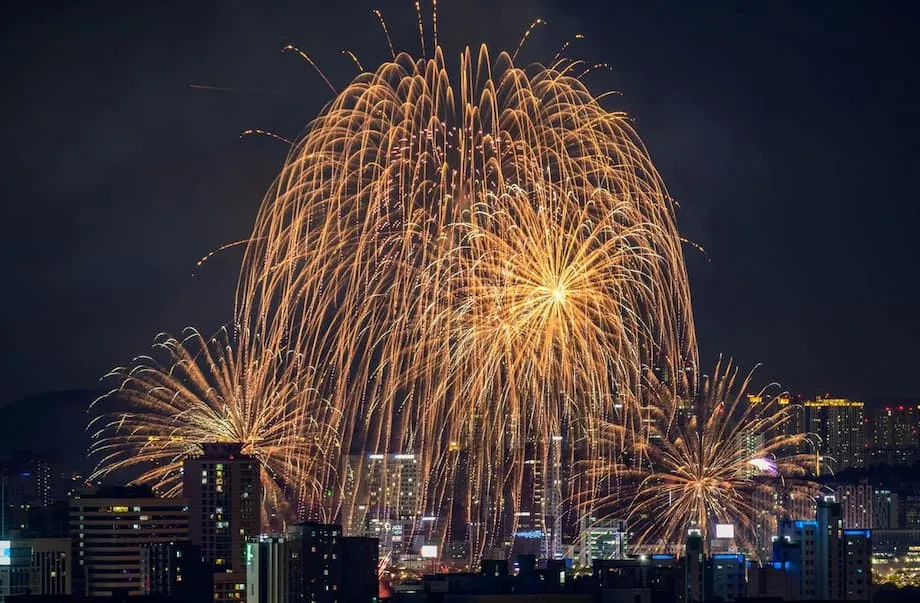
A million spectators expected along the Han River
More than one million people are expected along both banks of the Han River on Saturday, September 27, 2025, when the Seoul International Fireworks Festival returns to Yeouido Hangang Park. Italy, Canada and Korea will present displays beginning at 7 p.m., with a new mirrored arrangement around Wonhyo Bridge intended to bring synchronized highlights to a wider stretch of the river.
Contents
- A million spectators expected along the Han River
- How the mirrored display will work
- Italy, Canada and Korea tell three musical stories
- The safety operation extends across the riverfront
- Road closures and buses will change travel plans
- More subway trains, but possible limits at Yeouinaru
- Free viewing and reserved seating have different rules
- Where to watch beyond the main lawns
- Prime views are driving resale concerns
- A timetable for the festival weekend
- Practical preparations for a safer evening
- What to Know
Hanwha Group is staging the free festival with broadcast partner SBS and support from the Seoul Metropolitan Government. Activities begin at 1 p.m. across Yeouido, where brand booths, interactive zones and live entertainment will precede the evening fireworks. Pauses between the national teams will allow time for music and crowd guidance.
September 27 is earlier than the festival's usual date, the first Saturday of October. Chuseok falls in the first week of October this year, bringing heavy family travel and holiday traffic. Moving the fireworks to late September reduces the overlap with nationwide travel and allows city services to concentrate on the festival operation.
Yeouido and Ichon are expected to attract early arrivals seeking prime riverbank spaces. The expanded display stretches from Mapo Bridge in the west to the Hangang Railway Bridge in the east, but popular viewing areas will still have capacity controls. Organizers and city officials are urging visitors to plan both their arrival and their journey home.
The preparations cover far more than the performance itself: more than 3,700 safety and crowd control workers, additional subway trains, road closures, bus diversions, temporary toilets and restrictions on some riverfront destinations. For spectators, choosing a viewing area also means choosing a practical route out after the show.
How the mirrored display will work
Wonhyo Bridge will sit at the center of a new staging concept described as a decalcomania effect. In simple terms, the Han River becomes an axis for matching fireworks sequences, with identical effects launched in sync from multiple positions around the bridge and extending toward Mapo Bridge and the Hangang Railway Bridge.
The intended result is matching burst types, colors and heights on opposite sides of the bridge within milliseconds, all aligned with the same musical timing. This is the festival's first use of the mirrored concept at this scale. It aims to let spectators across a broader area see the same highlights, including locations that previously had less favorable viewing angles.
Digital controllers at each firing position connect to a master clock that also cues the soundtrack. That shared timing allows separate launch sites to act together. The precision matters because a mirrored sequence depends on matching moments across the river, rather than simply sending fireworks into the sky at roughly the same time.
Safety distances are mapped around the launch positions so material falling from large shells lands in controlled zones on the water or cleared areas on shore. If the wind changes, teams at the site can pause launch segments while keeping the music timeline ready to resume.
The wider arrangement improves sightlines across Yeouido, Ichon, Noryangjin and parts of Mapo District. Yeouido remains the strongest option for a close view, while more distant locations can frame the bridges and skyline together. Access to popular areas can change during the event as staff respond to crowd levels.
Italy, Canada and Korea tell three musical stories
Italy opens the program with a tribute to composer Ennio Morricone. His film music will accompany aerial shells that blossom and fade over long notes, with delicate gold willows, strobing comet runs and layered timing following the suspense in the score.
Canada follows with a superhero theme built around blockbuster soundtracks. Large percussion passages and recurring heroic musical themes are suited to rapid volleys, sequences that race along the water and fans of fireworks sweeping across the skyline in bold primary colors.
Korea's finale, Into the Shining Time, uses a journey through time and a new narrative style. The sequence moves from quiet reflection toward a faster celebration. Its creative team has described a Golden Hour motif, with warm colors and changing shapes marking the passage of time.
The Korean display is set to close with salvos at high altitude designed to fill the width of the river corridor. Across the three teams, sweeping film scores and pop anthems will turn the fireworks into a musical performance rather than a succession of unrelated bursts.
These displays, often called pyromusicals, use a time code that locks each firing cue to the soundtrack down to hundredths of a second. Computerized firing systems limit timing drift, while the fireworks are chosen partly for how long they burn.
A compact sequence of individual bursts can mark drumbeats. Large shells that burst several times can spread their effects across several measures of music. The choreography may feel spontaneous to spectators, but its cues are calculated and rehearsed in advance.
The safety operation extends across the riverfront
More than 3,700 safety and crowd control staff will be on duty, including about 1,200 Hanwha employee volunteers. Hanwha says it is allocating 3.13 billion won to safety management, covering personnel, equipment and monitoring for the festival's larger footprint.
Orange Safety, a smart control system, will analyze telecommunications data to show crowd density in real time. Twenty four CCTV cameras will monitor narrow or crowded passage points, helping staff decide when to direct people elsewhere or begin dispersal.
Seoul plans 90 temporary toilets, additional waste bins and cleanup teams after the event at Yeouido and Ichon Hangang parks. Medical personnel, ambulances and mobile situation rooms will be on standby. A joint command post will bring together district offices, police and fire units to coordinate a rapid response.
Yeongdeungpo District will deploy 325 people for safety, traffic control, cleaning and medical support. Mapo District plans staff at designated busy locations, including Seonyudo Park and Bamseom Park, along with additional patrols. Emergency text alerts may be used to prevent overcrowding in sensitive corridors.
Kim Tae-hee, head of Seoul's culture bureau, said the city would make safety the central priority of its preparations:
For the past 20 years, the Seoul International Fireworks Festival has lit up the fall sky and become one of the city's iconic events. We will mobilize all administrative resources to ensure that this year's festival concludes safely.
For visitors, these measures mean entry to a lawn, walkway or viewing area may be controlled when it becomes full. Staff instructions, temporary crossings and announcements will guide people as conditions change.
Road closures and buses will change travel plans
Yeouidong ro will close from 2 p.m. to 10 p.m. on September 27 between the southern end of Mapo Bridge and the 63 Building. Parking will not be available in the venue area, and the Hangang Bus will suspend its public service for the day.
Nineteen bus routes that normally cross Yeouido will take afternoon diversions. Another 15 routes crossing Hangang Bridge will pass without stopping during the period before the show. These changes mean a familiar bus journey may leave passengers farther from their intended viewing spot.
After the fireworks, Seoul will concentrate service on 26 bus routes between 8 p.m. and 10 p.m. at hubs including Yeouido Transfer Center, Yeouido Station and Yeouinaru Station. Visitors should allow for diversions when planning the return trip as well as the outward journey.
The city also plans taxi restrictions on Hangang Bridge and has asked drivers to avoid picking up or dropping off passengers on bridges with river views. Stopping in these places can interfere with movement through already crowded routes.
Bike share and personal mobility rentals in areas with dense crowds across Yeouido, Mapo, Yongsan and Dongjak will be paused from the evening of September 26 until the morning of September 28. Those restrictions span the night before the festival, the event itself and the following morning.
More subway trains, but possible limits at Yeouinaru
Subway Line 5 will add 18 trains and Line 9 will add 62, a combined 80 additional trains. Line 9 therefore accounts for 62 of the 80 additions, reflecting the substantial extra service planned on that route.
Yeouinaru Station, the closest subway stop to the riverfront, may have some exits closed or be skipped by trains at peak congestion. Visitors should choose an alternative station in advance and follow staff guidance when platforms reach capacity.
Yeouido, Mapo, Saetgang and Dangsan stations provide other approaches to the festival area. The most convenient choice depends on which bank or part of Yeouido a visitor wants to reach:
- Yeouido Station, on Lines 5 and 9, is an alternative when Yeouinaru is closed or trains pass without stopping.
- Mapo Station, on Line 5, serves the north bank near Mapo Bridge.
- Saetgang Station, on Line 9, provides access to western Yeouido.
- Dangsan Station, on Lines 2 and 9, allows an approach through local streets to avoid the riverfront crush.
Arriving well before sunset gives visitors more time to find a riverside space, although entry to popular lawns will be controlled once they are full. After the show, walking to a less crowded station before entering the gates may make departure easier.
A transit card with credit already loaded can speed passage through the gates. Visitors should keep their groups together, agree on a meeting point in case phone service slows or temporarily drops, and avoid stopping on stairs or in narrow bridge passages.
Free viewing and reserved seating have different rules
The fireworks are free to watch from public spaces. Reserved seating packages offer assigned places near the river, with foreign visitor packages sold through partners including Klook and Trazy.
Those packages include ticket pickup at 280, Yeouidong ro in Yeongdeungpo. Ticket booths typically operate from 3 p.m. to 7 p.m., and entry to seating zones closes when capacity is reached. Many offers are limited to people holding passports from outside Korea and require passport verification at pickup.
Visitors using a package should arrive early enough for identity checks and queues. An assigned viewing place still involves reaching the pickup point and entrance through an area expected to draw exceptionally large crowds.
VISITKOREA and E Land Cruise have also promoted limited invitation events with reserved seating at the Yeouido cruise dock. Separately, Seoul has invited 50 large families to watch from the Hangang Bus as a special program, even though the service will not operate for the public that day.
Nodeul Island is designated as a companion island for invited families from culturally marginalized groups. General access will be restricted during the show, so it is not an unrestricted alternative to the crowded riverbanks.
Where to watch beyond the main lawns
Yeouido and Ichon riverbanks offer the most immersive views for spectators without reserved seats. The new mirrored arrangement also broadens the viewing arc toward Noryangjin and parts of Mapo District, spreading the display beyond the traditional core.
N Seoul Tower on Namsan and hilltop locations along Bugak Skyway offer more distant panoramas. From those higher viewpoints, spectators can see the skyline and bridges within a wider cityscape rather than experience the fireworks from directly beside the river.
The Bugak ridge is another option for a distant view. These choices offer a different perspective from the close view on the Yeouido side, where the scale of the display is most immediate.
Capacity controls apply in some locations, and access may change in real time according to crowd levels. A chosen viewpoint therefore needs an alternative route or destination, especially where paths, entrances or nearby stations are crowded.
Prime views are driving resale concerns
Posts on secondhand platforms have offered to hold picnic spots for payment, resell free tickets at large markups and rent balcony time in apartments overlooking the river. Offers reported during the week ranged from tens of thousands of won for a mat space to several hundred thousand won for balcony access.
Some cafe seats with direct river views reportedly sold out quickly and then appeared again at higher prices. Hotel rooms overlooking the Han River have also attracted strong demand ahead of the festival weekend.
Hanwha says ticket scalping is illegal and that identity documents will be checked at official seating zones. The organizer has asked resale platforms to remove posts connected with unlawful transactions and warned that tickets traded illegally can be canceled.
City officials also plan enforcement against illegal vending and unauthorized occupation of public space around the riverfront. Visitors considering a paid spot need to account for the entrance and identity rules attached to official seating, as well as the controls governing public viewing areas.
A timetable for the festival weekend
September 27 brings several overlapping schedules: afternoon activities, ticket collection, road restrictions, the evening performance and transport arrangements afterward. Some mobility restrictions begin the previous evening and continue into Sunday morning.
The principal announced times are:
- September 26, evening: bike share and personal mobility rental suspensions begin in designated crowded areas of Yeouido, Mapo, Yongsan and Dongjak.
- September 27, 1 p.m.: brand booths, interactive zones and live entertainment begin across Yeouido.
- September 27, 2 p.m. to 10 p.m.: Yeouidong ro closes between the southern end of Mapo Bridge and the 63 Building.
- September 27, typically 3 p.m. to 7 p.m.: ticket booths operate for reserved seating packages.
- September 27, 7 p.m.: fireworks begin, with Italy, Canada and Korea performing in that order and pauses between segments.
- September 27, 8 p.m. to 10 p.m.: the city concentrates service on 26 bus routes at key departure hubs.
- September 28, morning: the scheduled pause in bike share and personal mobility rentals ends.
The fireworks will continue through the evening, but no exact finishing time is given. Visitors traveling a long distance should check their last train times and consider departing early enough to complete the journey.
Practical preparations for a safer evening
Public transportation is the recommended way to reach the festival, with the expectation of diversions and temporary closures near the river. Arriving early helps with finding a space, while having a departure station other than Yeouinaru reduces reliance on the closest and potentially busiest stop.
Water, a portable battery and a light jacket are useful items to carry without packing heavily. The river breeze can become cool after dark, and a charged phone helps groups stay in contact when service is available.
Visitors should follow staff instructions and paths operating in one direction, respect lines marking areas closed to entry, and avoid climbing barriers. Stairways and bridge walkways need to stay clear so people can move through them safely. Drones and laser pointers are prohibited for safety.
Temporary toilets and first aid tents will be available at Yeouido and Ichon Hangang parks. A small rubbish bag makes it easier to keep a viewing space clean and take waste away if the additional bins are full.
Groups should agree on a meeting point before the busiest period, since phones may become slow or lose signal temporarily. During departures, signs, staff directions and announcements will identify safer exits or temporary road crossings as crowd conditions change.
What to Know
- The festival takes place on Saturday, September 27, 2025, at Yeouido Hangang Park, with more than one million spectators expected along both riverbanks.
- Afternoon activities begin at 1 p.m. and fireworks at 7 p.m., featuring Italy, Canada and Korea.
- Korea's finale is titled Into the Shining Time. The new mirrored display centers on Wonhyo Bridge and extends between Mapo Bridge and the Hangang Railway Bridge.
- More than 3,700 safety and crowd control workers, including about 1,200 Hanwha volunteers, are planned. Hanwha's safety allocation is 3.13 billion won.
- Yeouidong ro closes from 2 p.m. to 10 p.m.; public Hangang Bus service is suspended and venue parking is unavailable.
- Line 5 adds 18 trains and Line 9 adds 62. Yeouinaru Station may have exit closures or be skipped during peak congestion.
- Bus diversions affect 19 Yeouido routes, while 15 routes crossing Hangang Bridge will pass without stopping before the show. Departure service will focus on 26 routes from 8 p.m. to 10 p.m.
- Nodeul Island has restricted general access during the show, and official reserved seating requires identity checks.
- Seoul plans 90 temporary toilets, medical support, additional waste bins and expanded cleanup at Yeouido and Ichon Hangang parks.