A critical material becomes a military pressure point
China's dominance of primary gallium production is giving Beijing a powerful tool in its competition with the United States over military electronics. Export licensing introduced in July 2023 was followed by a December 2024 ban on shipments of gallium, germanium and antimony to the US market. Chinese researchers now argue that secure access to these materials is helping China deploy advanced semiconductor technology faster than its rivals.
Contents
- A critical material becomes a military pressure point
- Why GaN matters inside a radar
- How export controls became a targeted ban
- What China claims about its military advantage
- US systems already depend on GaN
- Why material still moves through other countries
- Diamond and aluminum nitride enter the response
- Allies work to expand supply outside China
- The economic stakes and the next pressure points
- Key Points
An assessment from the Institute of Physics at the Chinese Academy of Sciences says China's gallium nitride semiconductor technology has reached maturity. Known as GaN, the material helps radars transmit stronger signals, electronic warfare equipment disrupt enemy systems, and missile guidance equipment operate within small spaces under demanding conditions.
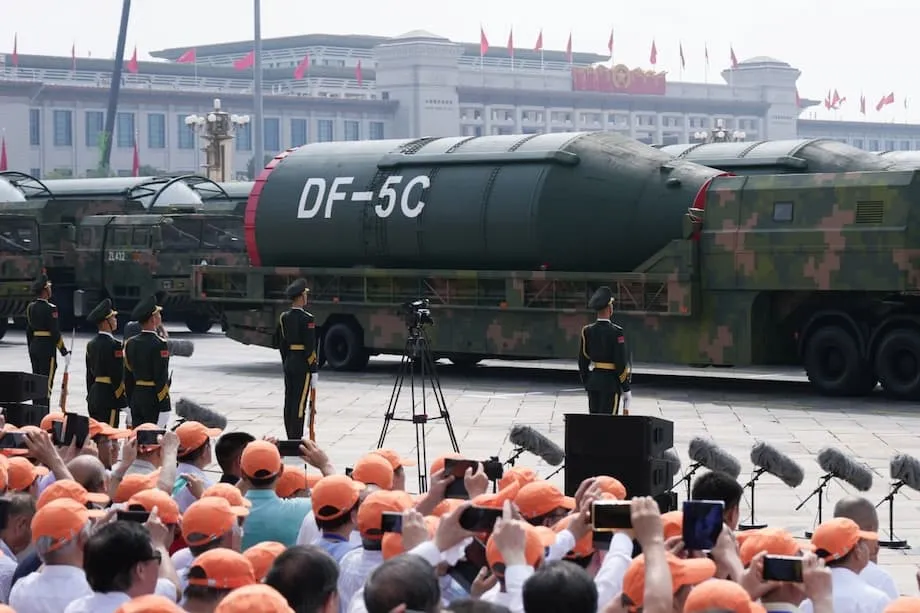
The assessment connects that progress with the new systems displayed at Beijing's military parade. Missiles, drones and armored vehicles attract attention, but the institute points to a less visible thread of semiconductor development behind advances in military equipment.
As of September 6, 2025, the central contest concerns both engineering and access to raw materials. China produces almost all the primary gallium feedstock used to make GaN devices. Restricting supplies abroad while expanding production at home can increase competitors' costs and complicate delivery schedules.
Analysts describe this pressure as a silent sanction: individual US defense companies need not be named for restrictions on essential materials to affect their production. Chinese researchers contend that the combination of domestic semiconductor progress and export controls is creating an emerging generation gap in phased array radars and electronic warfare hardware.
The United States already operates major systems using GaN. The dispute is therefore about how quickly and widely each country can put the technology into service, and at what cost.
Why GaN matters inside a radar
Gallium nitride belongs to a group of materials called wide bandgap semiconductors. Compared with traditional silicon, GaN can operate at higher voltages and temperatures, handle much more power in a given area, and switch faster. These properties make it useful in radio frequency amplifiers and equipment that controls electrical power.
A radar sends out signals and listens for their reflections. In a phased array radar, many transmitting and receiving elements work together. GaN helps those elements produce stronger signals without overheating and then quickly listen for faint returns.
Military radars have long relied on gallium arsenide or advanced silicon devices. GaN allows engineers to fit more elements into the same space and operate them at greater power. That can extend detection range, improve resistance to interference, and support several operating modes at once.
Missile guidance seekers face a related challenge: they must perform inside a tight nose cone while coping with attempts to jam their signals. GaN can help maintain performance within those limits. More capable seekers, tougher jammers and longer range radars are among the military benefits described in the Chinese assessment.
Ships and aircraft can also benefit from more efficient power conversion. Equipment that wastes less energy as heat can reduce the cooling burden and save weight. These advantages explain why access to gallium matters beyond the radar itself, reaching into communications, guidance and power management.
How export controls became a targeted ban
Beijing's restrictions developed alongside US measures limiting China's access to advanced chips and the tools used to manufacture them. China's Commerce Ministry cited national security when it introduced export licensing for gallium and germanium in July 2023.
The main steps were:
- July 2023: China imposed licensing requirements on exports of gallium and germanium.
- December 2024: China banned exports of gallium, germanium and antimony to the US market and tightened reviews of related items.
- By September 6, 2025: The supply contest included efforts to expand alternative production, recover material through recycling, and develop semiconductor technologies using other materials.
Gallium, germanium and antimony serve a broad range of industries. Together, their uses include semiconductors, infrared sensors, fiber optics, solar cells, batteries and ammunition. Restrictions can therefore affect civilian manufacturers as well as defense contractors.
China's first licensing rules were followed by a drop in gallium shipments. European gallium prices nearly doubled over a year as buyers sought supplies. Germanium became harder to obtain, while antimony prices rose sharply, including after the December 2024 action.
Purchasing material through another country does not always remove dependence on China. A refinery or trading company elsewhere may still rely on Chinese feedstock. That makes the origin of the material as important as the location of the immediate seller.
What China claims about its military advantage
The Institute of Physics assessment argues that China's materials position and semiconductor progress are supporting faster deployment of GaN across the People's Liberation Army. Chinese researchers and state media describe production at scale for airborne early warning aircraft, air defense batteries and fighter radars.
Accounts of that expansion identify phased array radars on platforms such as the KJ 500A airborne early warning aircraft and advanced radar sets associated with the J 20 fighter program. They also describe GaN seekers on missiles designed for long range air combat and wider use in air defense systems.
Independent confirmation of every platform is limited. China's large industrial footprint supports the broader picture of expanding GaN adoption, while the claimed generation gap rests on Chinese assessments of how rapidly the technology is reaching military units.
The practical issue is production volume. A country that can obtain enough gallium, manufacture reliable devices, and install them across aircraft, ships, missiles and ground systems can spread the benefits more quickly. Chinese researchers argue that domestic supplies help China do this while foreign buyers face greater uncertainty.
Longer radar range or better resistance to interference depends on the equipment built around the semiconductor. The institute's argument focuses on the cumulative effect of deploying improved arrays, seekers and power modules across many systems, rather than on one new device.
US systems already depend on GaN
The US Navy's AN/SPY 6 radar family is a central part of a new radar architecture for destroyers. The Marine Corps' AN/TPS 80 G/ATOR also uses GaN to support expeditionary units. Air Force and Army programs are pursuing the material for electronic warfare and missile defense.
A Center for Strategic and International Studies analysis identified gallium compounds as key inputs to advanced US defense systems, citing both AN/SPY 6 and AN/TPS 80 G/ATOR. It also described their growing use in advanced microelectronics.
Allied military systems have similar requirements. Higher material prices and uncertain deliveries can therefore spread through several countries' procurement programs, affecting radar modules, infrared sensors and precision manufacturing.
Chinese accounts place the difference between the two powers in deployment speed across the armed services and the cost pressure created by restricted gallium supplies. The United States has established GaN systems, while China claims it can introduce the technology more broadly and quickly.
For military planners, the consequences appear in delivery schedules, unit counts and maintenance work. Replacing older modules with GaN equipment takes a dependable supply of components as well as a successful design.
Why material still moves through other countries
Trade figures through 2024 show that restrictions tightened supply without immediately stopping every route. Chinese statistics recorded a steep fall in gallium and germanium exports to the United States after licensing began, followed by zero direct shipments after the targeted ban.
US trade data still recorded imports of material of Chinese origin. Reexports through other countries offer the main explanation. Belgium, in particular, has served as a major hub for germanium reexports.
Gallium can also pass through secondary production and reprocessing operations. Canada and Germany expanded secondary output, while Japan used refining and recycling to cushion the disruption. Secondary production recovers or reprocesses material already in the industrial chain, rather than supplying newly produced primary gallium.
Germany had not produced primary gallium for years, yet it accounted for a notable share of US imports. That pattern points to the importance of reprocessing and trade through intermediate countries. Chinese feedstock can remain part of the chain even when the final shipment comes from elsewhere.
Industrial buyers have faced more than higher prices. Germanium supplies became sporadic, and some users warned that they risked running out of stock. Procurement teams searching for replacement material can encounter longer lead times, adding costs and potentially delaying projects.
The result has been a gradual tightening. Alternative trade routes and recovery operations soften the immediate shock, but their capacity and access to feedstock remain important constraints.
Diamond and aluminum nitride enter the response
Washington's response combines efforts to secure more gallium and germanium outside China with research into materials that could match or exceed GaN in particular applications. Mining, refining and recycling address supply; semiconductor research addresses the technology itself.
The Defense Advanced Research Projects Agency has enlisted Raytheon to develop devices using synthetic diamond and aluminum nitride for electronics operating at high power and high frequencies. Both materials have wider bandgaps than GaN and could offer greater performance if researchers solve manufacturing problems.
Producing suitable material consistently and scaling it to larger wafers are among those challenges. Wafers are the pieces of semiconductor material on which devices are manufactured. Moving from promising materials to production requires those manufacturing steps to work reliably.
Colin Whelan, who leads Advanced Technology at Raytheon, described the work as a significant step in semiconductor technology. He said the team was drawing on experience with similar materials in defense systems to advance diamond and aluminum nitride for future sensors and communications.
These research programs run alongside the need to supply existing equipment. Radars and other systems already designed around gallium compounds still require those materials while new technologies are developed.
Allies work to expand supply outside China
Australia, Japan, India, South Korea and the United States are coordinating on critical minerals through arrangements including the Quad and the Indo Pacific Economic Framework. Their efforts include improving access to materials and strengthening supply chains against disruption.
The US Export Import Bank has introduced financing tools to support overseas mining and processing facilities insulated from Chinese control. Partner governments are also considering stockpiles, joint procurement and targeted investment while private companies expand recycling and recovery at smelters.
Japan has several routes to gallium, including refining, recycling and primary production associated with zinc processing. That combination makes it relatively resilient. Germany has explored restarting primary gallium production, while Canada and other countries have increased secondary production.
A recent Center for Strategic and International Studies assessment estimated that China controls the overwhelming share of primary gallium supply. China has also restricted exports of certain extraction technologies needed by competing producers. Higher prices alone may therefore be insufficient to bring new capacity into operation quickly.
Refineries may need modifications, smelters may need new recovery lines, and recycling operations must increase their output. Some projects have started and others remain at the planning stage, with lead times extending across multiple budget cycles.
Those schedules leave buyers exposed to changes in Chinese licensing while new facilities are being developed. Even modest adjustments to permissions can affect prices and delivery times when alternative supply is limited.
The economic stakes and the next pressure points
The US Geological Survey has estimated that a complete cutoff of gallium and germanium could reduce US gross domestic product by roughly $3.4 billion, more than $3 billion, while sending gallium prices sharply higher. The United States does not maintain a government gallium stockpile.
China's enforcement against reexports is one of the main factors determining how severe disruption becomes. Tighter action against material moving through other countries could restrict routes that have helped buyers manage the controls. Extraction resins, processing kits and other related items are also part of the enforcement picture.
Beijing's approach extends beyond these three minerals. China has introduced formal sanctions frameworks, asserted state ownership in strategic mineral sectors, and restricted exports of certain rare earth processing technologies. These measures follow earlier informal tactics and show the growing use of domestic trade rules to influence global supply.
Washington has responded with tighter restrictions on Chinese access to advanced chips and manufacturing tools, more additions to restricted entity lists, and efforts to diversify supply. Allies have created networks to give early warning of mineral disruptions and connected logistics plans intended to keep critical inputs moving during shocks.
Dr. Fabian Villalobos, a senior engineer at Rand, described the importance of these materials to defense technology in direct terms:
They are vital.
China is seeking to turn its materials position into more equipment in military service. The United States and its partners are trying to widen supply while improving sensors, communications and power electronics. The immediate balance depends on China's enforcement and how quickly alternative refining, recovery and recycling capacity becomes available.
Key Points
- A Chinese Academy of Sciences assessment says China's GaN technology has matured and is spreading across military systems.
- China introduced gallium and germanium export licensing in July 2023, then banned exports of gallium, germanium and antimony to the US market in December 2024.
- GaN supports stronger radar signals, resistance to interference, compact missile seekers and more efficient power electronics.
- The United States already uses GaN in systems including AN/SPY 6 and AN/TPS 80 G/ATOR. Chinese accounts claim faster deployment across China's armed services.
- Reexports, refining and recycling have kept some material moving, while buyers face higher prices and uncertain delivery times.
- DARPA and Raytheon are pursuing synthetic diamond and aluminum nitride devices as allies invest in alternative mineral supplies.
- USGS estimates a complete gallium and germanium cutoff could reduce US GDP by roughly $3.4 billion. The United States has no government gallium stockpile.