India Unveils Blueprints for Lunar Ambitions
Indian scientists have released detailed designs for new heavy lift rockets that will carry astronauts to the moon. The Indian Space Research Organisation (ISRO) announced the configurations for the Next Generation Launch Vehicle (NGLV) and the Lunar Mission Launch Vehicle (LMLV) through a new tender document. These designs mark a major shift from solid fuel boosters to cleaner liquid methalox propulsion. This change prepares India for building a space station and landing humans on the lunar surface by 2040.
Contents
- India Unveils Blueprints for Lunar Ambitions
- The NGLV and NGLV-H: Powering Future Missions
- LMLV: The Lunar Specialist
- A Shift to Methane and Clean Propulsion
- Building the Third Launch Pad
- Timeline and Future Milestones
- Challenges Ahead for ISRO
- Global Context of the NGLV
- Looking Toward the Moon
- The Bottom Line
The announcement comes as ISRO prepares to build a third launch pad at its Sriharikota facility. The government approved the new pad in January 2025 with a budget of 3984.86 crore rupees. The facility is scheduled for completion by March 2029. This new infrastructure will support the launch of massive rockets that are significantly larger than the current workhorses PSLV and LVM3.
ISRO has previously used a combination of unsymmetrical dimethylhydrazine and nitrogen tetroxide including for its workhorse Vikas engine for the PSLV rockets and liquid hydrogen and liquid oxygen for its cryogenic upper stages.
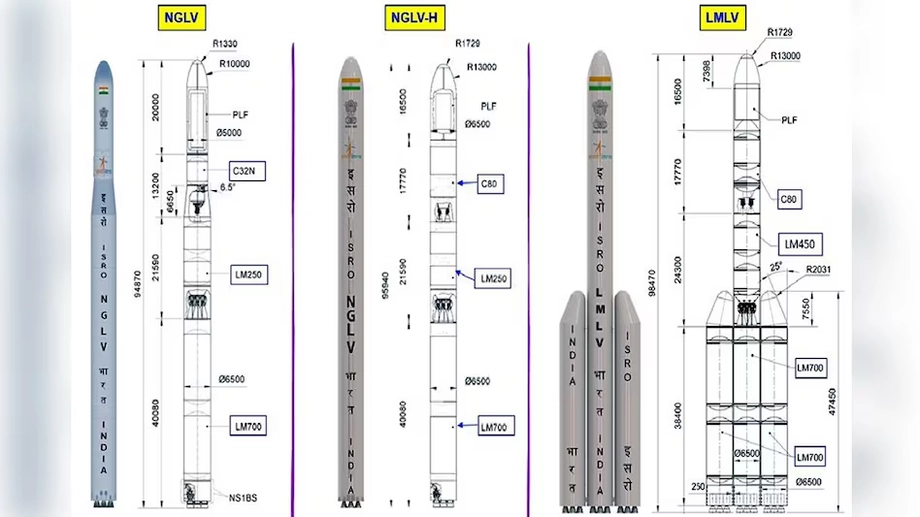
The new rocket family includes three main variants: the standard NGLV, the heavier NGLV-H, and the specialized LMLV for moon missions. Each variant uses advanced propulsion systems to handle heavier payloads. The designs aim for partial reusability which will help lower the cost of space access over time.
The NGLV and NGLV-H: Powering Future Missions
The standard NGLV stands as the backbone of India's future launch capabilities. This vehicle features two main stages powered by liquid oxygen and methane. The first stage uses the LM700 engine and the second stage uses the LM250 engine. Both stages rely on methalox propulsion which offers cleaner combustion and easier refueling compared to older chemical fuels. An upper C32N cryogenic stage provides the final push to orbit using liquid hydrogen and liquid oxygen.
The NGLV-H is the heavy lift version of this family designed for larger payloads. It retains the same LM700 and LM250 main stages but replaces the C32N upper stage with a larger C80 cryogenic stage. The C80 stage features two engines to handle extra weight. This configuration allows the rocket to lift more than a thousand tonnes into low earth orbit.
Engineers have tested the gas generator for the NGLV engine at the Isro Propulsion Complex in Mahendragiri. The November 2026 test simulated a chamber pressure of 31.5 bar which equates to 60 percent of the engine's full thrust. The test showed smooth ignition and stable combustion proving the hardware is ready for further development.
LMLV: The Lunar Specialist
The LMLV represents India's most powerful rocket design to date. This super heavy lift vehicle is specifically configured for lunar missions. It uses a cluster of three LM700 cores for initial thrust and one LM450 stage for the middle phase. The top stage is the massive C80 cryogenic unit.
This complex arrangement provides immense lifting power to send heavy spacecraft and crew modules toward the moon. The rocket stands approximately 98.5 meters tall. While the LMLV is not yet the final approved design for the first manned lunar landing it provides the necessary capacity for future lunar outposts.
The LMLV design signals a move toward establishing a permanent presence on the moon. It will carry the heavy modules needed to build a lunar base and support crewed missions. The focus on methalox and cryogenic fuels ensures the rocket can be refueled in space which is critical for long duration missions.
A Shift to Methane and Clean Propulsion
A key feature of the new rockets is the switch to methalox propulsion for the main stages. The LM700 LM250 and LM450 engines all use liquid oxygen and methane. This combination burns cleaner than the kerosene based fuels used in previous decades. Cleaner engines produce less residue which simplifies maintenance and allows for reuse.
The upper stages continue to use hydrolox or cryogenic propulsion which means liquid hydrogen and liquid oxygen. These fuels provide higher efficiency for the final push into orbit and toward the moon. The elimination of solid fuel boosters from the new configurations marks a strategic change. Solid boosters are single use and leave residue while liquid engines can be throttled and shut down if needed.
Building the Third Launch Pad
The construction of the third launch pad is critical to the NGLV program. Current facilities at Sriharikota are designed for smaller rockets like the PSLV and SSLV or medium lifters like the LVM3. They cannot handle the massive size and weight of the NGLV family.
Government officials confirmed that site surveys are complete and civil work is underway. The project includes fuel storage facilities mobile launch pedestals and rail tracks for transporting rocket components. Private companies and small industries will also participate in the construction and supply chain.
The new pad will be operational by 2029 aligning with the first planned launch of the NGLV. The timeline ensures India has the infrastructure ready before it needs to launch heavy modules for its space station by 2035.
Timeline and Future Milestones
The development of India's space future follows a clear schedule. The following timeline highlights key dates and targets.
- January 2025: Cabinet approves the third launch pad project.
- February 2026: Ground surveys complete and civil work begins.
- November 2026: Successful gas generator test for NGLV engine.
- December 2024: Start of NGLV development timeline (eight year project).
- 2031: First planned flight of the NGLV.
- March 2029: Target completion of the third launch pad.
- 2040: Target for Indian astronauts to land on the moon.
These dates reflect the rapid pace of India's space program. The organization aims to launch regularly from the new pad once it is ready.
Challenges Ahead for ISRO
Despite the detailed designs several challenges remain. The methalox technology is proven but must be certified for flight. Engineers need to test the LM700 and LM250 engines at full thrust for extended periods. The C80 upper stage also requires validation in a flying vehicle.
The reuse of rocket stages is another major hurdle. While the NGLV is designed for partial reuse the landing and refurbishment process must be highly efficient to be cost effective. Vertical takeoff and vertical landing will require precise guidance systems.
Building the launch pad itself is a massive engineering task. The facility must support cryogenic fuels which are extremely cold and volatile. Safety systems must be robust to handle the increased volume of propellants used by the new rockets.
Global Context of the NGLV
India joins a select group of nations developing heavy lift launch vehicles. The NGLV aims to compete with vehicles like SpaceX's Starship and Boeing's SLS. The use of methane is a strategic choice. Methane is cheaper and produces less carbon residue than kerosene. It also allows for in situ fuel production on the moon or Mars which supports long term exploration.
The NGLV capacity of 30 tonnes to low earth orbit is three times that of the LVM3. This jump in capability allows India to launch entire modules of a space station at once rather than assembling them piece by piece.
Looking Toward the Moon
The LMLV design provides the muscle needed for lunar missions. It can carry crew modules heavy habitats and cargo supplies in a single launch. This reduces the number of missions required to establish a moon base.
India's vision for 2040 includes a human landing on the moon. The NGLV family will support this by providing reliable and heavy lift capabilities. The third launch pad will serve as the home for these historic launches.
The tender documents provide a clear roadmap for the next decade. They combine technical precision with ambitious goals. The transition from solid to liquid propellants sets the stage for a new era of space exploration for India.
The Bottom Line
- ISRO has released designs for the NGLV and LMLV rockets targeting moon missions by 2040.
- The third launch pad at Sriharikota is being built with a budget of 3984.86 crore rupees.
- NGLV uses liquid oxygen and methane for cleaner and reusable propulsion.
- LMLV features three cores and a C80 upper stage for heavy lunar payloads.
- The launch pad is expected to be ready by March 2029 for NGLV flights.
- Recent engine tests confirm the viability of the new methalox technology.
- India aims to launch regular heavy missions from the new pad to build a space station and reach the moon.