A Selfie Taken as Putin Left the Plenary Hall
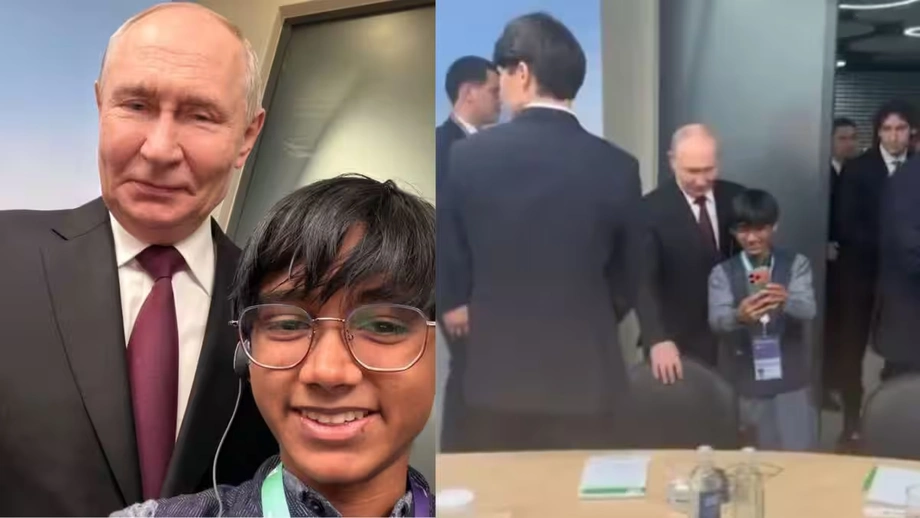
Vladimir Putin had just finished the plenary session of AI Journey 2026 in Moscow when a teenager from Kerala stepped forward, shook his hand and asked for a photograph. The conference opened on Thursday, 26 November 2026, ran for three days, and brought young developers together with researchers and officials from India, China, Russia, Serbia, Brazil, Kenya, Kazakhstan and the United Arab Emirates. Raul John Aju, the school student known at home as the AI Kid of India, got his picture and posted it on Instagram under the handle @raul_the_rockstar.
Contents
- A Selfie Taken as Putin Left the Plenary Hall
- Putin Ties the Teenager's Work to Make in India
- Is AI a Threat to Learning? A Question Put to a School Student
- Who Is Raul John Aju?
- How a Father's Job at Adobe Started It All
- A Company Run by a Teenager, With His Father on the Payroll
- The Tools: Project 47X, RESQ AI and ThinkCraft
- A Timeline From a Kerala Bathroom to Moscow
- What Is Still Unclear
- Key Points
Kazakhstan's president, Kassym-Jomart Tokayev, took part in the same session with young innovators, and the conversation covered AI in education, science, medicine, the economy and the arts. Aju was among the young AI talents the Russian embassy described as having held meetings with Putin and Tokayev, calling him a schoolboy who created the ThinkCraft platform.
The post that followed was less about the photograph than about the distance travelled to reach it. Aju wrote that he was still processing the moment.
Still trying to process this. From being a little kid making videos for fun to meeting President Putin at 17, life has given me opportunities I never even knew to dream of. So much more to learn, so much more to do. Grateful for every single person who's been part of this journey.
In a second post with the selfie, he went further back, to a bathroom in his family home where he filmed his first video at the age of nine.
From making my first video in a bathroom at 9 to taking a selfie with President Putin, never in my wildest dreams did I think life would take me here. More than anything I've achieved, I'm grateful for the person this journey has helped me become. Meeting some incredible people at AI Journey (way smarter than me) made me realise how much more I have to learn.
He thanked the conference team and his parents, named his friends Jay Bhadwal, Harry Effect and Josh Joji, and signed off with a line that has travelled further than most of his posts.
Still a curious kid, just with a few more stories to tell.
Putin Ties the Teenager's Work to Make in India
The exchange did more than produce a photograph. Putin listened to Aju describe the tools he has built and then linked them to Prime Minister Narendra Modi's manufacturing and self-reliance drive.
Ultimately, your work helps realise PM Modi's 'Make in India' call, right? Because it helps young people to find their own solutions and implement these solutions.
The remark landed days after the Office of the United States Trade Representative published findings from a Section 301 investigation into India's manufacturing policies. That report named Make in India, the Production-Linked Incentive scheme, Atmanirbhar Bharat and the India Brand Equity Foundation among measures it said contributed to structural excess capacity in the steel, solar, health and information technology sectors. Putin's praise therefore put a school student's projects inside a live trade argument between Washington and Delhi.
Aju's own position is that India should not simply copy the artificial intelligence models built in the United States and China, but build systems suited to its own languages and needs. Much of his work sits in that gap: tools that read Malayalam, Hindi and Urdu, and legal help written in plain language rather than statute.
Is AI a Threat to Learning? A Question Put to a School Student
The part of the conversation that has drawn most attention came when Putin turned the discussion to classrooms. He asked whether heavy use of artificial intelligence in education weakens the ability of young people to think and remember.
Is it not a threat, I mean, for educational process when you resort to artificial intelligence?
Putin went on to describe a classroom in which a student asks a machine for an answer instead of working the problem out. "There is a risk that a person, especially a young person, will not want to remember anything," he said, according to accounts of the exchange carried by Russian media.
Aju answered with a comparison to calculators. Students, he said, should master the basics first and bring technology in afterwards.
Thus, artificial intelligence at some stage can be connected to the education process when you are already quite educated, you understand the basics, you understand how you can learn, how to remember. Artificial intelligence can help you look for new ideas and find some new meanings.
He also gave a practical example of what he means by learning with a machine rather than from it. A child who likes mathematics, he said, can meet the subject through pictures, videos and games, and AI can help a teacher tailor that material in a class of 40 pupils, where individual attention is scarce. He recalled his own father scolding him for playing a game the day before a mathematics examination, when the game was in fact the thing he was studying.
I feel we are supposed to collaborate with AI rather than just use it to replace our whole thing.
That argument is compressed into a line Aju uses often when he talks about work and jobs: "AI will not replace you. But someone using AI will."
Who Is Raul John Aju?
Aju comes from Ezhumattoor in Pathanamthitta district, Kerala, and studies in Class 12 as a Plus Two Commerce student at North Edappally government higher secondary school. Profiles published on 27 November 2026 mostly give his age as 17, while several put him at 16. His route into technology did not run through an engineering or computer science course. He is described as a teenage AI entrepreneur, developer and educator, and the nickname AI Kid of India has followed him since his early teens.
The numbers attached to his name vary with the profile. He has built around 15 AI tools by the count given in several accounts, while others say more than 10. His LinkedIn page lists him as founder and chief technology officer of AIRealm Technologies, and his introduction there is short and unpolished.
I build things with AI. I talk about them. Sometimes I break them. Then I build them again.
The same profile credits him with eight TEDx talks and sessions at Indian Institutes of Technology, universities and schools, and an online following above 500,000 people. His work has drawn attention beyond classrooms: the governments of Kerala and Dubai have sought his advice on putting AI into public services.
How a Father's Job at Adobe Started It All
The origin story is unusually domestic. When Aju's father took a job at Adobe, the household gained access to professional creative software, and the boy spent hours inside it.
When my father got a job at Adobe I got free access to all the premium tools and I was able to learn about AI. After that I created my robot [known as MeBot, built for a school science project].
Video editing came first, and MeBot followed at 12. It was a humanoid robot assembled for a school science fair, and it marked the point where Aju moved from using other people's software to building his own machines. Self-teaching carried him into robotics, natural language processing and the unglamorous work of testing tools on real users.
A Company Run by a Teenager, With His Father on the Payroll
AIRealm Technologies Pvt Ltd was incorporated in August 2024, when Aju was 16, according to company records cited in profiles of the teenager. It now employs 15 people, and the founder is also its chief technology officer. Its training programmes have reached nearly five lakh students and professionals by the highest figure given; other profiles have put the number at more than 1.4 lakh.
The arrangement at the top of the company is the detail that travels fastest on social media. Aju's father works for him and draws a monthly salary of Rs 2 lakh, having spent years at Amazon, Adobe, Wipro and IBM.
I can gain as much knowledge as I want from my phone, but I don't have his experience. He has worked for companies like Amazon, Adobe, Wipro, and IBM, so I can learn from him. Also, to be honest, it was good for my marketing!
The company began as a way to gather scattered projects under a single name, and with a specific problem in mind: people without debit or credit cards who still need to pay for things digitally.
The main reason was I wanted all of the tools that I had built to be under one brand name. I also wanted to create a payment system to make people's lives easier, so that they can just use a QR code to pay for things, if they don't have a credit or debit card.
The Tools: Project 47X, RESQ AI and ThinkCraft
Aju's projects cluster around access. Project 47X applies AI to legal information, turning dense rules into guidance an ordinary person can follow, and has been described as involving collaboration with the Kerala and Dubai governments. JustEase, developed with the Kerala government, is built to help people find information and make decisions during emergencies. RESQ AI, also called Rescue AI, combines emergency guidance, information about laws and a route to legal assistance.
ThinkCraft and ThinkCraft Academy take the other half of his work, teaching students and working professionals what AI is and how to use it, including people with no technical background. A separate line of development handles voice, with systems built for Malayalam, Hindi and Urdu so that users are not forced into English to reach a digital service. His LinkedIn profile describes the company's central product as a legal technology platform offering instant legal guidance.
The conference circuit has followed. In 2026 Aju attended the India AI Impact Summit in New Delhi, where he met United Nations Secretary-General António Guterres and delivered an opening address on AI and the safety of children.
A Timeline From a Kerala Bathroom to Moscow
- Age 9: films his first video in a bathroom and begins teaching himself technology after his father joins Adobe
- Age 12: builds MeBot, a humanoid robot, for a school science project
- August 2024: founds AIRealm Technologies Pvt Ltd and serves as founder and chief technology officer
- 2026: attends the India AI Impact Summit in New Delhi, meets UN Secretary-General António Guterres and speaks on AI and children's safety
- 26 November 2026: AI Journey 2026 opens in Moscow; Aju interacts with Putin and Tokayev, then takes a selfie with Putin after the plenary session
- 27 November 2026: his Instagram posts circulate widely and Putin's Make in India remark is quoted across Indian outlets
What Is Still Unclear
No date has been given for Aju's next public appearance, and the Moscow conference ended without any announced follow-up programme involving him. The claims about his training figures and tool count rest on his own profiles and on interviews he has given, and one outlet that carried the story attached a note that the claims in his post had not been independently verified.
The details of the conversation with Putin circulate mainly through short video clips and translated Russian accounts of the session, which is why different versions of the same exchange use slightly different wording. What is fixed is the sequence: the plenary session first, the exchange with young innovators next, and the selfie as Putin left the hall.
Key Points
- Raul John Aju, the Kerala teenager known as the AI Kid of India, met Vladimir Putin at AI Journey 2026 in Moscow on 26 November 2026 and photographed himself with him after the plenary session.
- Putin linked Aju's work to Prime Minister Narendra Modi's Make in India call, saying it helps young people find and implement their own solutions.
- The two debated AI in education, with Putin warning that students may stop remembering and thinking, and Aju comparing AI to a calculator that should come after the basics.
- Aju founded AIRealm Technologies Pvt Ltd in August 2024, employs 15 people, has built around 15 AI tools and has trained between more than 1.4 lakh and nearly five lakh people.
- His father works for the company on a monthly salary of Rs 2 lakh after years at Amazon, Adobe, Wipro and IBM.
- His projects include Project 47X for legal information, JustEase with the Kerala government, RESQ AI for emergencies and ThinkCraft Academy for AI teaching.
- His age is given as 17 in most profiles published on 27 November 2026 and as 16 in others.
- He met UN Secretary-General António Guterres at the India AI Impact Summit in New Delhi earlier in 2026.