Twenty four certificates, one new name and a 2028 deadline
Vietnam's Ministry of Education and Training published the draft circular setting the rules for the 2027 high school graduation exam on 26 November 2026, and the appendix that decides who may skip the foreign language paper now runs to 24 certificates across seven languages. Fourteen of the entries are for English, the subject almost every candidate sits and the one that weighs most when universities pick students.
Contents
- Twenty four certificates, one new name and a 2028 deadline
- Who may skip the foreign language paper
- Other routes out of the exam hall
- Oxford tests arrive after a recognition decision
- What the appendix accepts, in points and levels
- From 2028 the ministry narrows the gateway
- An exemption is not a place at university
- Universities set their own conversion tables
- Cameras, mixed cohorts and the six rõ principle
- Dates that shape the next two years
- Key Points
The single new arrival is the Oxford Test of English. A score of at least 81 points on the standard test, or 111 on OTE Advanced, will count as meeting the foreign language requirement when graduation is assessed. Oxford University Press develops both tests, they are taken on a computer, and they assess listening, speaking, reading and writing.
The numbers behind the list are small but telling. Of the more than 1.2 million candidates who registered for the 2026 exam, close to 8,000 asked to be excused from the foreign language paper, most of them holding an English certificate at the level of IELTS 4.0 or its equivalent.
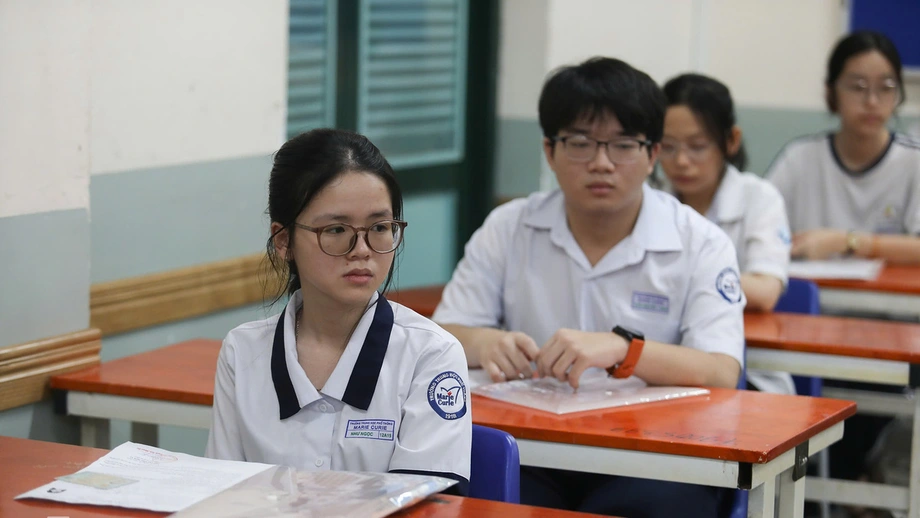
Opinions on the draft are open until 6 December 2026. The 2027 exam keeps the structure used in 2025 and 2026, and the revisions concentrate on how the test is organised, guarded and marked rather than on what candidates are asked.
Who may skip the foreign language paper
Two groups qualify in 2027. The first is made up of members of the national team sent to international Olympiads in a foreign language, chosen by decision of the Minister of Education and Training. The second is much larger: any candidate holding a certificate from the appendix, or one the ministry recognises as equivalent to level 3 or higher of the six level framework used in Vietnam, as long as the certificate is still valid on the day the candidate completes registration for the exam.
Level 3 is the bar, and it is a working intermediate standard rather than fluency, roughly the ground an IELTS score of 4.0 covers in English. The draft is strict about the paperwork: a certificate that has expired before registration does not qualify, whatever score it records.
Article 43 of the draft sorts exemptions into three categories: from every subject, from the foreign language paper, and from the literature paper. The third is written for candidates from abroad. A foreign national who holds a Vietnamese language certificate at level 3 or above under the framework for non native speakers is excused from the literature exam, which is compulsory for everyone else.
Other routes out of the exam hall
Three groups are excused from the exam entirely. The first takes in students summoned to train with national or regional teams for academic Olympiads. The second covers members of teams sent to international or regional science and technology competitions and to cultural or arts festivals abroad. The third covers people with particularly severe or severe disabilities, and people who took part in the resistance and were exposed to chemical agents, along with their children, where the exposure has cut working capacity by 61 per cent or more.
Conditions attach to each. Students in the first two groups must have been called up in the second semester of grade 12, must be graded Dat (pass) or better for training and study across grade 12, and must appear on the ministry's exemption list. Team members also need written confirmation from the selecting agency that they trained and competed as required, sent to the provincial education department before the exam. Candidates with disabilities need a certificate from a competent authority, and those outside the general curriculum need their principal to certify each year of their individual education plan.
Oxford tests arrive after a recognition decision
The Oxford Test of English is new to the exemption list, not to Vietnam. In May 2026 the ministry recognised both versions as equivalent to levels of the six level framework: 81 points on the standard test sits at level 3, and 111 points on OTE Advanced sits at level 4, one step above the exemption threshold.
For candidates, the effect is another route to the same exemption, offered by a publisher whose tests some schools and language centres in Vietnam already use internally to place students. The score needed is modest. At 4.0 in IELTS terms, it certifies that a student can handle familiar material and everyday conversation, not that they can follow a university lecture.
What the appendix accepts, in points and levels
For English, the appendix keeps the certificates recognised for 2026 and adds the Oxford pair. The thresholds follow the same logic as the framework, and they are set at the point where a candidate can manage a text and a conversation rather than study in an English speaking university.
- TOEFL ITP from 450 points and TOEFL iBT from 45 points, both issued by Educational Testing Service.
- IELTS from 4.0, issued by the British Council or IDP.
- TOEIC with all four skills: listening 275, reading 275, speaking 120 and writing 120.
- B1 Preliminary, B1 Business Preliminary and B1 Linguaskill from Cambridge, and Aptis ESOL B1 from the British Council.
- Pearson English International Certificate at level 2, PTE Academic from 43 points and Versant English Placement Test from 43 points.
- A certificate at level 3 or above under Vietnam's six level framework, issued by a unit licensed to run the assessment.
- Oxford Test of English from 81 points and OTE Advanced from 111 points.
Six other languages keep the thresholds used in 2026. Russian requires TORFL level 1, issued by the Russian centre of science and culture in Hanoi. French requires TCF at 300 points or DELF B1. Chinese requires HSK level 3 or TOCFL level 3. German requires Goethe-Zertifikat B1 or DSD B1. Japanese requires JLPT N3 or J.TEST level D, and Korean requires TOPIK level 3.
The appendix runs to 24 entries; tabulations that treat the Oxford pair as a single addition put the number at 23.
From 2028 the ministry narrows the gateway
A second rule is written into the same draft. From 1 January 2028, exemption will be considered only for two groups of certificates: those issued under the Vietnamese framework, including the six level version, at level 3 or above, and foreign certificates the ministry has recognised for use in the national education system at level 3 or above.
The shift moves the decision out of the exam regulation and into the ministry's recognition process. Today a test provider lands in the appendix by name with a minimum score printed next to it. After 2028 the question becomes whether the ministry has issued an equivalence decision for that certificate at all, and which level it maps to. The draft names no list for that period.
For a candidate sitting the exam in 2027, the appendix decides. For a student entering grade 10 in the 2027 school year and graduating after 2028, the framework decides, and a band score such as IELTS 6.0 will only help for graduation if it sits inside the ministry's equivalence register.
An exemption is not a place at university
The exemption is written for graduation recognition, and it stops there. In 2026 many universities did not convert foreign language certificates into an English subject score at all, and required candidates to sit the graduation exam in English if they wanted to use a combination that includes the subject. A candidate who takes the exemption in 2027 can reach graduation with no English score to hand to those universities.
The draft closes one route to double counting. A candidate who qualifies for the exemption but still wants to sit the paper may do so, and must then use the exam result in the graduation calculation. Exemption and an exam score cannot be combined to a candidate's advantage.
Universities set their own conversion tables
National Economics University in Hanoi has sketched how it will treat certificates in 2027. Under a draft conversion table, IELTS 5.5 becomes 8 out of 10 for the English subject, 6.0 becomes 8.5, 6.5 becomes 9, 7.0 becomes 9.5, and 7.5 to 9.0 becomes a full 10. TOEFL iBT and TOEIC sit on the same table. The university also proposes bonus points of 0.25 for IELTS 5.5 to 6.5 and 0.5 for 7.0 and above, with the total capped at 0.5 on a 30 point scale. Candidates choose between conversion and bonus points, not both. The official admissions plan is due in December 2026, and the university expects three methods: domestic competency and thinking tests, international aptitude tests and A levels, and the graduation exam.
Ho Chi Minh City University of Law has published the same scale for applicants admitted on exam results, and accepts TOEFL ITP, TOEFL iBT, TOEIC, Aptis ESOL, VSTEP and PTE Academic alongside certificates in Chinese, Japanese and French. Only the highest certificate counts. The law school plans four methods for 11 majors, one fewer than in 2026, while widening the number of subject combinations: its law major accepts 53, up from 12.
The room for bonus points is shrinking. Under Circular 95/2026/TT-BGDĐT, universities that awarded bonus points in 2026 or earlier may keep doing so for 2027, capped at 0.5 points on the 30 point scale and with an explanation on file. From the 2028 admissions season, bonus points are not allowed at all. Converting certificates into subject scores remains permitted, as long as each university publishes a table that is fair between candidates.
Dương Văn Bá, vice principal of Intracom University, describes the end of bonus points as a policy with two sides. Dropping the points narrows the gap between students who can pay for courses and certificate preparation and those who cannot, he says, and the risk is that it weakens the incentive to study languages at all.
It is possible to keep a moderate bonus, for example 0.5 points as applied in 2027, to recognise candidates' effort in learning foreign languages without creating too large a gap in admissions.
Cameras, mixed cohorts and the six rõ principle
The draft changes more than the certificate list. Exam sites will need camera systems covering the storage of papers, the work of candidates and invigilators in the rooms, and the movement of papers between the duty room and the exam rooms. The draft forbids using those cameras to read papers while candidates are working.
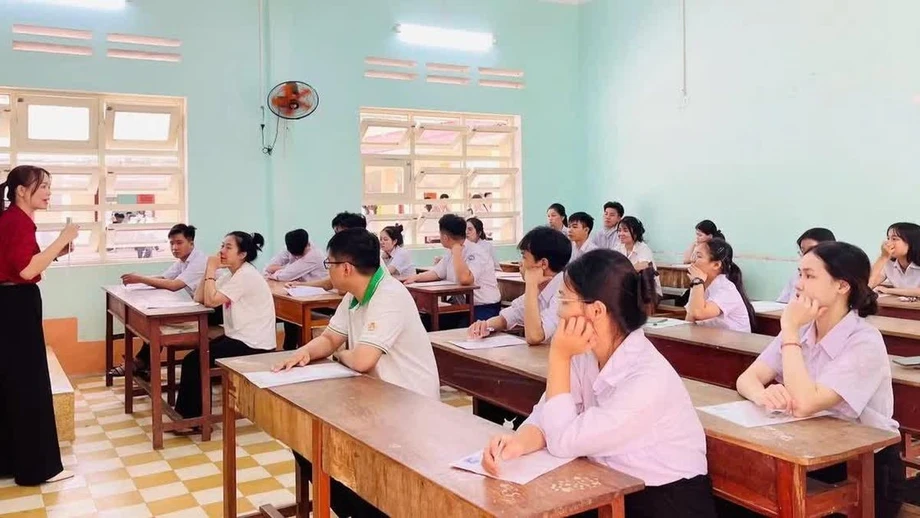
Candidates from at least two high schools must be mixed into each site and room where travel allows, and provincial steering committees must approve any exception and add measures to keep the exam secure. Invigilators must be drawn from at least three different schools, and the three invigilators assigned to a room cannot work at the same school. Staff of the school hosting a site handle facilities only; apart from the deputy head responsible for facilities, they leave the exam area while candidates are working, and unused rooms stay locked and sealed.
The ministry sets out a principle it calls 6 rõ, or six clears: clear person, clear task, clear time, clear responsibility, clear product and clear authority, applied to the exam council, its boards and each site. Badges for everyone on duty must carry a photograph and full details. University lecturers drafted in to help run the exam move from inspection to supervision of invigilation, marking and re-marking: one member at the duty room of each site, each lecturer covering four to six rooms, and five lecturers at each exam council for the marking stage. Storage periods for exam documents are aligned with Circular 08/2025/TT-BGDĐT, and the rules on certificates of completion and graduation diplomas are updated.
Dates that shape the next two years
- 26 November 2026: the draft circular is published for comment.
- 6 December 2026: the comment period closes.
- December 2026: National Economics University is due to publish its 2027 admissions plan, including conversion and bonus point tables.
- 31 December 2026: all universities must publish their 2027 admissions information on their websites.
- 1 January 2027: new major names and codes take effect under Circular 74/2026/TT-BGDĐT.
- The 2027 exam: the first sitting under the revised rules, with the enlarged certificate appendix in force.
- 1 January 2028: exemption narrows to certificates at level 3 or above under the Vietnamese framework or on the ministry's recognition register.
- 2028 admissions: bonus points for language certificates disappear, while conversion into subject scores stays.
Key Points
- The Ministry of Education and Training published a draft exam regulation on 26 November 2026, with comments open until 6 December 2026.
- The appendix lists 24 foreign language certificates for 2027, 14 of them for English.
- Oxford Test of English at 81 points and OTE Advanced at 111 points are added for the first time.
- Exemption requires a certificate at level 3 or above of the six level framework, valid on the registration date.
- From 1 January 2028 only certificates at level 3 or above under Vietnam's framework, or on the ministry's recognition register, will count.
- Nearly 8,000 of more than 1.2 million candidates sought exemption from the foreign language paper in 2026.
- Exemption applies to graduation only; many universities still require an exam score, and National Economics University and Ho Chi Minh City University of Law will convert IELTS from 5.5 in 2027.
- Bonus points for certificates are capped at 0.5 under Circular 95/2026/TT-BGDĐT and end entirely with the 2028 admissions season.
- Exam sites will add cameras, mix candidates from at least two high schools and draw invigilators from at least three schools.