A prison drama dominates Vietnamese cinemas
Trại giam hạnh phúc, released in English as The Happiest Cell, crossed VND200 billion in ticket sales on the evening of November 27, seven days after its official opening on November 20. The achievement has also been described as an eight day result when the opening date is counted inclusively. Box Office Vietnam put its cumulative gross at more than VND208 billion by noon on November 28. At that point, it had sold 67,172 tickets from 4,664 showings for approximately VND6 billion in revenue during the day.
Contents
- A prison drama dominates Vietnamese cinemas
- How quickly did ticket sales rise?
- A gentle teacher enters cell D9
- The street helper who inspired Phúc
- Why did a quiet November release become a hit?
- Trung Lùn's third hit after 30 years in entertainment
- Strong performances, but an overcrowded script
- A police screening takes the message beyond entertainment
- What VND200 billion means for the business
- The next tests at the box office
- At a Glance
The film became the fifth Vietnamese production to reach VND200 billion in 2026. Its new total carried it past Phí Phông: Quỷ máu rừng thiêng, with more than VND201 billion, and Nghỉ hè sợ nghỉ hưu, with VND207.7 billion. Only the year's two biggest Vietnamese hits remained ahead of it. The arrival of Running Man Vietnam 2026: Về nhà did not dislodge Trung Lùn's prison drama, which continued to receive roughly 4,600 showings a day after passing the milestone.
Its advantage over other releases was already enormous during its first weekend, when it accounted for about 80 percent of weekend box office revenue, including preview screenings. By the morning of November 23, the family drama Ngày con còn mẹ had earned VND57 billion after 10 days. The Hunger Games: Sunrise on the Reaping had managed VND4 billion after three days, Godzilla Minus Zero had VND34 billion after two weeks and Ramayana: Rise of a Legend was approaching VND17 billion.
How quickly did ticket sales rise?
The film began preview screenings on November 18, two days before its wide release. Box Office Vietnam's successive snapshots show how quickly it moved from a strong opening to a national hit.
- November 18: Special preview screenings began.
- November 20: The official opening brought in VND21 billion, the highest first day revenue for a Vietnamese film in 2026 outside the holiday and Lunar New Year periods.
- November 22: Revenue passed VND80.8 billion by the morning.
- November 23: The total reached VND107 billion by 8 a.m. This put it above VND100 billion three days after the official opening, or just over four days after previews began.
- November 24: Vietnam Culture Day produced its best daily result, nearly VND37.9 billion, lifting the total beyond VND160 billion.
- November 25: Revenue reached VND178 billion by the evening, with the film receiving nearly 5,600 showings a day.
- November 27: It passed VND200 billion. That day alone supplied nearly VND10 billion from more than 111,000 tickets and over 4,752 showings.
The speed invites comparison with two earlier successes. Thỏ ơi!! needed five days to reach VND200 billion, reached VND300 billion after roughly eight or nine days and finished with VND449 billion. Trại buôn người also took seven days to reach VND200 billion, then passed VND300 billion after 12 days and VND400 billion after 16 days, finishing with VND496 billion. Trấn Thành's Mai reached VND200 billion in five and a half days during the 2024 Lunar New Year holiday and eventually exceeded VND550 billion. Trung Lùn's film is slower than those record setters, but it achieved its opening pace in November, traditionally a much quieter cinema period.
A gentle teacher enters cell D9
The story begins in 2002 with Võ Hồng Phúc, a literature teacher played by Tuấn Trần. Phúc and his younger sister Hạnh, played by Sally Hồng Anh, lost their parents early. While protecting Hạnh during an arson attack, Phúc causes another person's death. He receives a prison sentence of one year and eight months, exchanging a classroom for an institution with unfamiliar rules and hierarchies.
Phúc initially suffers bullying and what the film calls special attention from established prisoners. His eventual opponents include Long Đầu Bò, a bald and heavily tattooed inmate played by Lương Thế Thành, who represents the prison's violent informal power structure. A second important relationship develops with Senior Lieutenant Tú, played by Ma Ran Đô. Tú begins as a strict, rule bound officer with fixed assumptions about prisoners, but Phúc's conduct gradually changes the way he understands them.
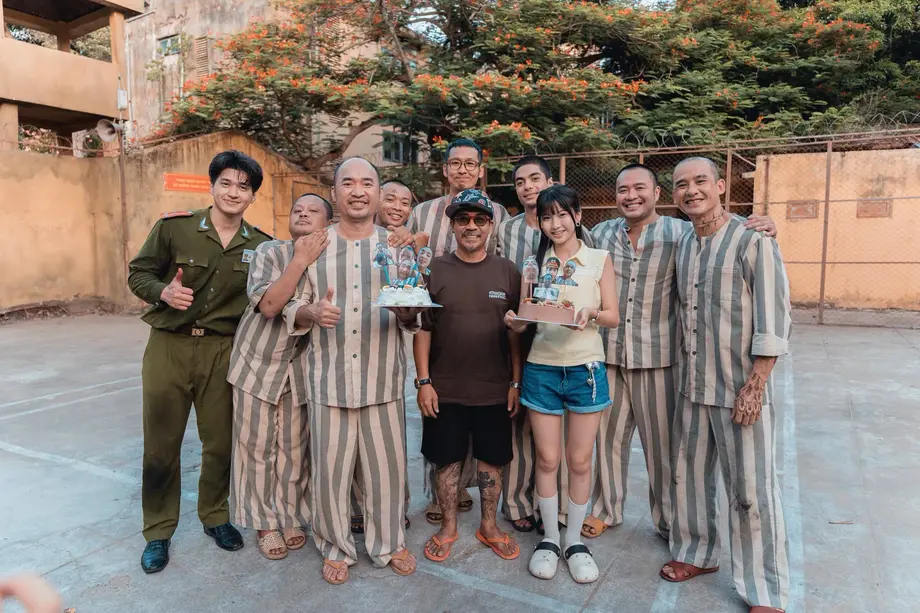
Much of the comedy comes from the group known as F6 in cell D9. Chính, played by Tiến Luật, likes to display authority while protecting younger inmates. Điền, played by Hoàng Phi, uses crude behavior to conceal the pain of having no family. Thuận, played by La Thành, longs for affection and a home. Minh Hữu, played by Gi A Nguyễn, withdraws because of prejudice surrounding his sexuality. Khuyến Dương plays Bách Khoa, an illiterate prisoner with a rough exterior whose story involving his mother supplies some of the film's most emotional scenes. Their arguments, practical jokes and gradual friendships allow the story to move between physical and psychological abuse, laughter and the desire to begin again.
The street helper who inspired Phúc
Phúc's kindness has a model outside fiction. Đỗ Thành Long, widely known as chú Long Quận 9, became familiar on social media through his yellow Honda Wave and his free assistance to strangers around Ho Chi Minh City. For more than 15 years, he has repaired motorcycles, patched tires, supplied petrol and provided first aid. Accounts of his work describe thousands of people assisted, including injured people taken to hospital and travelers who lacked money to get home. He received a local commendation for exemplary good deeds in 2024.
Long also appears in the film as a motorcycle repairman in two short scenes. In the first, Phúc gives petrol to a flower seller, leaving himself and Hạnh without enough fuel to get home. Long then helps the siblings, passing assistance from one stranger to another. In the second, he quietly watches Hạnh spend her limited money on ice for a container of free drinking water. Neither scene requires him to deliver a speech; his presence connects the film's message to a person already known for helping without payment.
Trung Lùn invited Long to attend a screening after the release. Work commitments had prevented him from going when the cameo was first discussed publicly, and no later attendance was announced.
Why did a quiet November release become a hit?
The premise is easy to explain: a gentle teacher enters prison and tries to retain his decency among people who expect him to harden. Prison life has rarely been examined directly in Vietnamese commercial cinema, giving the film a distinctive setting. At the same time, its mixture of comedy, family feeling, remorse and moral choices resembles the accessible formula Trung Lùn used in his two Làm giàu với ma comedies. Viewers can follow the jokes without knowing anything about prison procedure, then stay for the prisoners' personal histories.
The cast supplied several routes to different audiences. Tuấn Trần, Tiến Luật, Ma Ran Đô and Lương Thế Thành brought established followings. Khuyến Dương, already known for comedy on TikTok, helped the production reach younger viewers. Singer Duy Mạnh appears in a cameo and contributes Kiếp đỏ đen, which provided material for widely shared clips. He also wrote and performed Đóa Tường Vi vẫn nở, used at an emotional point in the story. Audience recommendations, excerpts from comic scenes and discussion of the relationship between Phúc and Tú then kept the film visible after its initial publicity.
Timing reinforced that response. Vietnam Culture Day on November 24 gave many people an additional day for leisure activities, and cinemas benefited alongside museums, historical sites and concerts. Several earlier releases were already losing momentum. At its busiest before the VND200 billion milestone, The Happiest Cell had nearly 5,600 daily showings. Box Office Vietnam said only Despicable Me 4, Mưa đỏ and one Trấn Thành feature had previously exceeded that level. More tickets encouraged cinemas to allocate more screens, which in turn made the film easier to find at convenient times.
Trung Lùn's third hit after 30 years in entertainment
Trung Lùn was born Nguyễn Nhật Trung in 1972 and graduated from Theatre Arts School II in 1995. The institution later became the Ho Chi Minh City University of Theatre and Cinema. He began as a comedy actor, struggled to find consistent work and temporarily left the profession to earn a living. His appearances in Lý Hải's Trọn đời bên em music films brought wider attention and helped lead him toward directing.
His television credits include Gia đình là số 1 in 2017, Ngôi sao khoai tây in 2018, the second season of Gia đình là số 1 in 2019 and Sui gia hay xui gia in 2022. Years of sitcom work are visible in his ensemble scenes, where one actor sets up a joke and another supplies the response. He was already over 50 when his first cinema feature, Làm giàu với ma, earned VND128 billion in 2024. Its 2025 sequel, Làm giàu với ma 2: Cuộc chiến hột xoàn, earned VND101 billion. The Happiest Cell is his third feature and his third consecutive film above VND100 billion, making him the second Vietnamese director after Trấn Thành to achieve that sequence with his first three features.
For this project, Trung Lùn and the screenwriter sought material from police officers and people with professional knowledge of prisons. The crew also constructed a prison set rather than relying entirely on an existing location. Explaining how those sometimes conflicting accounts shaped the script, the director said:
Each person brought the crew different stories and advice. In the end, I made the bold decision to tell the story in the most humane way possible.
After the film passed VND200 billion, Trung Lùn called the gross a very solid number and said his emotions remained much the same. He instead highlighted lengthy messages from colleagues describing their reactions, adding:
Being praised by so many colleagues is the greatest happiness.
Strong performances, but an overcrowded script
An early review awarded the film four out of five, praising its ability to move between comedy and tragedy without making every prisoner either a monster or a saint. Tuấn Trần's restrained performance gives Phúc uncertainty and inner conflict as well as goodness. Ma Ran Đô keeps Tú's personality consistent while allowing his attitude to change. Lương Thế Thành's threatening appearance marks a sharp departure from gentler roles, while Khuyến Dương supplies both humor and quiet emotional scenes. Comparisons with the Korean drama Prison Playbook arose because of the setting, but the Vietnamese film uses different conflicts and places greater weight on a direct movement between laughter, suffering and consolation.
The reservations are just as specific. The opening can feel slow, numerous secondary stories dilute the central narrative and too much tragedy is placed on Phúc. Some dialogue becomes melodramatic, several resolutions arrive too easily and some prisoners receive backstories that are not fully convincing. Long Đầu Bò's history and motives are particularly thin, leaving the villain with less depth than the people around Phúc. The sorrowful conclusion may also surprise viewers who expect the title and the warm middle section to lead toward an uncomplicated happy ending.
The T16 classification indicates that the film is intended for viewers aged 16 and above. Frequent profanity and sensitive sexual material involving gay characters may make it unsuitable for some family outings, so parents of teenagers should consider those elements alongside the rating.
Lương Thế Thành said VND200 billion was a figure he had never dared to imagine. He also treated hostile messages about his villain as encouragement, recalling similar reactions to his role in Bóng ma hạnh phúc:
This is the second time I have had the honor of being scolded. Thank you, audiences. These words are motivation for me to continue with even more villainous roles.
A police screening takes the message beyond entertainment
Tân Hưng Ward Police in Ho Chi Minh City organized a screening on November 25 at the CGV cinema in the SC VivoCity shopping center. People under the ward police's management attended alongside officers and partner forces. The purpose was education and rehabilitation rather than an ordinary recreational outing.
In a public explanation of the event, the ward police described what they wanted participants to take from the story:
The activity helps people who have made mistakes understand more deeply the consequences and harm of breaking the law, and the losses for themselves, their families and society when they become involved in crime.
The program also incorporated warnings about drugs, legal consequences, reoffending and relapse into addiction. The police statement presented prevention and education as partners to enforcement, with each participant's positive change serving as a measure of effectiveness under the tasks of Steering Committee 26. For viewers discussing the film online, the screening offered a concrete example of its themes of responsibility and second chances being used outside commercial cinemas.
What VND200 billion means for the business
Trung Lùn previously estimated that the film would need about VND100 billion in ticket sales, possibly a little more, to break even. A detailed production budget and eventual profit have not been disclosed. Box office revenue is the total paid for tickets before exhibitors, distributors and other parties take their shares, so doubling the director's estimated break even point does not mean the production has earned VND100 billion in profit.
The wider market shows why the milestone matters. More than 70 Vietnamese film projects entered the market in 2026, but only a portion passed VND100 billion. Hộ linh tráng sĩ, for example, had investment of approximately VND100 billion yet grossed just VND38.4 billion. The year's successes also span very different subjects: cross border trafficking in Trại buôn người, relationships in Thỏ ơi!!, family memory in Nghỉ hè sợ nghỉ hưu and folk horror in Phí Phông. A recognizable subject or famous cast can attract an opening audience, but it does not guarantee enough recommendations to sustain screenings.
The film adds to two substantial box office careers. Tuấn Trần had already become the first Vietnamese actor associated with VND1,000 billion in cumulative ticket sales from films he led, following his breakthrough in Bố già. Films featuring Ma Ran Đô have accumulated nearly VND950 billion, and his first three features, Nụ hôn bạc tỷ, Tử chiến trên không and Truy tìm Long diên hương, each passed VND200 billion. These figures measure the films' ticket revenue, not the actors' personal earnings.
The next tests at the box office
The Happiest Cell had entered its second official week by November 28, but its final gross and closing date remain unknown. It had not announced a VND300 billion milestone. Retaining a large number of showings will become more difficult as new Vietnamese releases arrive.
Hàm Trần's Con mắt thứ ba is scheduled for December 4 after selection for the Midnight Passion section at the 2026 Busan International Film Festival. Hoàng Tuấn Cường's action and family drama Người mẹ xấu is scheduled for December 31. Mẹ Mìn has postponed its release for a second time; its producers gave no specific reason and have not announced a replacement date. Those decisions will determine how much direct competition Trung Lùn's film faces during the rest of its run.
At a Glance
- The Happiest Cell passed VND200 billion on November 27 and exceeded VND208 billion by noon on November 28.
- It was the fifth Vietnamese film to reach VND200 billion in 2026.
- The film opened officially on November 20 after previews began on November 18, earning VND21 billion on its first day.
- Vietnam Culture Day on November 24 supplied its best daily result, nearly VND37.9 billion.
- The story follows literature teacher Phúc as he navigates cell D9 and changes inmates and prison officer Tú.
- Phúc was inspired by free roadside helper Đỗ Thành Long, who appears in two cameo scenes.
- The film is Trung Lùn's third consecutive feature to exceed VND100 billion.
- Its strengths include the ensemble acting and balance of humor and emotion; its weaknesses include crowded subplots and a divisive ending.
- The T16 film contains frequent profanity and sensitive sexual material, warranting consideration by parents of teenagers.
- Its final revenue is not yet known, with new local releases scheduled for December 4 and December 31.