What changed for public medical seats
Public medical colleges in Bangladesh will admit 5,270 students to MBBS courses in the 2026 to 2027 academic year, 270 more than the 5,100 public places available a year earlier. The same final list keeps 545 BDS seats across nine government dental colleges and dental units. Applications opened online on 25 November, candidates have until 3 December at 11:59 pm to apply, and the common entrance test is set for 18 December from 10:00 am to 11:15 am.
Contents
- What changed for public medical seats
- How the extra places were counted
- Where the three new colleges will start
- Why the Fulbaria approval drew objections
- Key dates students should follow
- Who may apply, and which groups get relief
- How the common test will decide rank
- How many places exist outside government colleges
- What the expansion changes on campus
- Key Points
The increase is more than a number on a form. It brings three newly approved colleges into the admissions list for 2026 to 2027: Thakurgaon Medical College, Narsingdi Medical College and Sarkari Karmachari Medical College in Fulbaria, Dhaka. Each is listed with 50 MBBS places. The the admission circular, issued by the Directorate General of Medical Education on 25 November, also gives 40 government medical colleges in total. It covers admissions to government and private medical and dental colleges, but the new public seats are the part that changes the public system most directly.
One practical caveat sits beside the expansion. The main notice said none of the three colleges had its own infrastructure built yet. Officials connected with the colleges later said Narsingdi and Thakurgaon had been prepared enough for classes from May and June, while Sarkari Karmachari would start in two floors of an existing hospital. No date was given for complete permanent campuses at all three colleges.
How the extra places were counted
The headline increase comes from a simple comparison. Government MBBS seats stood at 5,100 in 2025 to 2026 and rose to 5,270 for 2026 to 2027. Add the unchanged 545 BDS places and the public total moves from 5,645 to 5,815, a rise of 270. Private medical seats, military seats and private dental seats are counted outside that public total.
The ministry document on the new colleges described 190 newly added places in three categories. It counted 150 seats at the three new public colleges, 20 extra seats at Shaheed Ziaur Rahman Medical College in Bogura and 20 extra seats in army run colleges at Bogura and Cumilla. Army places are not part of the 5,270 public MBBS figure, so the two totals answer different questions. The final public list is the figure used for the 270 seat rise.
College by college numbers in the final list matter to applicants because students choose preferences. The final list gives 250 MBBS seats each to Dhaka, Chittagong, Rajshahi, Mymensingh, Sylhet MAG Osmani, Barishal Sher-e-Bangla, Rangpur, Sir Salimullah and Shaheed Suhrawardy medical colleges. A published list of medical colleges put several of those colleges at 225 seats each, including Dhaka, Chittagong, Rajshahi, Mymensingh, Sylhet, Barishal, Rangpur, Sir Salimullah and Shaheed Suhrawardy. Applicants need to use the final admission list when filling choices.
Other government MBBS seats in the final list include 220 at Shaheed Ziaur Rahman Medical College in Bogura, 200 each at Cumilla, Dinajpur, Faridpur and Khulna, 125 each at Gopalganj, Shaheed Tajuddin Ahmad in Gazipur, Manikganj and Tangail, and 100 each at Cox's Bazar, Noakhali, Pabna, Jashore, Kushtia, Satkhira, Shahid Syed Nazrul Islam, Jamalpur, Patuakhali, Sirajganj and Mugda. Rangamati, Nilphamari and Sunamganj have 75 each. Habiganj, Chandpur, Magura, Naogaon, Netrokona and the three new colleges have 50 each.
Where the three new colleges will start
Thakurgaon Medical College received approval on 13 May, in the constituency of President Mirza Fakhrul Islam Alamgir, and became the 38th government medical college. Narsingdi Medical College followed on 14 June, in the constituency of Health Minister Sardar Mohd Sakhawat Hossain Bakul, and became the 39th. A 16 November meeting set 50 seats for each college.
Sarkari Karmachari Medical College took a different route. The Ministry of Public Administration issued a gazette on 9 November, signed by senior secretary Md Kamruzzaman Choudhury. A 22 November meeting at the Secretariat then approved 50 students for the college. The final seat list, signed by deputy secretary Mohammad Hamidul Islam, placed it in Fulbaria, about one kilometre from Dhaka Medical College. Officials working with the hospital described the distance as less than half a kilometre.
The college will use the Government Employees Hospital, a facility with 500 beds that serves more than 3,000 patients a day. Two floors are being prepared as classrooms and laboratories. The permanent campus is planned for the Jhilmil residential project area in Keraniganj. Because the hospital is close to Dhaka Medical College, the new college will depend heavily on shared clinical space, teaching staff and laboratory planning in its first year.
Bangladesh calls a medical school a medical college. Such colleges teach the MBBS degree, the main medical qualification for doctors, while dental units teach BDS, the dental qualification. Colleges are affiliated with a regional university that awards or oversees degrees. The Bangladesh Medical and Dental Council sets recognition standards. The new colleges are listed with Rajshahi Medical University for Thakurgaon and Dhaka University for Narsingdi and Sarkari Karmachari, with classes listed from 2027. The wider list ties other public colleges to Chittagong Medical University, Rajshahi Medical University, Sylhet Medical University and Khulna Medical University.
Why the Fulbaria approval drew objections
The Sarkari Karmachari college became contested because the gazette came from the Ministry of Public Administration, while medical colleges normally pass through health ministry review. The usual path sends a proposal to the Directorate General of Medical Education, then to a committee that visits the site and checks facilities. The health ministry reviews the recommendation before sending it onward for approval.
Officials connected with the process gave conflicting accounts. Public Administration Minister of State Abdul Bari first questioned the gazette and said medical college approval belongs to the health ministry. He later said his ministry had sent a proposal and that the health ministry had allowed 50 students.
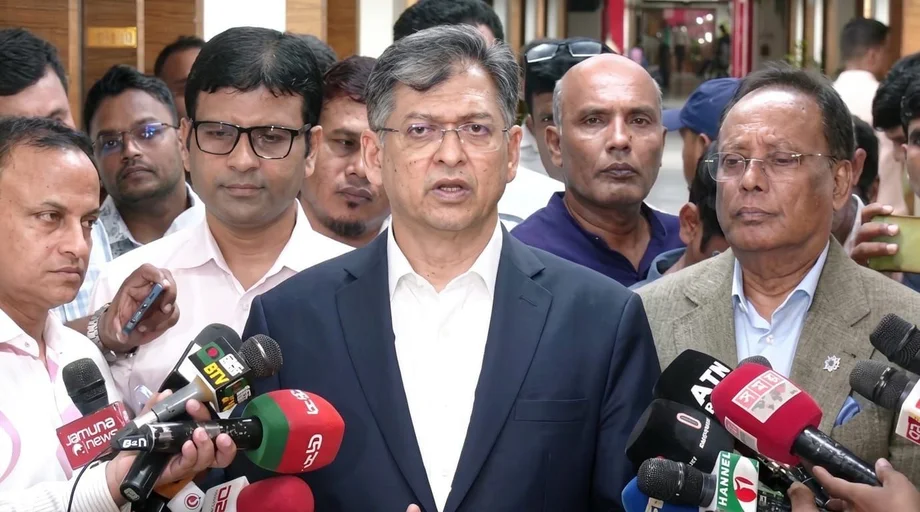
Health Minister of State E M A Muhit said on Wednesday at ICDDR,B that his ministry had not given formal establishment approval. He said a committee of seven members formed in June was examining applications for new medical and dental colleges. He said his ministry took a positive view of the proposal.
We are positive about the proposal.
The Public Administration senior secretary, Md Kamruzzaman Choudhury, who signed the gazette, argued that after government approval the health ministry took the needed steps. He said his ministry had authority over the order.
After government approval, the Ministry of Health took the necessary steps.
Former secretary and public administration researcher Abdul Awal Majumder said the order breached the Rules of Business, the rules that divide work between ministries. He said the list of 60 functions assigned to the Ministry of Public Administration does not include establishing medical colleges.
If the order published on the ministry website is correct, it is a clear violation of the Rules of Business or the code of procedures.
The office of the prime minister had no secretary at the time. At least two officials contacted for comment declined to speak officially, though one said the health ministry was the proper lead for establishing a medical college. That disagreement matters because the college is already in the admissions list, with 50 places advertised before every approval question had a public answer.
Key dates students should follow
The admissions calendar moved quickly from approvals to a national test. An earlier Directorate General of Medical Education plan, made on 16 September, had pointed to 4 December as a possible exam date. A Sunday meeting in the Ministry of Health conference room fixed 18 December, and the director general of medical education, Md Nazmul Hosain, confirmed the date. The final circular replaced the earlier date after the policy was published on 24 November and applications opened on 25 November.
- 13 May 2026: Thakurgaon Medical College approved as the 38th government medical college.
- 14 June 2026: Narsingdi Medical College approved as the 39th.
- 5 November 2026: the health minister promised 20 extra seats at Shaheed Ziaur Rahman Medical College in Bogura at its 35th founding anniversary.
- 9 November 2026: the gazette for Sarkari Karmachari Medical College was signed.
- 16 November 2026: a policy update meeting approved 50 seats each for Narsingdi and Thakurgaon.
- 22 November 2026: a health ministry meeting approved 50 seats for Sarkari Karmachari.
- 25 November 2026: online applications opened in the evening, and the final admission circular was published.
- 3 December 2026: application window closes at 11:59 pm.
- 4 December 2026: application fee payment closes at 11:59 pm.
- 14 to 17 December 2026: admit cards can be downloaded and printed in colour.
- 15 to 17 December 2026: attendance seats can be downloaded.
- 18 December 2026: MBBS and BDS entrance test runs from 10:00 am to 11:15 am.
- March or April 2027: classes are expected to start at the new colleges.
Application fee is 1,000 taka, paid only through a Teletalk prepaid mobile number. The exam authority said candidates must fill the online form according to instructions on the websites of the health education division, Directorate General of Medical Education, Directorate General of Health Services and Teletalk Bangladesh.
Who may apply, and which groups get relief
General candidates must be Bangladeshi citizens and must have passed HSC, A level or equivalent in 2025 or 2026. SSC, O level or equivalent must have been passed in 2023 or later. Both exams must be in the science group, and HSC studies must include biology, physics and chemistry. O and A level candidates must complete equivalence certification with the Directorate General of Medical Education before using those grades in the form.
The grade point average, or GPA, is the school score used for university entry in Bangladesh. General applicants need a combined GPA of at least 8.50 in SSC and HSC, with at least 3.50 in HSC biology. The policy says an applicant who passes the national test can then compete for a place. Ranking uses both school results and the entrance test.
Candidates from tribal communities and people from hill districts who are not from tribal communities receive lower academic entry thresholds. Their combined GPA requirement is 8.00, with at least 3.00 in biology. One percent of seats are reserved for disadvantaged groups, and the 25 percent of places at Rangamati Medical College are included within that reservation. The quota figures in the college list break the 5,270 public MBBS places into 4,953 general places, 264 freedom fighter places and 53 tribal places.
Foreign students seeking places in private medical or dental colleges need a combined GPA of 6.00 and 3.50 in biology. They become ineligible if either exam result is below 3.00. The 2026 to 2027 policy lowered that route from the previous combined requirement of 7.00 and the earlier single exam floor of 3.50.
How the common test will decide rank
The MBBS and BDS exams will use one question paper for the second year in a row. Government and private colleges are covered by the same test. Students who passed through English medium and want to sit the test in English will receive an English paper.
The written paper lasts 75 minutes and has 100 questions worth one mark each. Biology carries 30 marks, chemistry 25, physics 15, English 15, and general knowledge, professional attitude and human qualities 15. Negative marking means a wrong answer removes 0.25 marks, so guessing has a price. A candidate needs 40 marks to pass.
The final merit list has 200 marks. The written test supplies 100. SSC GPA contributes up to 40, calculated by multiplying the GPA by eight. HSC GPA contributes up to 60, calculated by multiplying the GPA by 12. Students who passed HSC in 2025 lose three marks from the total. Students admitted in the 2025 to 2026 academic year to a government medical college, dental college or dental unit lose five marks.
Those deductions create a second chance system with a cost. A 2025 HSC graduate can try again in 2026, but enters the rank list slightly behind a 2026 graduate with the same scores. A student already holding a government medical seat faces a larger deduction if seeking another place.
How many places exist outside government colleges
Private colleges form a large part of medical training in Bangladesh. The final figures list 68 private medical colleges with 6,021 MBBS seats and 25 private dental colleges or units with 1,360 BDS seats. A broader list of medical colleges put private MBBS places at 6,040, while the final admission figures gave 6,021. Public and private medical colleges together, excluding armed forces colleges, hold 11,291 MBBS places. Within that group, government colleges have 46.7 percent and private colleges 53.3 percent.
Armed forces colleges are listed separately. Seven colleges run by the armed forces offer 425 MBBS places. The Armed Forces Medical College in Dhaka has 125. Five army colleges in Bogura, Chittagong, Cumilla, Jashore and Rangpur now have 270 places in total after Bogura and Cumilla each gained 10. Navy Medical College in Chittagong has 50. The armed forces colleges are affiliated with Bangladesh University of Professionals.
Last year, 122,632 candidates applied for 13,051 seats across the wider admission system, and 66.57 percent passed the screening test. The new count of public and private MBBS and BDS places is close to that scale but not identical, because armed forces seats and some dental figures are tabulated separately. The test pass rate tells applicants how many cleared the cut scores, while final admission depends on rank, reservations and the order of college choices.
What the expansion changes on campus
The first visible change will be 150 new students at Thakurgaon, Narsingdi and Sarkari Karmachari. For Sarkari Karmachari, the first batches will study in a hospital built for patient care, not a dedicated college campus. The hospital has a patient load that makes clinical exposure possible, but classrooms, laboratories and teacher time must be carved out of an already busy workplace.
Teacher shortages matter because the government system has been short of teachers for some time. Data from the Directorate General of Medical Education showed 43.38 percent of teaching posts in government medical colleges were vacant in May. In November 2025, the health ministry reduced 280 public medical seats, citing shortages of teachers, infrastructure and laboratory facilities. The 2026 to 2027 decision reverses all but 10 of those 280 public places within a year.
Officials said Narsingdi and Thakurgaon had been prepared since May and June and were closer to readiness. The Fulbaria college had a less settled plan, including talks to rent a nearby Bangladesh Railway building for classes. Public Administration Minister of State Abdul Bari said discussions had begun with the railway.
We have already discussed the matter with them. Through an agreement between ministries or another arrangement, we can take it on rent. Classes will be held there.
Students will feel the difference in practical ways. A medical college needs lecture halls, anatomy and pathology laboratories, hospital wards for clinical teaching, experienced doctors who teach, and a university affiliation that governs exams. If those pieces arrive slowly, the first cohort may spend its early months in temporary arrangements even though its seats are already counted in the national list.
Key Points
- Public MBBS seats rose by 270 to 5,270 across 40 government medical colleges.
- The nine government dental colleges and units keep 545 BDS seats.
- Thakurgaon, Narsingdi and Sarkari Karmachari medical colleges each have 50 seats for the incoming year.
- The Sarkari Karmachari approval drew public dispute over which ministry had authority.
- Applications close on 3 December, fees on 4 December, and the common test is on 18 December.
- The exam has 100 questions, 75 minutes, a 40 mark pass score and negative marking.
- Infrastructure, teacher vacancies and permanent campus plans remain the main concerns for the new colleges.