A real professor inside a fictional Song dynasty
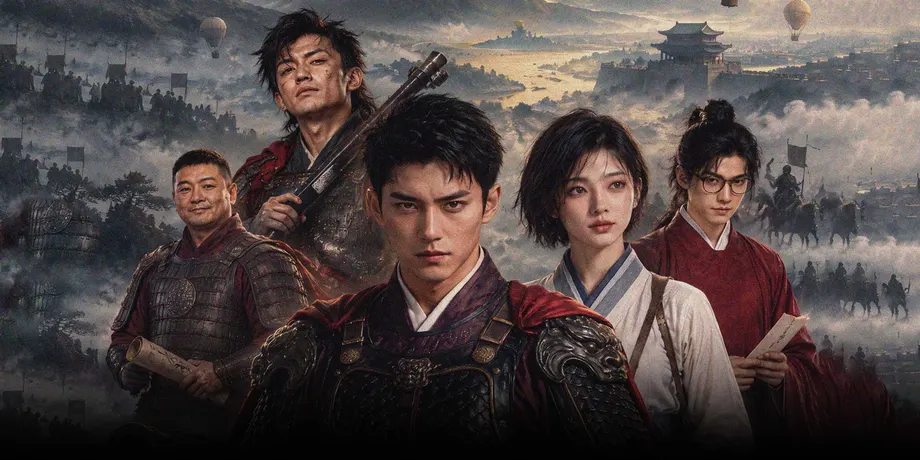
An AI drama about five modern soldiers trying to prevent a national catastrophe has done something unusual even by the standards of Chinese internet fiction: it paused the action so a real historian could explain the history. The series, Chixie Ru Song, whose title can be rendered as Entering the Song With Weapons, has passed 12 billion plays across the internet since its launch in August. That figure counts plays rather than individual viewers.
Contents
- A real professor inside a fictional Song dynasty
- How 13 days produced a digital double
- What happens when modern weapons meet 1122
- Why the Northern Song still stirs strong emotions
- Fame stopped at the screen
- The remote studio behind more than 1,100 episodes
- Why the power fantasy still has rules
- Where vertical video and AI still show their limits
- AI has also changed Wu's scholarship and classroom
- The ending is fixed, but the historical test remains
- What to Know
The production has released more than 1,100 episodes across 11 seasons in roughly four months. It has also collected more than 10 million saves on Hongguo, a Chinese platform for short dramas. Most installments are brief and designed for a vertical phone screen, allowing the story to advance through frequent confrontations, discoveries and reversals.
At the end of season 11, Professor Wu Zhengqiang of the School of History at Zhejiang University appeared in episode 113 as a digital version of himself. Wang Haochuan, one of the travelers from the present, asks him why the prosperous Northern Song dynasty moved step by step toward the Jingkang Incident. Wu's face and voice were produced with AI, but the historical explanation came from a scholar who has studied the Song period for more than two decades.
How 13 days produced a digital double
The collaboration began with a WeChat friend request on November 3. An intermediary asked Wu to provide historical knowledge for the drama. His first response was to decline. He did not watch short dramas and initially assumed that advising on a production, or reviewing its episodes, would consume too much time. His usual viewing leaned toward historical documentaries and videos about knowledge rather than brief fictional serials.
The intermediary persisted, explaining that the team wanted to improve the production and offer reliable background to an audience that already included highly educated viewers. A telephone conference the next morning convinced Wu that he would not need to supervise the drama. He only needed to explain Song history. He downloaded the Hongguo app, watched some episodes and read the comments. The mixture of knowledgeable viewers and complete beginners persuaded him that an introductory explanation could be useful.
- November 3: An intermediary approached Wu on behalf of the production team.
- November 4: After an online telephone conference, Wu agreed to take part.
- Three days later: He delivered a memo of about 3,000 Chinese characters, prepared with assistance from AI, covering government offices, clothing, warfare, diplomacy and historical figures.
- November 14: At 1 p.m., he received a sample lasting four minutes and 35 seconds, about 12 hours before publication.
- November 15: Season 11 appeared at 1:08 a.m., with Wu's cameo following 112 main installments in that release.
Wu supplied photographs and video material, while the producers created versions of him in ancient and modern clothing. He chose the modern appearance. An early model struck him as too realistic, so he requested adjustments and later joked that people might not recognize him. The synthesized voice surprised him with its accuracy, including a discernible Zhejiang accent. The sample originally had him speaking to a student, but the final version substituted Wang Haochuan, which Wu considered a better dramatic choice.
Only two small corrections were needed before release. The platform's heat reading passed 100 million on the first day, reaching the series' highest level since August. Heat is a platform measure of activity, not a count of individual viewers. From the first invitation to publication, the entire process took 13 days. Wu never met any member of the creative team in person and dealt almost exclusively with his designated contact.
What happens when modern weapons meet 1122
The story begins in 1122, the fourth year of the Xuanhe reign. Five modern special operations soldiers arrive near Qinghe village on the northwestern frontier. Lin Zhao handles strategy, Xie Changfeng conducts military operations, Wang Haochuan enters the civil administration, Ma Zhenbang develops weapons and Chen Su builds a medical service. Internet fiction calls this arrangement group time travel because several people cross into the past together rather than relying on one exceptional hero.
The date matters. Wu points out that major fighting between the Song and Western Xia had ended by then. The Song court was forming the Alliance Conducted at Sea with the newly powerful Jin dynasty, agreeing to attack the Liao from different directions. The drama's successful campaign against Western Xia, followed by a protagonist choosing to start another war, therefore departs from the historical sequence.
Modern equipment does not make the five travelers unlimited in power. Their ammunition cannot be replaced, so firearms remain a reserve rather than an everyday solution. Ma Zhenbang instead improves existing Song bow technology and develops the Qinghe crossbow, which local workshops can manufacture. Wang must learn how a person without an established family can qualify for the imperial examinations and enter government. Wu compares the registration problem to needing the correct local documentation before taking a modern examination.
The appearance of the Yao and Zhong families adds another historically grounded detail. Both were influential military lineages in the northwest, even when particular scenes involving them are fictional. For Wu, these restrictions create the drama's central tension: guns may change a battle quickly, but they cannot transform a dynasty at the same speed.
Why the Northern Song still stirs strong emotions
The Jingkang Incident destroyed the Northern Song in 1127, five years after the drama begins. Jin forces captured the capital, Kaifeng, and took Emperors Huizong and Qinzong north. For viewers familiar with the event, every victory won by the fictional soldiers carries the same underlying question: can this known disaster still be prevented?
Wu sees the show's popularity as an emotional response to the contrast between Song achievement and Song defeat. The period is associated with extraordinary economic, political and cultural accomplishments, yet its armies repeatedly suffered in conflicts with neighboring states. Public anger over the treatment of the general Yue Fei adds to that frustration. One historical interpretation also imagines that the Song had opportunities for early modern development that were later interrupted, encouraging speculation about whether different decisions might have produced another outcome.
Chinese fiction has already explored several ways of returning to the Song. Shao Song concentrates on an emperor, while Zaizhi Tianxia and Xin Song emphasize institutional reform. Chixie Ru Song belongs to a military approach. Wu considers such stories counterfactual exercises, meaning that they deliberately change conditions and ask what might follow. He does not expect an entertainment serial to meet the standards of academic research. Its rapid emotional rewards and the slower, more demanding work of historical study serve different purposes.
Fame stopped at the screen
Wu followed the response to his episode by using AI tools to organize and examine about 50,000 comments. Most viewers requested new episodes or praised the drama. Only a small number wondered whether the professor was real. Before news coverage of his participation spread, his younger brother was the only person among his relatives and friends who had seen it. His students, who generally did not watch the serial, were surprised to discover that their teacher had taken part.
Wu summarized the response when speaking about his sudden visibility.
It is not me who is popular. It is the drama.
Speaking at Zhejiang University on November 26, he rejected the suggestion that he had entered a new profession. His avatar represented a real scholar delivering historical information, which he compared to giving a public lecture away from campus. He said the experience had not changed the nature of his work, and he was not worried that it would damage his academic authority. The show's enormous audience had not brought comparable attention to his own publications.
He has no plan to become a history blogger, and he does not currently have time to operate or develop the digital avatar, which he says remains his own. He would accept a similar invitation from another production and joked that he would enjoy appearing as a guest character. The collaboration also made him wonder whether his books, including Guanjia de Xinshi and Zhongchen zhi Bian, could be adapted for the screen.
The remote studio behind more than 1,100 episodes
The drama was adapted from Chagen'er's web novel by Lao Shiyi Theatre, a grassroots production group rather than a conventional studio filled with full time actors and camera crews. Its three central creators live in Hebei, Jilin and Hubei. They did not meet together in person until the production had reached roughly 1,000 episodes. Other participants are spread across Hubei, Anhui, Jiangxi, Guangdong and Fujian, and the wider group has never assembled in one place.
Team members include mothers caring for children at home, drivers for ride hailing platforms and delivery workers. Scripts, scenery and character assets advance through separate workstreams, while AI tools generate the visual material. The creators place prompt writing near the end of the technical process rather than treating it as the whole method. Wu's experience fits that pattern: a scholar in Zhejiang could enter the story without visiting a set or meeting the director.
The remote workflow does not mean that every historical detail is disposable. The team discarded and remade several consecutive episodes after discovering that the colors of official robes did not match the relevant ranks. Its model of the poet Li Qingzhao began with a surviving classical painting, which was restored through AI and then adjusted. Some viewers said they recognized her immediately.
Why the power fantasy still has rules
Many time travel stories turn modern knowledge into immediate superiority. Chixie Ru Song gains part of its appeal by slowing that process. Saving Qinghe village does not automatically give the travelers legal status, obedient soldiers or control of the state. They must establish themselves locally, train village defenders, build medical capacity and work within the limits of Song institutions and production.
Wang Haochuan's examination route illustrates the difference between knowing modern facts and obtaining authority in another society. The death of Qin Hongying provides an even harsher limit. Advanced knowledge cannot always protect a person from corrupt institutions or destructive human behavior. That loss interrupts the fantasy that a traveler with superior information must invariably win.
Wu regards complaints about incorrect official titles or implausibly fast promotions as useful audience feedback, but he does not think every narrative shortcut deserves academic condemnation. His own standard is whether the characters face meaningful constraints. A modern soldier who still needs local allies, legal status and replaceable weapons offers a more demanding story than one whose knowledge removes every obstacle.
Where vertical video and AI still show their limits
The same format that makes the serial easy to consume also restricts it. Most short dramas use a 9:16 vertical image, leaving little horizontal room for armies, crowds or landscapes. Episodes commonly last less than three minutes, and their opening seconds can influence whether platform algorithms recommend them. The result is a story often built by connecting one outcome directly to the next.
In Chixie Ru Song, the travelers rescue villagers and become accepted within days. The leader quickly becomes a community head, while militia training, a clinic and improved weapons follow at high speed. Those developments are understandable as plot summary, but they leave little space for ordinary routines or the gradual construction of trust. The suffering of frontier communities is also conveyed more through dialogue and close reactions than through expansive scenes.
The visual errors are sometimes much smaller and much stranger. A raw yolk floats in egg soup. Bowls appear empty during meals, chopsticks vanish, and modern military clothing or a Bluetooth earpiece survives scenes in which the soldiers have supposedly settled into Song life. Even in season 10, close views of memorials and letters can reveal simplified Chinese characters, invented characters or disordered writing.
These mistakes persist partly because AI video is generated in shots or segments. Correcting one object can require generating the scene again and may alter a character's appearance in neighboring shots. Repeated repairs consume computing capacity and introduce fresh risks, so a production working at this speed may leave an error in place. The result is a serial that can sustain a complex plot while still struggling with the contents of a soup bowl.
AI has also changed Wu's scholarship and classroom
Wu's cameo was not his first experiment with the technology. When AI image tools were still new to him, he used portraits of Song emperors to produce a complete set of playful cartoon likenesses and three dimensional images. His version of Zhao Kuangyin, the dynasty's founder, became round and cheerful. He also designed refrigerator magnets and later followed AI adaptations of classic literature and news of the children's author Zheng Yuanjie turning fairy tales into animated works.
His confidence in AI research developed more cautiously. An earlier test asking for a Song figure's examination record produced an answer that looked plausible but contained fabricated information. He subsequently tested several systems against foundational historical collections, including Xu Zizhi Tongjian Changbian, Song Huiyao Jigao, Quan Song Wen and Sanchao Beimeng Huibian. He eventually selected the strongest service and paid for its most expensive membership level.
Wu now says the better systems can provide references, make preliminary distinctions between evidence and occasionally locate material that would otherwise be difficult to find. He considers some of his former database retrieval work replaceable. That experience also explains why he sees AI as an unstoppable change, even though he does not know whether his own digital appearance will ultimately have positive or negative effects.
The classroom presents a harder problem. Wu considers banning students from AI pointless, but unrestricted use can allow them to skip training in traditional historical methods. Cost creates another divide because dependable services require subscriptions and paid usage. Students who can buy more capacity may produce stronger results, while he cannot fund every member of a class. He says he still has no satisfactory answer for setting assignments or assessing them fairly.
The ending is fixed, but the historical test remains
Chagen'er, author of the original novel, has already established one part of the eventual conclusion: none of the five travelers will return to the present. Important characters die at decisive moments, giving the story a cost that sits uneasily beside the pleasures of victory. Chagen'er described the moral center of that ending directly.
The story I write is anti-war.
Additional episodes outside the main ending have been planned, but the author says the time to announce them has not arrived, and no release date has been given. Wu remains curious about a different problem. He wants to see how the writers connect the coming conflict between Song and Jin to the Jingkang catastrophe, and whether the five travelers can make their altered history coherent.
That uncertainty contrasts with the television drama Taipingnian, which begins with the known endpoint of Wuyue surrendering its territory to the Song and employs several historical advisers to refine costumes, objects and official titles. Wu compares Chixie Ru Song to digging a very large hole and says he wants to see how its creators fill it.
For viewers inspired to check the history, Wu draws a practical distinction. A counterfactual drama can awaken interest, but dependable facts still require documentaries, scholarly books and reading. He is returning to his own teaching and research while the production must demonstrate whether changing individual battles can produce a convincing alternative for an entire dynasty.
What to Know
- Chixie Ru Song has passed 12 billion internet plays and released more than 1,100 episodes across 11 seasons.
- Wu Zhengqiang appeared as a digital avatar in episode 113, explaining the background to the Jingkang Incident.
- The collaboration took 13 days from the first WeChat request to publication, and Wu never met the creative team in person.
- The story begins in 1122 and follows five modern soldiers whose weapons, knowledge and ambitions remain limited by Song institutions and resources.
- A widely distributed grassroots team produces the series remotely, while historical errors can still require entire sequences to be remade.
- The vertical format, compressed pacing and AI visual errors continue to restrict the production despite its scale and popularity.
- The eventual ending will not send the travelers home, while extra episodes remain planned without an announced date.
- Wu is open to similar collaborations but plans to continue his academic work rather than become a full time history blogger.