A Gulf conflict is pushing Nepali families into the hands of loan sharks
Nepal's government is being urged to stop illegal moneylenders from seizing land, evicting families and using violence or sexual coercion after conflict in the Gulf cut off the earnings on which many borrowers depended. Human Rights Watch said an estimated 2,000 Nepalis were denied labour permits each day after departures were suspended in March 2026, leaving people with jobs, visas and loans but no permission to travel.
Contents
- A Gulf conflict is pushing Nepali families into the hands of loan sharks
- How loan papers can turn a small debt into a claim on everything
- The permit shutdown turned delayed jobs into defaults
- When police treat violence as a private dispute
- Families paid many times over and still lost everything
- Women, Dalits and Indigenous communities face added danger
- A prison sentence of up to seven years has not cleared the backlog
- Years of protests produced another nine point agreement
- What meaningful enforcement would change
- Key Points
The Human Rights Watch statement, dated November 26, 2026, said its researchers interviewed 18 borrowers, local government officials, lawyers and activists in six districts of the Tarai, Nepal's southern plains. They also reviewed government reports and examined more than 50 cases in Nawalparasi district. The abuses they documented include beatings, death threats, unlawful land dispossession, arbitrary eviction and sexual exploitation.
Meenakshi Ganguly, the organisation's Asia deputy director, said illegal practices were rife despite government commitments and were leaving people with the fewest resources dependent on lenders who could take everything they owned. She urged Prime Minister Balendra Shah's government to enforce the law against fraudulent and abusive lending consistently, rather than leaving borrowers to negotiate individually with creditors before cases reach court.
At least two Nepali workers have been killed in the conflict and 15 injured, the statement said. It asked Nepal's international partners to support affordable institutional credit, debt relief and stronger protection for migrant workers. The group said the conflict did not create predatory lending, but made an existing system more dangerous by removing wages and remittances while loan demands continued.
How loan papers can turn a small debt into a claim on everything
Government investigations described a practice in which a borrower signs or places a thumbprint on an unsecured personal loan contract known locally as kapali tamasuk. The document can falsely list a principal amount three to ten times larger than the cash actually received. A person who borrowed 100,000 rupees could therefore face paperwork claiming a debt of 300,000 to 1 million rupees before interest is even considered.
These loans are commonly called meter byaj. Human Rights Watch found cases with compound annual interest rates of 36 to 60 percent or more, compared with less than 10 percent charged by banks. Compounding means that unpaid interest is added to the balance, allowing further interest to accumulate on a growing debt. Borrowers who miss payments can consequently owe far more than they expected even while making regular payments.
The system has roots in Nepal's feudal history, when local elites used debt to bind peasants to tenancy and hereditary servitude, including the Kamaiya and Haliya systems. The present form of meter byaj expanded during the civil war from 1996 to 2006 and spread rapidly after political unrest in the Tarai in 2007. Land and property became the main assets that families could lose.
An estimated 7 million Nepalis now work abroad. About half are in India, while a majority of the remainder work in Gulf countries. Their remittances, the money sent home to relatives, contribute about a third of Nepal's gross domestic product. With affordable credit difficult to obtain, many households borrow from informal lenders to pay recruitment and travel costs. Human Rights Watch has previously found that some companies in Gulf states drive these costs by refusing to pay recruiters' fees, knowing that workers will ultimately bear them.
The permit shutdown turned delayed jobs into defaults
The United States and Israel began their assault on Iran on February 28, 2026. Iran subsequently blocked and attacked ships travelling through the Strait of Hormuz and attacked sites across Gulf states, according to the findings. The strait is a narrow passage for shipping between the Persian Gulf and the open ocean, so disruption there affects fuel supplies, transport costs and trade well beyond the immediate conflict.
Nepal suspended institutional and individual labour permits in March to protect its citizens. The restrictions covered destinations including Saudi Arabia, the United Arab Emirates, Qatar and Kuwait, and applied both to recruitment arranged through institutions and to permits obtained individually. Thousands of people were stopped at the international airport despite having valid medical clearances, verified visas and binding employment contracts. Administrative delays also led foreign companies to cancel contracts.
Workers who were already abroad faced job losses, unpaid leave, wage reductions and other disruptions that reduced their ability to send money home. Department of Foreign Employment data showed that approvals for work in the Gulf fell by 52 percent, from 228,165 to 109,249, between the outbreak of the war in late February and mid September compared with the same period a year earlier. Returnees often arrived without the income they had expected while their loan payments continued.
The economic pressure extends beyond migration. UN agencies warned that rising fuel prices, closed shipping routes and financial uncertainty were placing mounting pressure on economies, labour markets and vulnerable households. The World Bank projected that Nepal's economic growth could fall from 3.67 percent in 2024 to 2.3 percent in 2026 because of reduced tourism, higher transport costs and supply chain problems. Inflation, a weakening currency, expensive fuel and stalled fertilizer supplies add to household costs. Families then divert money toward food, fuel and healthcare, leaving less for loan repayments and increasing the risk of default.
When police treat violence as a private dispute
Borrowers told Human Rights Watch that default can bring public humiliation as well as financial demands. An unnamed borrower from Rautahat said lenders beat his father in front of other villagers to pressure the family into surrendering its land.
They beat him in the middle of the road during the day so that everyone else in the village would see what happens when you cannot pay the meter byaj. The local goons told us, 'If you don't sign over the land title today, your family will receive a corpse tomorrow.'
Borrowers and activists in Madhesh Province said police repeatedly refused to register complaints and instead described intimidation by moneylenders as private civil disputes. A migrant worker from Rautahat said that when a lender came to break his family's door, officers told them to go home and settle the matter themselves. Such treatment can leave threats, forced entry and violence outside the criminal process even though the law covers abusive lending.
Signed blank cheques provide another source of pressure. A borrower signs without entering an amount, allowing the lender to fill it in later and use banking laws when the cheque cannot be paid. A farmer from Siraha district described how this was used against him.
The lender made me sign a blank check when he gave me a loan, and later on he filled it for 10 lakhs (US$6,500) and sent the police to threaten me with jail when the check bounced.
Ten lakh means 1 million rupees. Borrowers also described lenders using informal deeds and disputed contracts to obtain foreclosure orders, arrest warrants, land transfers and evictions. Shiv Shanker, a protest leader from Gaur in Rautahat who says he experienced moneylender abuses himself, described the power imbalance he encountered.
The lender told me openly that he owns the courts and the administration.
Families paid many times over and still lost everything
Ramnath Musahar, from Susta in Nawalparasi district, said his family borrowed money in 2015 to send two of his brothers to work in the Gulf. The brothers sent home 1.2 million rupees (US$8,000), and the family sold land to pay another 1.8 million rupees (US$11,000). Despite those payments, the lender went to the district court with what Musahar described as a fake contract and claimed that the family still owed 5 million rupees (US$33,000).
Musahar said the court relied on the document and the family's thumbprints, after which police removed their belongings. He described the transformation of their lives in his own words.
The court looked only at the paper and our thumbprints; it did not look at our tears. The police came and threw our belongings into the dirt. We went from being independent farmers to beggars overnight.
Santidevi Mahato from Biratnagar died by suicide on June 21 after threats from a moneylender, according to people interviewed by Human Rights Watch. She had borrowed 150,000 rupees (US$975) in October 2015 and repaid 400,000 rupees (US$2,600) in instalments. Even after receiving more than twice the original sum in repayments, the lender seized her land and threatened to evict her from her house in violation of their agreement, the interviewees said.
Women, Dalits and Indigenous communities face added danger
Human Rights Watch said households headed by women, Dalits, who have historically been labelled untouchable and subjected to caste discrimination, and Indigenous ethnic communities often have fewer protections against beatings, sexual violence and dispossession. A woman from Dhanusha district said a moneylender raped her after threatening to evict her children while her husband was trapped in a labour camp abroad and unable to send money.
She said the lender arrived with the contract and demanded that she compromise with him to prevent the eviction. She described how control over her home was used as coercion.
He held our roof over my head like a weapon. I had to endure his abuse in silence because a poor woman in this village has no voice against a powerful man who holds her land paper.
Chirai Chamar, a widowed Dalit worker in Paklihawa, Nawalparasi, borrowed 20,000 rupees (US$130) while struggling to secure control of inherited family land. She said the moneylender offered to help obtain ownership papers in exchange for two katthas, or 650 square metres, of land. He then took another four katthas and paid her 150,000 rupees (US$970), a sum she considered grossly below its value. When rights activists tried to recover the land and restore her livelihood, local thugs threatened them and destroyed her crops. She said police and local officials did not assist despite complaints.
Ashamaya, a resident of Thecho in Lalitpur whose name was changed for her account, ran a small tea shop before closing it to care for her sick father in law. She borrowed at an annual interest rate of 120 percent as medical costs mounted, then took another expensive loan to repay the first. She later sold land to settle a debt but had to borrow again for her husband's medical treatment. Human Rights Watch said the moneylender coerced her into sex with multiple men and forced her to sign a new contract for 2.5 million rupees, five times her initial debt.
A prison sentence of up to seven years has not cleared the backlog
Nepal criminalised these informal lending practices on May 5, 2023, classifying them as an improper transaction. Fabricating loan amounts, forging contracts and threatening borrowers can bring a prison sentence of up to seven years. Human Rights Watch said enforcement remains weak, with successive inquiry commissions leaving more than 65,000 complaints unresolved because of gaps in legal provisions and administrative bottlenecks.
The Commission for the Investigation of Loan Sharking was established in April 2023 to collect complaints, examine structural problems and resolve disputes. By May 21, 2023, when District Administration Offices stopped accepting complaints for that process, more than 28,000 had been filed across 67 districts. Madhesh Province accounted for 21,552 of them, showing how heavily the crisis was concentrated there. The commission resolved and closed only 5,115 loan disputes.
A later commission led by Baburam Regmi reported in November 2025 that 41,409 complaints had been registered in 43 districts. Of these, 6,393 had been resolved, about 15 percent of the total, while 35,016 remained pending. The figures help explain why a criminal prohibition alone has not given borrowers a practical route to recover land, stop eviction or challenge an inflated contract.
Poshan Raj Bhandari, Nawalparasi's Deputy Chief District Officer, told Human Rights Watch that the present legal framework could not settle the problem by itself.
The existing law will not be enough to resolve this problem; the government needs to think of a separate legal process to resolve this.
Under international human rights law and standards, governments have an obligation to take steps to protect people from serious abuses by private actors, including moneylenders. Those steps include investigating and prosecuting serious crimes rather than treating them solely as disagreements between a debtor and a creditor.
Years of protests produced another nine point agreement
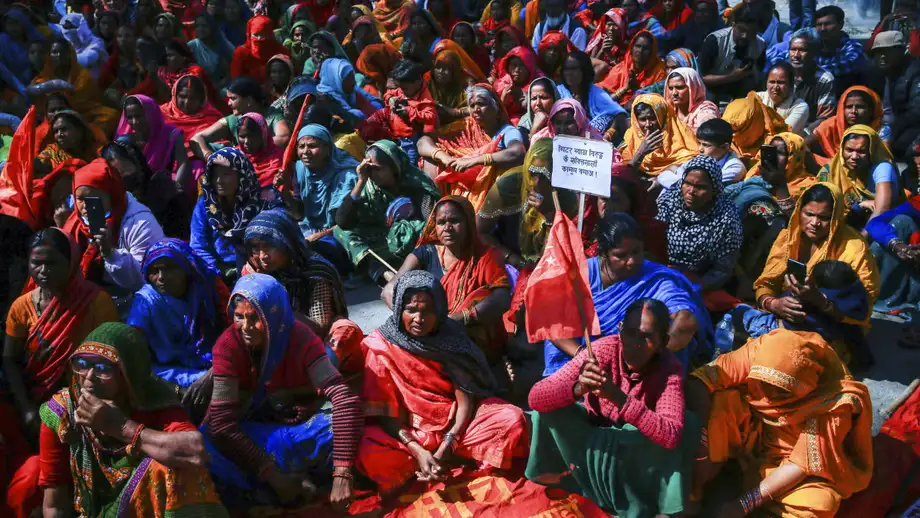
Debt victims have organised three extended protests in Kathmandu over the past four years, the longest lasting 442 days, as well as three long marches. In 2022, hundreds walked barefoot for weeks from districts including Siraha, Dhanusha, Mahottari, Sarlahi, Kapilvastu and Nawalparasi. Each round of protest brought government commitments, but victims said those commitments were not carried through, prompting further district and provincial demonstrations.
The search for a remedy has moved through several commissions and agreements:
- April 2023: The government created the three member Commission for the Investigation of Loan Sharking after the protests that began with the 2022 marches.
- March 2024: A new commission was formed under former high court judge Tej Bahadur Karki.
- March 2025: Another commission was established under Baburam Regmi, which later reported tens of thousands of pending complaints.
- March 2026: Balendra Shah's government was elected with a large majority. Victims hoped for a collective debt moratorium but instead reported a surge of arrest warrants against debtors after lenders approached police.
- July 9, 2026: Protesters began a justice march from Janakpur to Kathmandu, described by the movement as an 11-day action.
- July 17, 2026: After negotiations, the government signed a nine point pact with protest leaders and the march was called off.
Home Affairs Minister Sudhan Gurung travelled to Nijgadh on the sixth day of the march for direct talks. Three days of negotiations followed. Nigra Nabin, a leader of the protest movement, said victims had three central demands based on past experiences: nullify illegal agreements and the loan contracts supporting them, pass a new law creating special legal procedures, and establish a separate body dedicated to securing justice for victims. The government accepted those core demands in the pact.
The agreement has raised expectations without removing the immediate danger for families facing arrest or eviction. Sobita Devi Mahato, one of the victims still waiting for a resolution, expressed the desperation surrounding the delay.
If this is not resolved, the only resort I have is to go to the Home Ministry and hang myself there.
What meaningful enforcement would change
Human Rights Watch's recommendations connect criminal enforcement with financial relief. Prosecuting a violent lender would address an immediate crime, while reviewing fraudulent contracts and expanding affordable credit would address the conditions that allowed the debt to grow. Its main requests are:
- Halt arbitrary arrests of borrowers and prosecute lenders responsible for violence, sexual exploitation and threats.
- Penalise forced evictions and land grabs used as debt collection, and stop police and district authorities from enforcing foreclosures based on illegal agreements.
- Place a legal hold on land transfers and evictions connected to disputed informal loans while new legislation is prepared.
- Create debt relief and grievance systems that can restructure debts, meaning that repayment terms can be changed to give borrowers a realistic way to pay.
- Set maximum interest rates, require clear information about loan terms and assess whether a borrower can reasonably repay before credit is given.
- Expand affordable institutional credit, strengthen oversight of labour recruitment, and improve employment and social security within Nepal so households have less need to finance migration through informal debt.
For a family whose land title is disputed, a legal hold could mean remaining at home while the contract is examined. For a worker whose overseas job was cancelled, assistance or revised repayment terms could prevent a temporary loss of income from becoming the permanent loss of land. Human Rights Watch also asked donors and international partners to support these systems and stronger protections for migrant workers.
Ganguly linked the demands to the political mandate on which the Shah government came to power.
The Balendra Shah government was elected with the promise of change, to overturn existing oppressive structures. More closely regulating moneylenders and ending their chokehold on farmers and laborers is a crucial step in ensuring lasting social justice.
No deadline was given for passing the proposed law, creating the debt relief system or imposing the requested hold on evictions and land transfers. The immediate measures of implementation will therefore be practical: whether police register complaints, whether arrest warrants and property seizures based on disputed contracts stop, and whether the July agreement produces the new legal process and justice body demanded by borrowers.
Key Points
- Human Rights Watch documented land seizures, evictions, violence and sexual exploitation by illegal moneylenders in Nepal.
- An estimated 2,000 Nepalis were denied labour permits daily after Gulf departures were suspended in March 2026.
- Approvals for work in the Gulf fell 52 percent, from 228,165 to 109,249, between late February and mid September compared with the previous year.
- Kapali tamasuk contracts can list three to ten times the cash borrowed, while meter byaj loans can carry annual interest of 36 to 60 percent or more.
- Nepal made fraudulent and abusive informal lending punishable by up to seven years in prison in May 2023, but enforcement remains weak.
- More than 65,000 complaints remain unresolved across successive inquiry commissions.
- The Shah government signed a nine point pact on July 17 after victims marched from Janakpur toward Kathmandu, but no implementation deadline was given.