A Pay Rise With a Cleaner Payment Route
Jakarta. Indonesia's education minister and a parliamentary commission have agreed on a monthly incentive of Rp1 million from 2027 for teachers outside the state civil service, after discussions that also covered how the money will be paid. The current incentive is Rp400,000 a month. Under the plan, it would rise to Rp1 million and be sent every month directly into each teacher's bank account.
Contents
- A Pay Rise With a Cleaner Payment Route
- A Short Timeline of the Agreement
- What the Minister Asked For, and How Lawmakers Responded
- What Rp1 Million Would Change in Daily School Life
- The Bigger Fight Is Over a Legal Minimum Salary
- Why the UMP Benchmark Matters From West Java to Jakarta
- Budget Space Exists, but the 2028 Rules Will Change
- Students Put Teacher Welfare on the National Teachers Day Agenda
- What Has Not Been Decided
- Key Points
Lalu Hadrian Irfani, deputy chairman of Commission X, which oversees education in the House of Representatives, said the figure follows a proposal by Abdul Mu'ti, minister for primary and secondary education. The increase would be 2.5 times the current amount, an extra Rp600,000 each month. For a teacher receiving Rp400,000, that is the difference between a small payment and one that can cover a larger share of transport, food or school costs.
The payment route matters as much as the amount. Lawmakers said the money would arrive each month rather than through a less regular process, giving teachers a clearer way to see when the incentive has been paid.
A Short Timeline of the Agreement
The sequence began around National Teachers Day, when teacher pay became a live political issue in Jakarta.
- Wednesday, 25 November 2026: Mu'ti put the Rp1 million proposal to Commission X at a working meeting in the parliamentary complex in Senayan, Jakarta.
- Thursday, 26 November 2026: Commission X held a public hearing with Mu'ti on teacher and education staff aspirations. Lalu said the discussions produced at least three points, with the incentive rise as the first.
- 2027: The government plans to seek budget support for the higher incentive through the state budget process, using the additional spending mechanism called Anggaran Belanja Tambahan, or ABT.
- 2028: A Constitutional Court decision changes the education budget picture by removing the Makan Bergizi Gratis free meal program from the education budget allocation.
A separate amendment process is under way for Law No. 20/2003 on the National Education System, commonly called the Sisdiknas Law. That law is the vehicle lawmakers want to use for a minimum salary standard, while the Rp1 million incentive itself is a budget measure.
What the Minister Asked For, and How Lawmakers Responded
Mu'ti framed the rise as a reward for teachers who have spent years working outside the civil service. He told Commission X that the existing Rp300,000 incentive had already been raised to Rp400,000 and was now running. He then said he had discussed a further rise to Rp1 million with House leaders.
The education minister said the proposal still sat in informal talks, but he expected it to move if formal approval followed. He said leaders had already given an informal nod.
Prinsipnya secara nonformal sudah disetujui oleh pimpinan DPR, tinggal nanti kalau DPR, komisi, pimpinan, dan Komisi X setuju kami akan ajukan di APBN tahun 2027
APBN is the Indonesian abbreviation for the state budget. In English, Mu'ti was saying that the idea had support in principle but still needed formal approval before the government put it into the 2027 budget. Lalu's response in the meeting was immediate and warm.
Keren itu, Pak Menteri. Setuju kita, kita pasti setuju itu. Pak Dedi, setuju ya? Setuju sekali, Pak Menteri
Mu'ti also raised the possibility that President Prabowo Subianto could announce the measure on National Teachers Day, calling it a major gift for Indonesian teachers. The step he placed in the budget process was the 2027 submission, after the required approvals.
What Rp1 Million Would Change in Daily School Life
Lalu described the amount in plain terms at the parliamentary complex. He said teachers outside the civil service currently receiving Rp400,000 would move to Rp1 million if the plan holds.
Insyaallah mulai 2027, tunjangan insentif bagi guru-guru non-ASN yang hari ini Rp400 ribu akan naik menjadi Rp1 juta
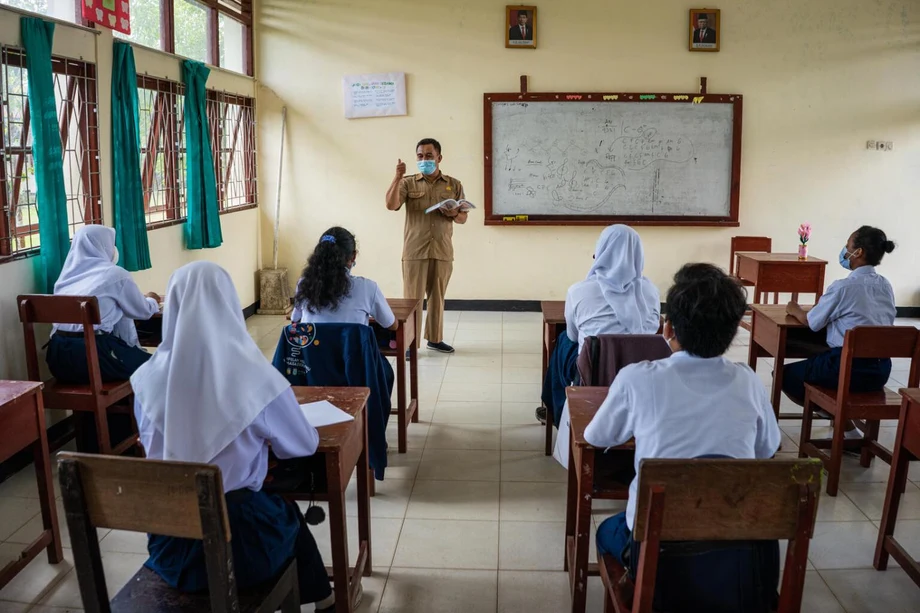
The quote uses the Indonesian term for teachers who are not part of the state civil service apparatus. In practice, that group can include honorary teachers, private school teachers and teachers hired by local systems without civil servant status. They often do the same classroom work as civil servant teachers but receive lower and less predictable pay.
Direct payment changes the route as well. Instead of waiting for funds to pass through several hands, the teacher would be the account holder receiving the transfer, which makes the payment easier to verify.
For a family budget, the extra Rp600,000 matters because it is 150 percent more than the current Rp400,000. The planned Rp1 million is still below the 2026 average provincial minimum wage of Rp3.51 million, so the incentive would not by itself meet the proposed salary benchmark. It would be more than three times the Rp300,000 level that Mu'ti said was previously paid to some teachers.
The Bigger Fight Is Over a Legal Minimum Salary
Commission X wants more than a higher incentive. It wants a floor for teacher pay written into the body of the revised Sisdiknas Law, so that a future government cannot leave the issue to regulation alone. Lalu said the benchmark should be the provincial minimum wage, known in Indonesia as upah minimum provinsi or UMP.
Speaking at the parliamentary complex on 26 November, Lalu said a country that wants to guarantee teacher welfare needs a clear minimum salary. He said some teachers still earn only hundreds of thousands of rupiah each month.
Kalau negara ingin menjamin kesejahteraan guru maka kami di Komisi X sangat sepakat bahwa harus ada gaji minimal bagi guru-guru kita yang hari ini memang terus berjuang untuk mempersiapkan generasi penerus bangsa
Lalu said the UMP should become the national reference point and that all political factions should back the rule. In another passage, he set out the target in numbers.
Sehingga kami insyaallah di revisi Undang-Undang Sistem Pendidikan Nasional minimal Upah Minimum Provinsi merupakan patokan bagi gaji guru-guru kita di seluruh tanah air. Sehingga tidak ada lagi guru yang gajinya Rp 200.000, Rp 300.000 dan sebagainya.
In English, he wants no teacher to be left on salaries of Rp200,000 or Rp300,000 a month. Lawmakers want the provision in the main body of the revised law, which is the operative part that sets rules, rather than in an explanatory section.
Why the UMP Benchmark Matters From West Java to Jakarta
UMP is the legal wage floor set by province. Indonesia's average UMP was around Rp3.51 million a month in 2026, but the rate varied sharply. West Java stood at Rp2.32 million, while Jakarta stood at Rp5.73 million.
West Java and Jakarta show why a UMP benchmark would not create one identical teacher salary across the country. A teacher in West Java would be measured against Rp2.32 million, while a teacher in Jakarta would be measured against Rp5.73 million. Jakarta's figure is about 2.5 times West Java's.
The gap is even wider when compared with the lowest teacher pay figures cited in the debate. Rp200,000 was described as about $11 a month and Rp300,000 as about $16. Against the average UMP of Rp3.51 million, Rp300,000 is about 8.5 percent. Even the planned Rp1 million incentive is about 28.5 percent of that average, which explains why lawmakers are discussing it as an incentive and a salary floor as separate issues.
For students and parents, the practical difference is that a salary floor would set a baseline for pay for teachers, while the incentive would add a monthly payment to certain teachers. A child in an underfunded school may see the effect in teacher retention, class stability and the ability of schools to keep experienced staff, although the regulations still have to define how each payment works.
Budget Space Exists, but the 2028 Rules Will Change
Indonesia put Rp757.8 trillion ($41.3 billion) into education in the 2026 budget, equal to 20 percent of state spending. Of that amount, Rp274.7 trillion was allocated to educators and education personnel. The size of that allocation sits beside a stubborn problem: some teachers still receive only Rp200,000 to Rp300,000 a month.
Commission X and Mu'ti are also considering the ideal teacher salary level in light of a change coming in 2028. The Constitutional Court ruled that the budget for Makan Bergizi Gratis, the free nutritious meal program, will no longer be taken from the education budget from that year. That gives education planners a different budget picture when they discuss how much teachers should earn.
Lalu said the timing creates room to work on a clearer salary formula. He said Commission X and the minister would continue that work.
Nah momentum inilah kami di Komisi X bersama Mendikdasmen sedang memformulasikan sesungguhnya besaran gaji guru yang ideal itu seperti apa. Nah ini yang akan kita laksanakan terus
Mu'ti raised one more budget gap in the same meeting. He said the 2027 allocation for TKA SMA, the high school academic assessment, was not yet available and asked Commission X for support so it could run well. The request showed how the pay plan sits inside a wider education budget negotiation.
Students Put Teacher Welfare on the National Teachers Day Agenda
Students gathered in Jakarta on Wednesday, 25 November 2026, to mark National Teachers Day with demands for better teacher welfare and wider education reforms. Their call included fair wages for honorary teachers and teachers outside the civil service, transparent recruitment into government contract positions and stronger legal protection for educators.
The students also asked for better school infrastructure, equal access to education and fully free education. They urged the government to spend the mandated 20 percent allocation for state and regional education budgets effectively.
The protest placed the teacher pay issue next to other problems families see in schools. For lawmakers at the parliament complex, the timing gave the Rp1 million incentive and the Sisdiknas amendment a clear public backdrop.
What Has Not Been Decided
Formal approval is the first gate. Mu'ti said House leaders had given informal support, but the proposal still needs the agreement of the House leadership and Commission X before it enters the 2027 budget. Proposed wording in a law also needs support from all factions if it is to survive the legislative process.
No date was given for a final vote, a presidential announcement or a final regulation on eligibility. The exact salary thresholds under the Sisdiknas revision, the final legal wording and the full list of teachers who would receive the Rp1 million incentive were not set in the discussions described.
The next dated steps are the 2027 budget process for the incentive and the 2028 education budget change linked to the Constitutional Court ruling. Until those steps are completed, the Rp1 million figure is a firm political target with a defined start year, not a payment teachers can yet count on.
Key Points
- The planned incentive would rise from Rp400,000 to Rp1 million a month in 2027 for teachers outside the state civil service.
- Payments would be made every month by direct transfer into teachers' bank accounts.
- Mu'ti said the proposal has informal support but needs formal approval before entering the 2027 state budget.
- Commission X wants a teacher salary floor tied to the provincial minimum wage written into the revised Sisdiknas Law.
- Indonesia's 2026 education budget was Rp757.8 trillion, including Rp274.7 trillion for educators and education personnel.
- Student protests in Jakarta on National Teachers Day called for fair wages, transparent recruitment, legal protection and better school infrastructure.
- Final legal wording, salary thresholds and eligibility details were not set.