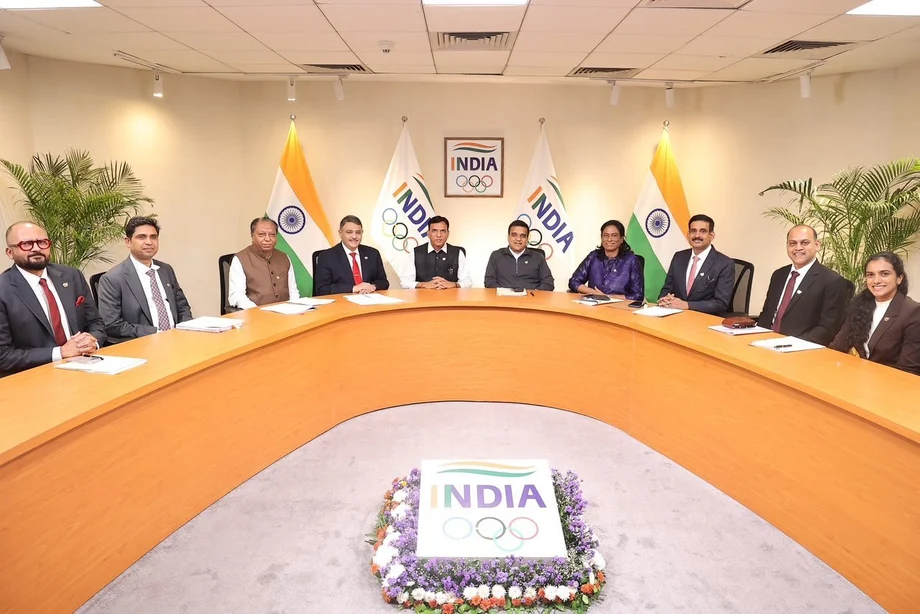
India Makes Its Pitch in a Virtual Meeting
India presented its vision and proposed roadmap for hosting the 2036 Olympic and Paralympic Games to the International Olympic Committee's Future Host Commission on 26 November, in an online session that ran for roughly an hour.
Contents
- India Makes Its Pitch in a Virtual Meeting
- The Team India Sent to the Commission
- What Ahmedabad Brings to the Table
- Six Rivals and a Deadline That Has Passed
- The December Survey That Feeds the March File
- How the IOC Actually Picks a Host
- A Process That Was Paused, Then Restarted
- Doping, Governance and an Election Under Scrutiny
- What Comes Next, and What Is Not Yet Decided
- Key Points
The pitch centred on Ahmedabad, the Gujarat city that is also preparing to stage the 2030 Commonwealth Games. Indian officials set out the city's existing sports venues, the infrastructure still to be built, the involvement of young people in the Olympic movement, legacy plans and the country's capacity to deliver a event on the scale of the Games.
A discussion followed with the commission, a body of nine members chaired by Kolinda Grabar-Kitarovic, the former president of Croatia. The Indian Olympic Association's account described a presentation of about 30 minutes and a discussion of about 20 minutes. One account described the hour as a 20 minute pitch followed by 40 minutes of questions.
The stakes are easy to state. India, the world's most populous country, has never hosted the Olympic Games. It staged the 2010 Commonwealth Games in New Delhi, an event overshadowed by allegations of corruption and mismanagement that organisers denied.
Ahmedabad has been the quiet engine of the campaign. Gujarat's government has been at the forefront of the effort, and the state's sports minister, Harsh Sanghavi, travelled to IOC headquarters in Lausanne in July last year as part of the first official Indian delegation to make the case in person.
The Team India Sent to the Commission
The delegation spanned government, the national Olympic body and athletes. Sports Minister Mansukh Mandaviya led it, joined by Sports Secretary Hari Ranjan Rao and Gujarat sports minister Harsh Sanghavi. The Indian Olympic Association was represented by its outgoing president P T Usha and chief executive Raghuram Iyer, alongside Nita Ambani, India's member of the IOC, and badminton champion P V Sindhu, who chairs the association's athletes commission.
Iyer spoke to reporters after the meeting and said the bid had wide backing from all stakeholders, including the central government.
I think we presented a good case and we are very, very hopeful that we will move to the next stage (of the bidding process).
He added that a national Olympic project cannot be carried by sport alone.
When a country is pitching for the Olympics, doing something so large ... requires the complete support and backing of the city, of the state, of the union.
Usha's presence carried its own symbolism. She was the first woman to head the Indian Olympic Association and did not seek re-election in the polls set for 5 December, having earlier lost a vote for the Sportspersons of Outstanding Merit category.
What Ahmedabad Brings to the Table
Ahmedabad is not pitching an empty plot. The city is due to host the 2030 Commonwealth Games, a multisport dress rehearsal that will leave behind venues and supporting infrastructure the Olympic plan intends to reuse. In 2029 the city is scheduled to stage the biennial World Police and Fire Games, and it is also bidding for the 2038 Asian Games. It is home to the world's largest cricket stadium.
The Indian Olympic Association said venues and supporting infrastructure built for the 2030 Commonwealth Games could also serve the Olympics. That argument matters because the IOC weighs a venue master plan and athlete experience, funding strategy, political and public support, delivery capability and a legacy strategy meant to leave long-term benefits for host communities.
Six Rivals and a Deadline That Has Passed
India is one of seven countries in the running. Germany, Hungary, Qatar, South Korea, South Africa and Turkiye complete the list the IOC issued in early October. Other countries had until 31 October to declare an interest.
Turkiye has already made its first presentation to the Future Host Commission, according to information available to Indian officials, making it the only rival known to have gone before the panel before India's turn.
Each rival brings a record. Qatar hosted the 2022 football World Cup and the 2006 Asian Games, and will host the Asian Games again in 2030. A Gulf Olympics would have to be shifted from the traditional July and August window because of the heat. South Africa hosted the 2010 football World Cup and the 1995 Rugby World Cup but has never held an Olympics. Germany's national Olympic committee voted last month to pick Munich as its candidate, a century after the 1936 Berlin Games held under the Nazi regime. Istanbul came second to Tokyo in the race for the 2020 Games, and Turkish officials hope to go one better.
The December Survey That Feeds the March File
The next step belongs to the public rather than to the delegation. The IOC will commission an anonymous survey in the seven bidding countries in the third week of December, asking people about their awareness of the Olympic movement and what hosting the Games would mean to them.
Those findings will feed into the evaluation of India's proposal in March 2027. India's pitch also leans on a busy calendar of events already staged and booked. Between January 2025 and June 2026 the country hosted 36 international sporting competitions across more than 15 cities, and it has secured the rights to 19 more for 2027 and 2028. Mandaviya has put the figure higher over a shorter window.
In the last 18 months alone, India has successfully hosted 40 international sporting competitions across 18 cities, demonstrating not only the strength of our sporting infrastructure but also our growing organisational capabilities.
How the IOC Actually Picks a Host
The road to a host city runs through a process the IOC has published in detail, as the ministry's 2024 statement to the Lok Sabha set out. A national Olympic committee starts a dialogue with the Future Host Commission. That conversation becomes a Continuous Dialogue, and later a Targeted Dialogue with a selected group of committees.
When the commission finishes its dialogue, the IOC holds an election in which members vote to award the hosting rights. The Ministry of Youth Affairs and Sports explained the mechanics in a written reply on 22 July 2024, signed off by Himanshu Pathak, in response to a question from Dr. Mansukh Mandaviya, then answering as Union Minister for Youth Affairs and Sports in the lower house.
The same reply explained how a sport gets onto the Olympic programme, a question that matters to any host hoping to add a discipline. A sport must be governed by an International Federation that undertakes to follow the rules of the Olympic Charter, must be practised widely around the world and must meet various criteria. Unless the IOC Executive Board decides otherwise, the decision is taken in principle seven years before the opening of the Games, or at the Session electing the host, whichever comes later.
India's national committee formally entered that machinery well before the November presentation. On 11 August 2025, Mandaviya told the Lok Sabha that the Indian Olympic Association had submitted a letter of intent and that the bid had reached the Continuous Dialogue phase.
IOA has submitted a letter of intent to IOC. The bid is now in the 'Continuous Dialogue' phase with the Future Host Commission of IOC.
A Process That Was Paused, Then Restarted
The timetable shifted under India's feet in 2025. Kirsty Coventry, the Olympic gold winning former swimmer from Zimbabwe who became the first woman and first African president of the IOC, said members at her first Executive Board meeting in June wanted the selection system reassessed. A working group was set up to review how future hosts are elected.
Coventry argued that the experience of hosts already chosen, Los Angeles for 2028, Brisbane for 2032 and the French Alps for the 2030 Winter Games, should be studied before new proposals move ahead. She has also set out the principle she wants to govern the choice.
Wherever the Games take place, one thing must never change: Athletes have to be at the heart of everything we do. That is why, for every future host, delivering the best possible experience for the athletes must always be the starting point.
For India, the pause meant a decision once expected sooner slipped back. The revised calendar now runs to the middle of 2029.
Doping, Governance and an Election Under Scrutiny
The presentation landed in a difficult stretch for Indian sport administration. The IOC has expressed disappointment over issues and disputes around the conduct of the 5 December elections at the Indian Olympic Association, saying they were affecting the operations and reputation of the Olympic movement in India. Usha had pulled out of the presidential race weeks after alleging that external forces were trying to sabotage her candidature, and had asked the IOC to intervene. The IOC responded with a statement urging a free and fair election without interference.
Doping has been the other recurring subject. India's record of positive tests is a concern for the IOC, which has sought corrective measures from the association, and the IOA has since set up a panel to address doping in Indian sport. When an Indian delegation first visited Lausanne in July last year, the message from the IOC was blunt: resolve the governance crisis, strengthen dope control and improve the country's Olympic performance.
India's athletes have won relatively few Olympic medals for a country of its size, a point officials in Lausanne have raised alongside the anti-doping file.
What Comes Next, and What Is Not Yet Decided
The path from here is mapped, though the dates depend on the review Coventry ordered. In March 2027 the IOC Executive Board is due to shortlist interested parties, moving them from the Continuous Dialogue into a strategic dialogue phase.
- December 2026: the IOC runs an anonymous survey in the seven bidding countries.
- March 2027: evaluation of India's proposal and a shortlist of interested parties, opening the strategic dialogue.
- During strategic dialogue: countries give initial responses to the Future Host Questionnaire and submit core financial and legal guarantees.
- Late 2028: preferred hosts enter the Targeted Dialogue, with the Future Host Commission reporting to IOC members.
- Mid 2029: the host of the 2036 Games is elected, after the Los Angeles Olympics of 2028.
Several things remain open. India has not formally proposed a host city through the IOC process, even though Ahmedabad is the working assumption in every presentation. The sports minister did not answer a parliamentary question on whether the plan would spread events across several cities, including hockey in Bhubaneswar, rowing in Bhopal, canoeing and kayaking in Pune and cricket in Mumbai. The association has also dropped its original bid theme, Rising Together, after it emerged that it echoed the tagline Japan used for Tokyo 2020.
Key Points
- India presented its 2036 Olympic and Paralympic hosting plan to the IOC Future Host Commission on 26 November, with Ahmedabad as the proposed host city.
- The commission of nine members is chaired by Kolinda Grabar-Kitarovic. India's delegation was led by Sports Minister Mansukh Mandaviya and included P T Usha, Nita Ambani, P V Sindhu, Hari Ranjan Rao, Harsh Sanghavi and Raghuram Iyer.
- Seven countries are in the race: India, Germany, Hungary, Qatar, South Korea, South Africa and Turkiye. Turkiye has already presented.
- The IOC will run an anonymous survey in the seven countries in the third week of December, and its findings will feed the evaluation in March 2027.
- Ahmedabad will host the 2030 Commonwealth Games, the 2029 World Police and Fire Games and is bidding for the 2038 Asian Games.
- India hosted 36 international competitions across more than 15 cities between January 2025 and June 2026, with 19 more booked for 2027 and 2028.
- The IOC paused its host selection process under President Kirsty Coventry and set up a working group to review it.
- Doping control and disputes around the 5 December Indian Olympic Association elections remain live issues with the IOC.
- The host is expected to be elected in mid 2029, after the Los Angeles Olympics.