Seoul selloff deepens ahead of Nvidia earnings
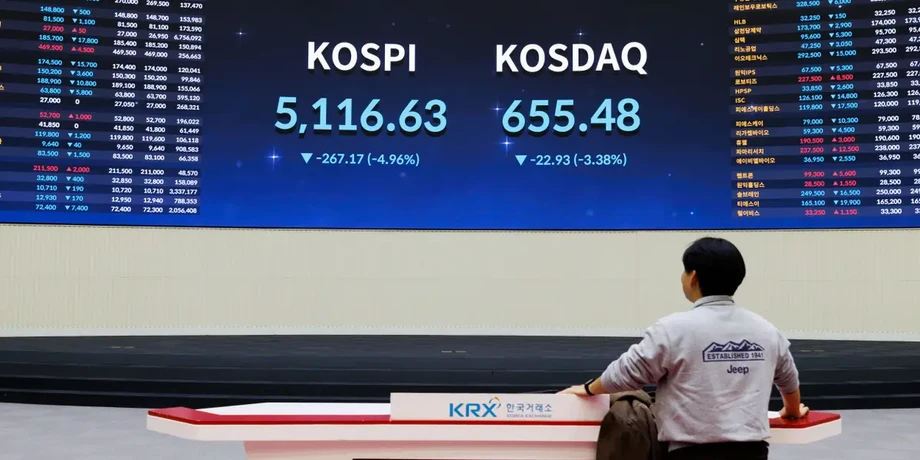
South Korea's KOSPI fell 190.03 points, or 3.59%, to 5,100.50 on Monday, November 16, 2026, as foreign investors sold technology shares ahead of Nvidia's earnings and Anthropic's planned stock market debut. Pension funds sold a net 564.7 billion won, their largest withdrawal in five years and two months, adding pressure as individual investors bought falling shares.
Contents
- Seoul selloff deepens ahead of Nvidia earnings
- An early rise turns into a broad retreat
- Why Nvidia's financing matters to Korean suppliers
- Chip losses spread through the supply chain
- Asia feels the same technology shock
- Borrowed money makes the decline harder to absorb
- The recovery required is larger than the fall
- Strong chip sales meet expensive financing
- A stronger won and a week of major decisions
- Key Points
Samsung Electronics dropped 4.47% to 196,800 won, while SK hynix fell 7.89% to 1.12 million won. The KOSDAQ, which includes many smaller technology companies, lost 34.01 points, or 4.86%, to finish at 665.65. Both markets reversed early gains.
Nvidia's leadership upheaval following Jensen Huang's departure has put the financing behind the artificial intelligence boom under scrutiny. Investors are watching whether interim chief executive Colette Kress will reduce investments and financial support for customers, potentially changing spending plans across an industry that buys South Korean memory chips.
Monday's decline was the KOSPI's third consecutive loss. It followed a recovery of 4.5% the previous week, when foreign investors became net buyers over a week for the first time in seven weeks. That brief improvement gave way to another session of heavy selling.
The pressure reaches beyond share portfolios. Brokerage loans tied to Samsung Electronics and SK hynix totaled 6.97 trillion won on November 12, according to financial data provider FnGuide. Falling prices can force investors using such loans to supply more collateral or face sales of their holdings, adding a household borrowing risk to the market's technology concerns.
An early rise turns into a broad retreat
The KOSPI opened at 5,305.40 and reached 5,327.99 before reversing. Its low of 5,069.83 represented a decline of 4.17% from Friday's close, before a modest recovery near the end of trading.
Market activity totaled 209.27 million shares worth 15.8 trillion won. Declining stocks outnumbered advancing stocks by 612 to 263, or more than two to one, showing that selling extended beyond the largest chipmakers.
Foreign investors sold roughly 1.38 trillion won of KOSPI shares, while individuals bought about 1.34 trillion won. Institutional net sales were put at 451.26 billion won in the closing figures, with other closing tallies placing them at 459.8 billion won and 464.7 billion won.
Pension funds accounted for particularly heavy selling. Their net disposal of 564.7 billion won was the largest since September 2, 2021, when they sold 1.0483 trillion won. Pension funds are part of the institutional category, so their sales are included in that broader total.
The KOSDAQ followed a similar reversal, climbing to 708.34 before falling as low as 664.98. Individuals bought about 376.7 billion won, while foreign investors sold 209.7 billion won and institutions sold 154 billion won.
Why Nvidia's financing matters to Korean suppliers
Nvidia depends on Taiwan's TSMC to manufacture advanced processors and on South Korean suppliers, including Samsung Electronics and SK hynix, for high bandwidth memory. That memory moves large amounts of information quickly, helping powerful AI processors work efficiently.
Kress, Nvidia's chief financial officer who took over as interim chief executive, is expected to restrain large transactions after a period of aggressive investments and computing deals. Investors are examining arrangements sometimes described as circular financing: a chip supplier invests in an AI business that, directly or through a cloud provider, purchases computing capacity built around the supplier's chips.
Such arrangements connect investment funding with demand for hardware. If Nvidia reduces its financial support, some customers may need other funding before expanding their computing capacity. Korean suppliers therefore face uncertainty about the timing of future orders, even while current demand remains strong.
Kim Doo-eon, an analyst at Hana Securities, identified leadership, financing and an investigation as issues facing Korean shares:
Nvidia's appointment of a successor CEO, the continuity of funding support for AI companies and the possibility of a prolonged security investigation will repeatedly test valuations in the domestic stock market.
Nvidia's next permanent chief executive and the scale of any changes to customer financing had not been settled. Those decisions matter to Korean companies because expectations of sustained AI spending have supported their share prices.
Chip losses spread through the supply chain
SK hynix's 7.89% decline was steeper than Samsung Electronics' 4.47% fall, reflecting particular concern about its exposure to memory supplied for Nvidia systems. SK Square, a major shareholder in SK hynix, dropped 9.71% to 688,000 won. Samsung Electro-Mechanics fell 8.19% to 785,000 won.
Smaller semiconductor companies also suffered. On the KOSDAQ, Simmtech fell 13.38%, Jusung Engineering lost 11.88% and EO Technics declined 9.79%. The selling reached companies supplying the materials, components and equipment needed to make chips.
Hyundai Motor slipped 1.48% to 265,500 won, a smaller decline than those of the major semiconductor names. Some sectors gained during the session: airline shares rose about 3.5%, while factory machinery shares advanced 2.78%. Investors were shifting money between industries as well as reducing technology exposure.
Samsung Electronics, SK hynix and Micron also faced a legal development in the United States. A court rejected motions to dismiss a class action alleging coordination over DRAM supply, allowing the case to proceed. DRAM is a common type of working memory used in computers and servers. The companies contest the allegations, and the case now moves into further proceedings.
Asia feels the same technology shock
Taiwan's Taiex fell 6%, while TSMC also lost 6%. MediaTek and ASE Technology declined sharply. In Japan, Kioxia fell 8%, Tokyo Electron lost 7% and Advantest dropped 11%. Those moves show how concern over one major customer can spread across companies making processors, memory and chip production equipment.
Japan's broader Nikkei 225 fell 2.4% to 59,662.02, while China's Shanghai Composite declined 0.9% to 3,602.57. Hong Kong moved against the regional trend, with the Hang Seng Index gaining 0.5% to 23,743.33 after technology shares had weakened the previous week.
Wall Street had already delivered a warning on Friday. Nvidia fell about 2% to $162.85, taking its weekly loss to nearly 13%. Its shares were down roughly one third from their October peak. AMD lost 8.75%, Broadcom fell 4.76% and the Philadelphia Semiconductor Index dropped 3.43%.
The Nasdaq Composite declined 0.91% and the S&P 500 fell 0.40%, while the Dow Jones Industrial Average edged up 0.10%. Semiconductor shares were under heavier pressure than the wider American market.
Borrowed money makes the decline harder to absorb
Samsung Electronics accounted for 3.64 trillion won in outstanding margin loans on November 12, while SK hynix accounted for 3.33 trillion won, according to FnGuide. Their combined 6.97 trillion won represented 27.2% of the 25.60 trillion won in margin debt across the KOSPI and KOSDAQ.
The two chipmakers' share of that debt was about four times their average of 6.73% last year. Within the KOSPI alone, they represented 36.5% of outstanding margin loans, concentrating borrowing in two stocks exposed to the same AI spending concerns.
Margin loans let investors borrow from brokers using shares as security. When those shares fall below a required value, the borrower must provide additional money or securities. A broker can sell the holdings if the investor cannot meet that demand.
Lee Jeong-hwan, a professor of economics and finance at Hanyang University, warned investors against assuming that a large decline guarantees a bargain:
Nobody knows where the bottom is.
Bank borrowing has also risen. Unsecured household loans at South Korea's five largest banks reached 109.75 trillion won on November 12, up 853.1 billion won in nine business days. Overdraft balances reached 44.26 trillion won, their highest since August 2022. How much of that bank borrowing went into shares is unknown.
Bank overdrafts generally do not trigger automatic stock sales when prices fall. Borrowers still owe the debt and interest, however, even if they sell their investments at a loss.
The recovery required is larger than the fall
Monday's KOSPI close was 44.04% below its June 22 record closing level of 9,114.55. Returning from 5,100.50 to that level would require a gain of about 78.7%, because the recovery starts from a much smaller base.
The index was also 45.66% below its June 19 intraday record of 9,385.59. Reaching that peak again would require a rise of about 84%. The difference between the two recovery figures comes from comparing Monday's close with either the closing record or the higher intraday record.
Samsung Electronics and SK hynix had already fallen 41.7% and 58.3%, respectively, between the KOSPI's June 22 closing record and November 13. Those losses followed gains of 194.8% and 348.4% from the start of the year through June 22.
For investors who bought near the peak, even a strong rebound can leave a substantial loss. For borrowers, the length of the recovery matters too, because interest continues accumulating while they wait.
Strong chip sales meet expensive financing
South Korea's semiconductor exports reached $16.6 billion in the first 10 days of November, up 331.2% from a year earlier, according to the Korea Customs Service. That provides a concrete measure of strong current demand while investors debate spending further into the future.
CoreWeave, an American AI cloud provider, reported third quarter revenue of $3.66 billion on November 10, up 168%. It also posted a $709 million net loss and $846 million in net interest expenses. Its figures illustrate how rapid sales growth can coexist with heavy financing costs.
Cho Hong-chong, an economics professor at Dankook University, took a more optimistic view of semiconductor demand:
Some companies may struggle to raise funds, but the semiconductor industry's fundamentals remain strong.
American borrowing costs added to the concern. The yield on the US Treasury note maturing in 10 years reached 5.15% on Friday, up from 4.86% a week earlier. Higher yields can make financing AI infrastructure more expensive and make bonds more attractive compared with shares.
US producer prices rose 6.5% in October from a year earlier, the steepest increase since November 2022. Investors were awaiting the Federal Reserve's October meeting minutes for clues about interest rates.
A stronger won and a week of major decisions
The won traded at 1,335.7 per dollar at 3:30 p.m., strengthening despite the equity selloff. Its gain was put at 1.9 won in the main closing account and one won in another closing tally. A lower number of won per dollar means the Korean currency has gained value.
Korean government bond prices rose. The yield on bonds maturing in three years fell 1.6 basis points to 3.743%, while the yield on bonds maturing in five years declined 1.1 basis points to 3.830%. A basis point is one hundredth of a percentage point, and bond prices generally rise when yields fall.
Nvidia's earnings are the next major test. Analysts surveyed by LSEG expect revenue of about $109.2 billion, up 91.6% from a year earlier, and adjusted earnings of $2.48 per share. Investors will also watch demand for Blackwell chips, progress on Rubin processors and Kress's plans for customer financing.
Charu Chanana, chief investment strategist at Saxo, explained why the company's outlook could matter more than a strong result:
A headline beat may carry less weight if management becomes more cautious about future demand.
The week's scheduled events bring several decisions close together:
- November 17: Nvidia is scheduled to release earnings after the US market closes.
- November 18: The Federal Reserve is scheduled to release its October meeting minutes, and Anthropic aims to set its initial public offering price.
- November 19: Anthropic is expected to begin Nasdaq trading under the ticker ANT.
Anthropic's planned debut gives investors another major AI investment to consider. Korean markets face concern that money committed to the listing could be redirected from existing technology holdings, just as Nvidia's results test confidence in future chip spending.
Key Points
- The KOSPI fell 3.59% to 5,100.50 for its third consecutive decline; the KOSDAQ lost 4.86%.
- Foreign investors sold about 1.38 trillion won of KOSPI shares, while pension funds recorded their largest net sales since September 2021.
- Samsung Electronics fell 4.47% and SK hynix dropped 7.89% amid uncertainty over Nvidia's leadership and financing strategy.
- Margin loans tied to the two chipmakers totaled 6.97 trillion won, or 27.2% of borrowing across both markets.
- Strong Korean chip exports contrast with concerns about financing costs and future AI investment.
- Nvidia earnings, Federal Reserve minutes and Anthropic's planned listing are scheduled for November 17 through 19.