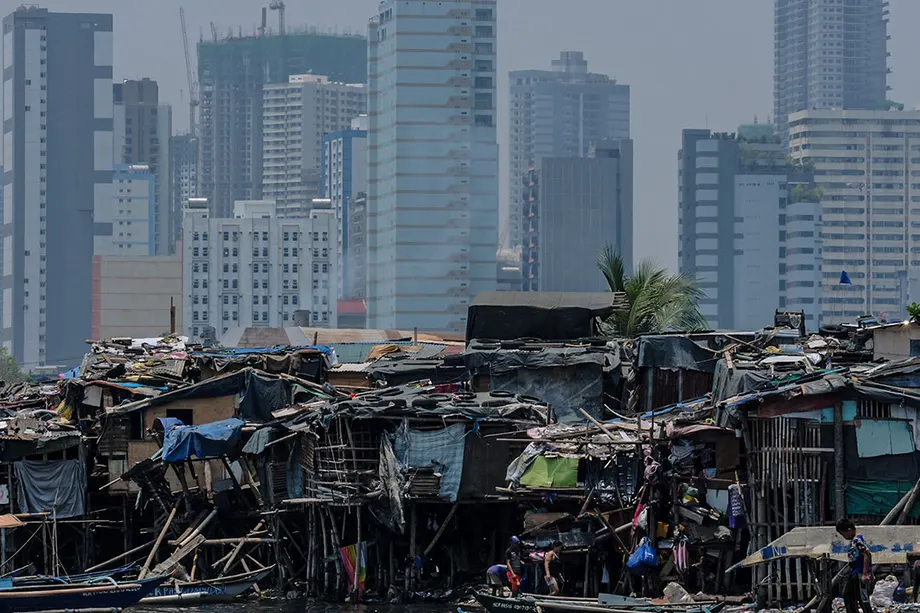
A higher benchmark changes the poverty count
The Philippines' poverty rate for 2023 would rise from 15.5% to 34.9% under a benchmark drawn from four Southeast Asian countries, adding 21.9 million people to the poverty count, according to the Philippine Institute for Development Studies (PIDS). The calculation puts a concrete number on the debate over whether the country's official poverty line still reflects basic living costs.
Contents
- A higher benchmark changes the poverty count
- What the regional comparison shows
- Why researchers want more than one measure
- Food choices sit at the heart of the review
- What P96.22 means for a family in Pangasinan
- Why the different poverty figures need context
- Families can cross the line in both directions
- Local household data could improve assistance
- Key Points
In its September 28, 2026 poverty measurement policy note, PIDS researchers Jose Ramon G. Albert and Mohammad A. Mahmoud examined a benchmark based on the national poverty lines of the Philippines, Indonesia, Thailand and Viet Nam. That benchmark is about 40% higher than the Philippine threshold.
The debate has sharpened around the Philippine Statistics Authority's (PSA) national poverty threshold of P96.22 per person per day in its 2025 poverty statistics. The amount covers food and other basic needs, including housing, education, transport and health. Researchers and residents have questioned whether the method behind that amount keeps pace with how people actually live.
A poverty line is a statistical boundary: people whose measured resources fall below it are counted as poor. Where that boundary sits affects how much hardship appears in national statistics and helps shape decisions about assistance. PIDS is calling for a review of the standard, while researchers also want better information about families who repeatedly move into and out of poverty.
What the regional comparison shows
Albert and Mahmoud's Policy Note PN 2026-17 presents two alternatives to the existing Philippine line. Adopting the full ASEAN-4 benchmark would put 34.9% of Filipinos below the threshold in 2023, more than twice the official rate of 15.5%. The increase is 19.4 percentage points.
Closing only half the gap between the Philippine line and the regional benchmark would raise poverty incidence to 25.2%, adding approximately 11 million people. Even that smaller adjustment would place about one person in four below the line, compared with roughly one in six under the existing measure.
The figures show how much the choice of standard matters. Both calculations examine poverty in the same year, 2023, using different thresholds. They describe how many people would qualify as poor under a higher standard of basic needs.
PIDS also compares the Philippine threshold of US$4.08 per person per day with World Bank lines of US$4.20 for economies with lower middle incomes and US$8.30 for economies with upper middle incomes. The note says the Philippines moved into the latter classification in July 2026, while its poverty threshold remained close to the lower standard.
Why researchers want more than one measure
Albert, a professional statistician and PIDS senior research fellow, told a seminar at De La Salle University-Angelo King Institute for Economic and Business Studies that poverty estimates depend on definitions, data and technical choices. Those choices include what measure of household welfare is used and where the poverty line is set.
Albert explained the effect of those decisions in direct terms:
Change any of those choices and the numbers will change,
Using the World Bank's US$8.30 line, Albert estimated that about 59% of Filipinos would be considered poor. A threshold of around US$6 would produce a rate of roughly 30% to 35%, according to his calculations. He argued that the Philippines should choose standards suited to its own policy needs.
Celia M. Reyes, a former PIDS president and emeritus research fellow who chairs the Technical Committee on Poverty Statistics, supported additional measures based on higher living standards while keeping the existing absolute poverty measure. An absolute measure uses a defined minimum level of needs, allowing officials to continue tracking people at the bottom of the income distribution.
Several measures can answer different practical questions. Poverty incidence counts the share of people below a line. The poverty gap measures how far their resources fall short. The squared poverty gap gives greater weight to people with the deepest shortfalls. A government deciding how much assistance families need benefits from knowing both how many people are poor and how severe their deprivation is.
Food choices sit at the heart of the review
Reyes said the current methodology starts with a menu designed to meet minimum dietary requirements at the lowest cost. She said a revised methodology is being validated after delays partly caused by pandemic data that did not represent normal conditions. No firm release date was given.
The Food and Nutrition Research Institute's Pinggang Pinoy food guide offers an example of a potentially higher dietary standard, Reyes said. A healthier basket containing more fruit and vegetables would also cost more. Choosing the food basket therefore helps determine the amount of income considered necessary.
IBON Foundation Executive Director Sonny Africa has challenged the existing method more sharply. He said it dates to 2011 and starts with a very inexpensive food bundle, then adds 43% to cover other basic expenses. His criticism is that electricity, water, rent, transport, education, clothing, communications and medical care need closer attention in their own right.
Africa's description makes the arithmetic easy to understand: a food allowance of P100 would become P143 after a 43% addition. His concern is whether that extra amount reflects the actual mix of bills families face. Rent, fares and school expenses can place very different demands on households with similar food needs.
The PIDS policy note recommends that the PSA focus on food consumption rather than income, account for unequal resources within households and return to its former release practices. Looking within households matters because a family total can hide differences in what individual members receive.
What P96.22 means for a family in Pangasinan
For a family of five, P96.22 per person works out to P481.10 a day. Across 30 days, that is P14,433 for food and other basic needs. The calculation brings the national figure closer to the scale at which families plan meals and pay bills.
In Region I, which includes Pangasinan, the daily minimum wage cited in local coverage ranges from P480 to P505, depending on the establishment category. One worker earning that rate would receive between P1.10 less and P23.90 more than the daily poverty threshold for five people on a paid working day. A household's needs continue on days when that worker has no paid work.
Myrna Marzan, a dishwasher at an eatery in Dagupan City, described being shocked by increases in her household's electricity bill. John David Docil, a university professor in the city, said the current minimum wage was insufficient for everyday expenses. Their accounts connect the statistical debate to particular pressures on household budgets.
Africa cited IBON's Family Living Wage estimate of at least P200 per person daily for a family of five, or approximately P1,000 a day. He also cited roughly P1,300 in daily earnings when work is limited to five days a week. The P200 figure is just over twice the official P96.22 threshold and reflects IBON's proposed standard for a decent life.
Why the different poverty figures need context
Africa also cited Social Weather Stations surveys in which around 55% of families, nearly 18 million households, considered themselves poor. He contrasted that with an official family poverty figure of about 6%. The dates and statistical bases behind those two figures were not specified in his account.
The family figures answer a different question from the PIDS calculation that 15.5% of individuals were poor in 2023. A survey asking families whether they consider themselves poor records their own assessment. An official income measure counts people or families against a defined threshold. Keeping the year, unit and definition attached to each number makes the debate easier to follow.
The main dated developments trace how the discussion reached its current point:
- 2003, 2006 and 2009: Family Income and Expenditure Survey data later used in a study tracked movements into and out of poverty.
- 2023: The year examined in the PIDS comparison between the official poverty rate and higher regional benchmarks.
- 2025: The PSA poverty statistics cited a national threshold of P96.22 per person per day.
- July 2026: The Philippines moved into the World Bank's upper middle income classification, according to PIDS.
- September 28, 2026: PIDS published Policy Note PN 2026-17.
- November 8 and 10, 2026: Public coverage carried Africa's criticism and accounts of household cost pressures in Dagupan City.
Families can cross the line in both directions
Reyes pointed to a study using the 2003, 2006 and 2009 Family Income and Expenditure Surveys that found about half of those classified as poor in 2009 were transient poor. These were people who moved into and out of poverty, rather than remaining poor throughout the period examined.
The difference matters for assistance. Families facing persistent deprivation may need sustained programs that address its causes. A household pushed below the line by illness or another temporary disruption may need immediate support to recover its previous position.
Albert said simulations of price shocks showed that millions of people initially above the poverty line could fall below it. Food, fuel and transport increases can squeeze families whose income is only slightly higher than the minimum threshold.
Albert described that exposure during the seminar:
Even if you are not poor today, it does not mean you are safe from poverty in the future,
Reyes called for risk assessments to identify groups most likely to be affected by particular shocks. Albert supported targeted help rather than blanket subsidies, with attention to vulnerable households as well as those already classified as poor.
Local household data could improve assistance
The Community-Based Monitoring System (CBMS), institutionalized through Republic Act No. 11315, could help governments identify those different needs, Reyes said. The system conducts a census of households and gathers information about individuals and several dimensions of welfare.
Sample surveys provide a broad picture by studying a selected portion of the population. A household census can give local governments more detailed information about who lives in an area and the problems particular families face. Reyes said CBMS can support the diagnosis of poverty, program design, targeting and monitoring.
Regular collection could also produce panel data, meaning information gathered from the same households over time. Following families repeatedly would help distinguish persistent hardship from temporary setbacks and show which households are moving closer to the poverty line.
CBMS also collects information beyond income, including dimensions relevant to health and education. That can help officials understand whether families with low incomes face other forms of deprivation and whether assistance needs to include services as well as money.
Albert said monetary and multidimensional measures provide complementary views, while the choice of indicators, weights and data also affects multidimensional results. Reyes linked better measurement to a practical goal: identifying who needs assistance and choosing programs that address the causes of their hardship.
Key Points
- The PSA's cited 2025 national poverty threshold is P96.22 per person per day, covering food and other basic needs.
- PIDS calculates that an ASEAN-4 benchmark would raise 2023 poverty incidence from 15.5% to 34.9%, adding 21.9 million people.
- Closing half the gap with that benchmark would put the rate at 25.2%, adding approximately 11 million people.
- A revised poverty methodology is being validated, according to Celia M. Reyes.
- Researchers want measures that capture persistent poverty, temporary setbacks and vulnerability to price shocks.
- More detailed household data could help local governments direct assistance to different needs.