Moonshot's next flagship could nearly double in size
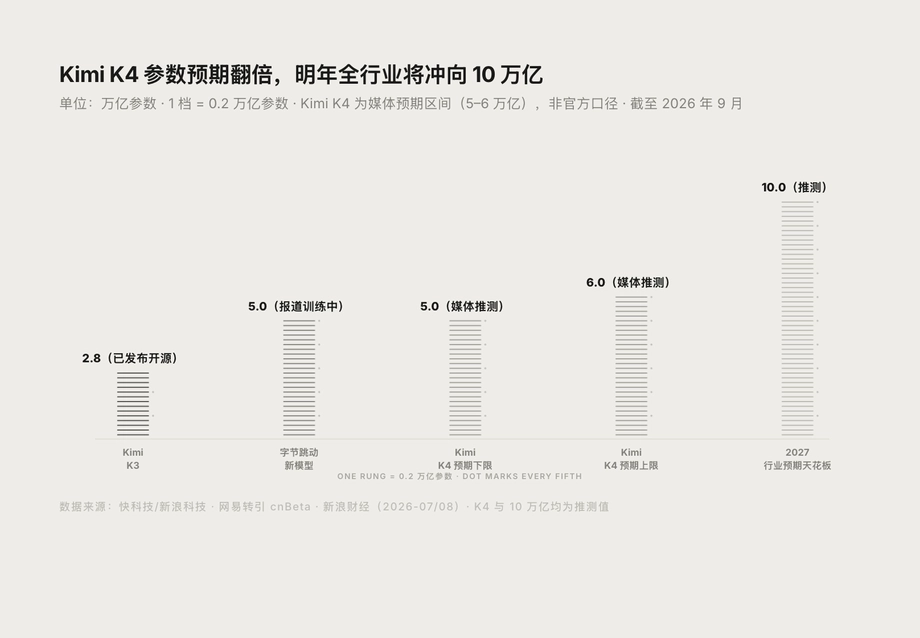
Moonshot AI is reportedly targeting 5.4 trillion parameters for Kimi K4, with a launch expected in the second or third quarter of 2027. The proposed model would be almost twice the size of Kimi K3 and K3.1 Pro, which are both reported to contain 2.8 trillion parameters.
Contents
- Moonshot's next flagship could nearly double in size
- What the 5.4 trillion figure means
- How the reported releases fit together
- Why K3.5 puts attention on training data
- Enough computing power now, pressure as models grow
- How Moonshot aims to get more from its hardware
- K3 Flash would address speed and cost
- Where the international comparison stands
- Key Points
The reported schedule places a smaller upgrade, Kimi K3.5, ahead of K4, potentially around the 2027 Lunar New Year. A faster product called Kimi K3 Flash is expected before the end of 2026, replacing Kimi K2.8.
Moonshot has not announced an official K4 parameter count or release date. The 5.4 trillion figure and the April to September 2027 launch window come from reporting about its development plans. Earlier estimates placed K4 between 5 trillion and 6 trillion parameters.
The central development is therefore a reported plan to expand both model size and the range of products available. Moonshot is also said to be investing in compression, self-distillation and post-training, techniques intended to improve what its models can do with the computing resources available.
For users, those parallel efforts matter in different ways. A larger flagship could handle more demanding work, while a lighter model could make everyday requests faster and cheaper. The reported roadmap provides targets for size and timing, but leaves future prices, measured performance and access arrangements undecided.
What the 5.4 trillion figure means
Parameters are numerical settings that a model learns during training. They help determine how it recognises patterns and produces answers. A model with more parameters has more capacity to learn, although its usefulness also depends on training data, design and the way it is refined.
K4's reported 5.4 trillion parameters would represent an increase of 2.6 trillion from K3's reported 2.8 trillion. Using those figures, the increase would be about 93%, making K4 roughly 1.93 times as large.
K3.5 would be a much smaller step in size. Its reported 3 trillion parameters would be about 7% above K3. That contrast suggests two different development approaches: refining the existing generation through K3.5, then making a much larger expansion with K4.
The exact 5.4 trillion target falls within the earlier estimate of 5 trillion to 6 trillion. One account attributes that range to Nomura Securities. Its consistency with the newer figure gives the reported plan a narrower target, while confirmation still rests with Moonshot.
How the reported releases fit together
Moonshot's reported schedule stretches from the introduction of K3 in July 2026 through the prospective arrival of K4 in 2027. The intervening releases would address both flagship capability and demand for a lighter product.
- January 10, 2026: Founder Yang Zhilin reportedly discussed plans for K4 during a public speech.
- July 17, 2026: Kimi K3 reportedly launched with 2.8 trillion parameters and a context window of 1 million tokens.
- Late July 2026: Preparations for K4 training reportedly began, alongside efforts to secure more computing capacity.
- Before the end of 2026: Kimi K3 Flash is expected to succeed Kimi K2.8.
- Early 2027: Kimi K3.5 is expected, possibly around the Lunar New Year, with 3 trillion parameters.
- Second or third quarter of 2027: Kimi K4 is reportedly targeted for release with 5.4 trillion parameters.
The wider K4 window covers April through September 2027. K3.5's proposed appearance around the Lunar New Year is also an estimate, leaving the interval between the two flagship releases uncertain.
Why K3.5 puts attention on training data
Kimi K3.5 is reportedly planned to use 10 trillion tokens of post-training data. Tokens are the pieces of information a model processes, often words or parts of words. A token count measures the volume processed, rather than the number of distinct documents or facts.
Post-training happens after a model has completed its main initial training. It can help the model follow instructions, improve its answers and handle particular tasks more reliably. Examples, feedback and repeated practice can all play a role.
The proposed 10 trillion token scale makes K3.5 more than a story about its modest parameter increase. Moonshot appears to be targeting substantial work on how the model behaves, alongside a smaller expansion in its underlying size.
The reporting gives no breakdown of those tokens, including how much material would be newly collected, generated by models or used repeatedly. That missing detail matters because the quality and variety of training examples shape what a model learns from them.
Enough computing power now, pressure as models grow
Moonshot reportedly has sufficient computing capacity for its current development programme. The same accounts describe limits on further expansion, particularly access to powerful hardware and large supplies of high quality data.
Those conditions can exist at the same time. A company may have enough equipment for work already under way while needing more chips, electricity and supporting infrastructure for a larger successor.
Preparations for K4 reportedly began in late July 2026, less than two weeks after K3's reported release. Moonshot was also said to be seeking additional Nvidia graphics processors based on the Blackwell architecture. These chips are designed to perform the many calculations used in AI training and operation.
K3's launch reportedly exposed pressure on the separate task of serving users. On July 19, Moonshot was said to have paused new consumer subscriptions because of insufficient computing capacity. Running a model for customers and training its successor both require substantial resources.
American Enterprise Institute researcher Ryan Fedasiuk was cited as estimating that the chips and associated energy infrastructure needed to support K3 services would require investment amounting to billions of dollars. That estimate concerns the resources needed to operate at scale, a recurring cost consideration as Moonshot plans a larger model.
How Moonshot aims to get more from its hardware
Moonshot's reported technical priorities include model compression, self-distillation and post-training. Each offers a way to improve capability or efficiency alongside the more expensive task of increasing model size.
Compression seeks to reduce the resources a model requires while retaining as much useful performance as possible. Depending on the method, it can reduce memory needs, speed up responses or make deployment less costly.
Self-distillation uses a model's own outputs or learned behaviour as teaching material for further training. In simple terms, a model can generate examples that help refine another version of itself. Selecting and checking that material is important because generated answers can contain mistakes.
Post-training then focuses on how the model applies its capabilities. For a user, improvements could appear as better instruction following or more dependable completion of a task. For Moonshot, the appeal is to improve practical performance without making every gain depend on buying a much larger computing system.
The reported emphasis on these methods helps explain why K3.5 and K4 can serve different purposes. One concentrates on refinement around a similar parameter scale; the other targets a substantial increase in capacity.
K3 Flash would address speed and cost
Kimi K3 Flash is reportedly planned for release before the end of 2026 as a successor to Kimi K2.8. It would expand Moonshot's lighter product range while the larger flagship models remain in development.
A lighter model can be useful for repeated everyday work, such as responding to routine requests or processing many short tasks. In those settings, waiting time and the cost of each request can matter as much as performance on difficult problems.
The reports identify possible competition from DeepSeek's Flash range, including V4.1 Flash and prospective V4.2 or V5.0 Flash releases. The competitive comparison is still prospective: K3 Flash's parameter count, pricing and measured performance have not been disclosed in the reported roadmap.
Moonshot is also reported to have retired the Kimi K2.5 and moonshot-v1 API services on August 31, 2026, directing developers towards K3. An API is the connection software uses to send requests to a model. Product changes therefore affect both people choosing a chatbot and developers maintaining applications that depend on a particular model.
Where the international comparison stands
K4's reported size is being compared with Mythos and Fable, which are said to have more than 5 trillion parameters. At 5.4 trillion, K4 would enter the same broad size range described for those models.
Comparing practical capability requires more detail: how models perform on the same tasks, how quickly they respond, what they cost to run and how reliably they complete work. Architecture also matters, including how much of a model is used to answer each request.
The reporting places Moonshot's development schedule roughly a year behind leading international efforts, attributing the gap to constraints on advanced computing resources and the accumulation of high quality training data. The assessment is approximate, with no shared benchmark or precise reference release specified.
K3's reported context window of 1 million tokens is another useful part of the comparison. A context window is the amount of material a model can consider in one interaction, including instructions and documents. It describes a different capability from parameter count, and matters to people working with lengthy files.
Moonshot's next concrete milestones would be the expected K3 Flash launch, followed by K3.5 in early 2027 and K4 later that year. Official specifications, access terms and comparable performance results would give users and developers the information needed to judge each release.
Key Points
- Kimi K4 reportedly targets 5.4 trillion parameters and a launch between April and September 2027.
- That would be about 93% larger than the reported 2.8 trillion parameters in K3 and K3.1 Pro.
- K3.5 is reportedly planned for early 2027, with 3 trillion parameters and 10 trillion tokens of post-training data.
- K3 Flash is expected before the end of 2026 as a successor to K2.8.
- Moonshot reportedly has enough computing capacity for current development, with further expansion constrained by hardware and data needs.
- Moonshot has not announced an official K4 parameter count or release date.