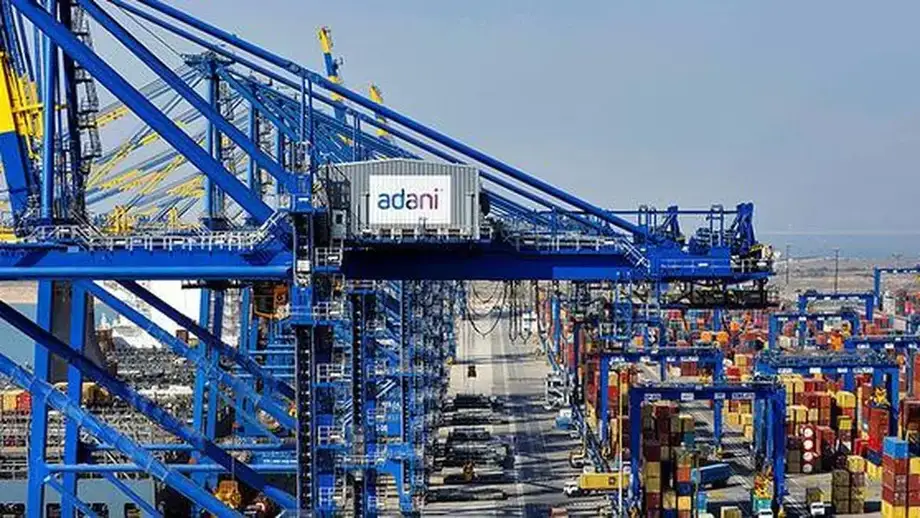
Eight European terminals anchor Adani Ports expansion
Adani Ports and Special Economic Zone Ltd (APSEZ) has agreed to acquire Netherlands headquartered Evos B.V. in a transaction valuing the European liquid storage business at €2.56 billion. The agreement, signed on November 5, 2026, would add eight terminals across five countries and increase APSEZ's liquids cargo volumes from 46 million to 83 million tonnes, using the companies' respective annual figures.
Contents
- Eight European terminals anchor Adani Ports expansion
- What the €2.56 billion price includes
- Debt will finance the cash purchase
- Where the tanks and pipelines are
- Why occupancy and contracts matter
- Revenue growth and stronger margins
- A larger liquids business with several fuel types
- International growth was already accelerating
- Approvals and the completion timetable
- Key Points
India's largest port operator is buying 100% of Evos from Igneo Infrastructure Partners following a competitive bidding process. Evos, described by APSEZ as Europe's second largest independent liquid storage operator, operates 452 tanks and 63 berths for vessels and barges. Its pipeline connections include Schiphol Airport and the Central Europe Pipeline System.
The purchase marks APSEZ's first major entry into Europe's liquid storage sector. Completion would expand its network from 20 to 28 ports and terminals across 10 countries, adding established operations in the Netherlands, Germany, Spain, Belgium and Malta.
APSEZ managing director Karan Adani said the purchase would give the company a substantial position in international energy logistics:
We are delighted to welcome Evos into our portfolio, giving us significant presence across key global liquid storage and energy hubs.
The acquisition is an agreement awaiting completion. APSEZ expects the process to take up to 15 months from signing, subject to government and regulatory approvals in India and relevant foreign jurisdictions, as well as consultation with works councils, which represent employees.
What the €2.56 billion price includes
APSEZ will pay an equity consideration of approximately €1.18 billion, subject to adjustments when the transaction closes. The detailed valuation puts the equity amount at €1.184 billion and the enterprise value at €2.558 billion, rounded to €2.56 billion in the announcement.
Enterprise value measures the value of the business including its net debt and certain other financial obligations. Equity value is the amount attributed to its shares. Here, the difference is €1.374 billion in net debt and items treated like debt, including €289 million of shareholder debt.
The transaction therefore combines a payment for ownership with the financial obligations attached to the business. F.S. Amelia S.à r.l. and Evos Manco B.V. are the named counterparties to the November 5 agreement.
APSEZ values Evos at 11.7 times its 2025 earnings before interest, tax, depreciation and amortisation, or EBITDA. This measure describes earnings before financing costs, taxes and accounting charges for assets are deducted. Evos generated €219 million of EBITDA in 2025.
Using estimated 2026 EBITDA of €225 million, the acquisition multiple falls to 11.4 times. That estimate assumes earnings growth of about 2.7% from 2025, giving readers a way to compare the purchase price with both recorded and projected operating earnings.
Debt will finance the cash purchase
MUFG is the sole underwriter for the acquisition and has committed financing of up to €2.8 billion. APSEZ says the transaction will be funded through debt. An all cash deal means the sellers receive money for their shares; APSEZ will borrow to finance the transaction.
The company estimates that the combined business would have net debt equal to 2.76 times annual EBITDA, using APSEZ's financial year 2026 figures and Evos's calendar year 2025 figures. This calculation, known as a pro forma ratio, shows how the businesses would look together using those earlier results.
APSEZ expects that ratio to decline to around 2.5 times by financial year 2027. Net debt means borrowing after subtracting cash, so the ratio compares the company's debt burden with its operating earnings. APSEZ held ₹12,502 crore in cash at September 30, 2026.
The financing plan makes Evos's ability to generate earnings central to the transaction. APSEZ is adding borrowing while acquiring a business with high occupancy and contracts that support recurring revenue. Its stated debt target is a projection for the combined business, while the acquisition itself remains subject to the approval process.
Where the tanks and pipelines are
Evos has 6.3 million cubic metres of storage capacity across terminals in Amsterdam East, Amsterdam West, Rotterdam, Terneuzen, Ghent, Hamburg, Algeciras and Malta. Amsterdam East and Amsterdam West are separate terminal locations within the same port city.
The network places Evos in the Amsterdam-Rotterdam-Antwerp energy trading region, Hamburg and the Mediterranean. Its customers include global energy companies, industrial and chemical businesses, and commodity traders that need places to receive, store and dispatch liquid products.
The 63 vessel and barge berths connect the storage network to maritime transport, while pipelines provide another route for moving products. The Schiphol Airport connection ties part of the platform to aviation fuel distribution. The Central Europe Pipeline System connection adds access to an established fuel transport network.
Evos handled 37 million tonnes in 2025. Storage capacity and throughput describe different things: capacity is how much the tanks can hold at a given time, while throughput measures the amount handled over a period. Products can enter and leave the same tanks repeatedly during a year.
Why occupancy and contracts matter
Evos's average commercial occupancy is 99%, according to APSEZ. That means almost all its storage capacity is commercially committed. Customers pay for access to storage space and associated services, making occupancy an important part of the business's revenue base.
A substantial portion of Evos's revenue is supported by take-or-pay contracts. Under such arrangements, customers commit to minimum payments even if they use less than the agreed amount of capacity or service. For a storage operator, that provides a more dependable revenue base than relying entirely on bookings made as needed.
Evos also has contracts linked to the consumer price index, or CPI, a measure of changes in prices. These arrangements allow contracted charges to adjust with inflation under the agreed terms. They can help the company keep revenue aligned with rising costs.
APSEZ describes Evos as an issuer with an investment grade credit rating and an established customer base. An investment grade rating indicates that a credit rating agency considers a borrower to have relatively sound capacity to meet its financial obligations. Together, the occupancy, customer relationships and contract structure explain why APSEZ is targeting the business for predictable cash generation.
Revenue growth and stronger margins
Evos's revenue increased from €323 million in 2023 to €367 million in 2024 and €392 million in 2025. The €69 million increase over two years amounts to about 21.4%. Annual revenue growth slowed from approximately 13.6% in 2024 to 6.8% in 2025.
The company generated €219 million of EBITDA from its €392 million of revenue in 2025, producing a margin of about 56%. In simple terms, it retained roughly 56 cents in EBITDA for every euro of revenue, before the financing, tax and accounting charges excluded from that measure.
APSEZ's international ports business reported an EBITDA margin of 44.8% in the first half of financial year 2027. Evos's 2025 margin was therefore 11.2 percentage points higher. The figures cover different periods, but they show why APSEZ expects the storage business to strengthen the earnings profile of its overseas portfolio.
Evos's estimated 2026 EBITDA margin is 55%, alongside projected EBITDA of €225 million. The forecast pairs a small rise in operating earnings with a slightly lower margin than in 2025. APSEZ's acquisition valuation uses both the recorded 2025 result and that 2026 estimate.
A larger liquids business with several fuel types
APSEZ says the purchase would increase its liquids cargo volumes from 46 million tonnes to 83 million tonnes, combining its financial year 2026 volumes with Evos's calendar year 2025 throughput. The additional 37 million tonnes represents an increase of approximately 80% over APSEZ's existing figure.
The comparison measures the scale being added using two different reporting calendars. Evos would account for about 45% of the combined 83 million tonnes, making it a substantial part of APSEZ's enlarged liquids business.
Evos handles gasoline, gasoil, marine fuels and jet fuel, alongside sustainable aviation fuel, biofuels, methanol and bioethanol. This gives APSEZ exposure both to established petroleum markets and to products used as alternatives to conventional fuels. Sustainable aviation fuel is an alternative aviation fuel intended to reduce emissions across its production and use compared with conventional jet fuel.
Karan Adani linked the purchase to Europe's changing energy needs and the company's approach to financing its expansion:
We look forward to partnering with Europe, supporting its sustainable energy transition and creating enduring value while maintaining the financial prudence that underpins our growth.
Adani also described the acquisition as part of APSEZ's ambition to handle one billion tonnes of cargo and build an integrated global transport platform. Evos contributes an operating storage network serving several fuel markets, rather than a project that still needs to be built.
International growth was already accelerating
APSEZ's international ports business handled 47 million tonnes in the first half of financial year 2027, compared with 17 million tonnes in the corresponding period a year earlier. That is an increase of 30 million tonnes, or approximately 176%.
The growth came from increased activity at Colombo West International Terminal, operations in Tanzania and the contribution from NQXT Australia. International revenue reached ₹3,586 crore, while EBITDA was ₹1,608 crore.
Evos would add a different business to that expansion: European storage terminals with contracted capacity, rather than growth concentrated in cargo moving through the existing international port network. APSEZ expects the acquisition to spread its earnings across more locations and add cash flows in major international currencies.
APSEZ shares closed at ₹1,897 on the BSE on the announcement day, down ₹10.10, or 0.53%. The company is pursuing the acquisition while its existing international operations are growing rapidly, putting both integration and debt management at the centre of the next stage of expansion.
Approvals and the completion timetable
APSEZ was selected after a competitive bidding process and signed the acquisition agreement on November 5, 2026. The company said regulatory applications and works council consultations would begin immediately.
The stated completion window extends to roughly February 2028. No exact closing date has been announced. The main dated milestones are:
- 2023: Evos recorded revenue of €323 million.
- 2025: Revenue reached €392 million, EBITDA was €219 million and throughput totalled 37 million tonnes.
- September 30, 2026: APSEZ held ₹12,502 crore in cash.
- November 5, 2026: APSEZ signed the agreement to acquire 100% of Evos.
- Within 15 months of signing: Expected completion, subject to approvals and works council consultation.
Completion would transfer a network of operating terminals, customer contracts and transport connections into APSEZ's portfolio. The company's financial objectives then depend on combining those earnings with its wider business while bringing the projected debt ratio toward its stated target.
Key Points
- APSEZ has agreed to buy 100% of Evos at an enterprise value of €2.56 billion, with equity consideration of about €1.18 billion.
- Evos operates eight terminals in five European countries, with 6.3 million cubic metres of storage capacity and 99% average commercial occupancy.
- The acquisition will be financed through debt, with MUFG committing up to €2.8 billion.
- Evos generated €219 million of EBITDA in 2025 at a margin of 56%.
- The deal would expand APSEZ's network to 28 ports and terminals across 10 countries.
- Completion is expected within 15 months of November 5, 2026, subject to approvals and employee consultation.