A record on the track and a first in rugby
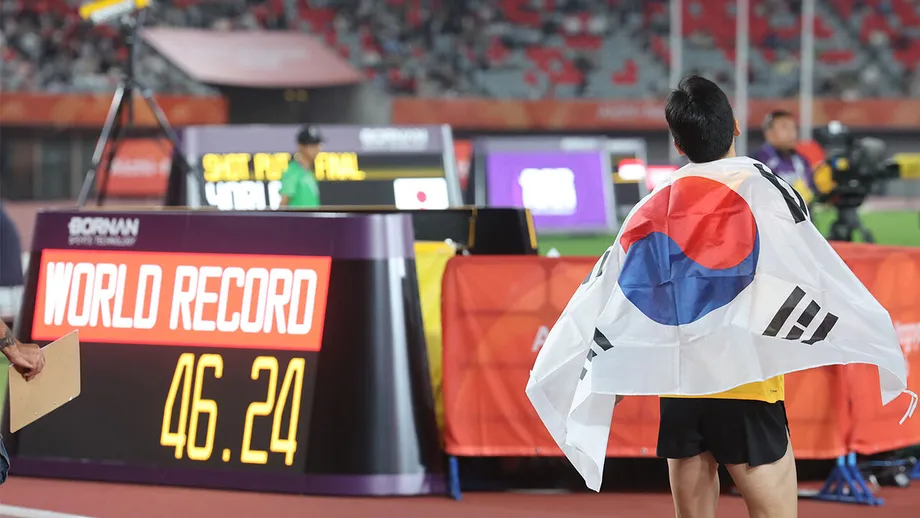
Jang Min-ho ran the men's T13 400 meters in 46.24 seconds, and South Korea defeated Japan 53-50 in wheelchair rugby as the Korean delegation reached 28 gold medals at the Aichi-Nagoya Asian Para Games on October 23, 2026. The sprinter's world record and the country's first Asian Para Games rugby title led a day of success across four sports.
Contents
- A record on the track and a first in rugby
- How Jang turned two races into two records
- World number 16 defeats the Paralympic champion
- Table tennis sets a new Korean benchmark
- Three titles for Yoon and a long wait ends for Jung
- Three badminton finals bring Park three silvers
- A road title, throwing medals and goalball bronze
- Korea moves beyond its original target
- Key Points
South Korea stood fifth with 28 gold, 36 silver and 33 bronze medals, a total of 97. China led with 204 golds, followed by Japan with 63, Uzbekistan with 45 and India with 30. Korea was two golds behind India with the Games scheduled to finish on October 24.
Six Korean titles came in athletics, wheelchair rugby, table tennis and cycling on October 23. The medal tally also included the men's MD22 table tennis doubles gold that Kim Ki-tae and Kim Bo-gyeom had won the previous day.
Table tennis finished with a Korean record of 12 gold medals, while badminton player Park Hae-seong collected three silvers at his first Asian Para Games. The men's goalball team returned to the podium for the first time since 2018 by defeating Iran for bronze.
How Jang turned two races into two records
Jang, 29, won the 400 meters at Mizuho Park Athletics Stadium in Nagoya, lowering the previous world record of 46.44 seconds by 0.20 seconds. Algeria's Skander Jamil Atmani had set that mark at the 2024 World Para Athletics Championships in Kobe.
Jang also improved his personal best of 46.47 seconds by 0.23 seconds. Japan's Ryota Fukunaga finished second in 47.98, leaving a gap of 1.74 seconds between the gold and silver medalists. Thailand's Chakrin Thammuni took bronze in 50.03.
Jang had qualified second fastest for the final with 50.92 seconds on October 22. Starting the final in lane five, he built his advantage after the 200 meter mark and maintained his speed through the last straight.
Three days earlier, on October 20, Jang had won the T13 100 meters in an Asian record of 10.48 seconds. He therefore finished his first Asian Para Games with two golds and records at both distances.
T13 is a competition class for athletes with visual impairments who race without guide runners. Classification groups athletes according to how their impairment affects their performance, helping make competition fairer.
Jang had also competed at the 2026 Asian Games, becoming the first Korean track and field athlete to take part in both that competition and the Asian Para Games. His 400 meter performance delivered Korea's first para athletics world record since Hong Seok-man ran the men's 800 meters in 1:34.91 in Arbon, Switzerland, in June 2010.
World number 16 defeats the Paralympic champion
South Korea's wheelchair rugby team entered its final at Wing Arena Kariya against an opponent ranked 15 places higher. Korea was world number 16; host Japan was number one and the gold medal winner at the 2024 Paris Paralympics.
Korea matched Japan through the opening half, which ended 26-26. The decisive shift came in the third quarter, when the Korean team moved two points ahead.
Japan remained close through the final quarter, but Korea protected its advantage and finished with a three point victory, 53-50. The result gave South Korea its first Asian Para Games gold in wheelchair rugby, achieved against the host nation and reigning Paralympic champion.
The win added a team title to a day already marked by Jang's individual record. Korea's rugby players had overcome the highest ranked opponent in their sport, while its leading sprinter had beaten the fastest recorded time in his event.
Table tennis sets a new Korean benchmark
South Korea completed its table tennis competition with 12 gold, seven silver and eight bronze medals at Sky Hall Toyota in Aichi Prefecture. Its 27 medals included three more golds than the previous Korean record of nine, achieved at both the 2018 Indonesia Games and the Hangzhou edition designated as the 2022 Games.
The increase from nine to 12 golds was one third. Table tennis supplied 12 of Korea's 28 gold medals at the October 23 tally, about 43 percent, making it a major contributor to the delegation's fifth place.
Kim Hyun-uk and Jang Young-jin secured the men's MD4 doubles title with four wins from four matches. They completed their round robin campaign by beating Thailand 3-0, taking the games 11-5, 11-6 and 11-9. In a round robin, each pair plays the others in its group, and the standings determine the winner.
Kim added the doubles title to his singles gold from October 20 and mixed doubles gold from October 22. His three titles came at his first Asian Para Games. Jang Young-jin earned his second gold after an earlier mixed doubles victory.
Another Korean pair, Park Jin-cheol and Kim Kyung-hyun, won MD4 silver with three victories and one defeat. Their only loss was against Kim and Jang on October 21; they finished by defeating India's Jehan Madan and Shubham Wadhwa 3-0.
Three titles for Yoon and a long wait ends for Jung
Yoon Ji-yu joined Kim as a winner of three gold medals after partnering Seo Su-yeon to victory in the women's WD5 doubles. Yoon had already won singles and mixed doubles gold, while Seo finished with two golds from singles and doubles.
The pair survived a close semifinal against China's Liu Jing and Huang Zhirui. After winning the first two games, they lost the next two before taking the deciding game 12-10 for a 3-2 victory. They then defeated Thailand 3-1 in the final, winning the fourth game 11-2.
Lee Mi-gyu and Jung Young-a won the women's WD10 doubles after a tighter contest in the standings. Their 3-0 victory over Thailand left them with three wins and one defeat, level with the Thai pair and China's Zhang Bian and Zhang Miao.
Lee and Jung took gold on game difference, finishing at plus seven. That measure subtracts games lost from games won and was used to separate the pairs with identical match records.
Lee earned her second gold of the Games. For Jung, the title was her first Asian Para Games gold after three silvers at Incheon in 2014. She had already won singles silver and mixed doubles bronze at Aichi-Nagoya before finally reaching the top of the podium.
Park Hong-kyu and Hwang In-chun added men's MD14 doubles bronze. North Korea's Jeon Ju-hyeon and Kim Yeong-rok also received bronze in that event. Korea's completed table tennis total exceeded both its previous record and its target of seven golds for these Games.
Three badminton finals bring Park three silvers
Park Hae-seong reached the men's singles, men's doubles and mixed doubles finals at his first Asian Para Games. Each ended with silver, with China's Qu Zimo on the winning side in all three events.
Yoo Soo-young, Park's partner in men's doubles, also won silver in men's singles. Their results added medals across individual and paired competition, even though the Korean players could not turn those final appearances into gold.
Park's three silvers were part of a Korean delegation tally in which silver was the largest category. By October 23, Korea had 36 silver medals compared with 28 golds and 33 bronzes.
A road title, throwing medals and goalball bronze
Jung Jae-seop supplied Korea's cycling gold by winning the men's C4-5 road race in 1 hour, 48 minutes and 21 seconds. His victory extended the day's gold medal success beyond the athletics stadium and indoor venues.
Three other Korean athletes won athletics silver. Lim Young-ji recorded 5.10 meters in the women's T20 long jump. Kang Woe-taek threw 33.91 meters in the men's F32 club throw, while Jeong Ji-won reached 28.40 meters in the F51 club throw.
The letters and numbers attached to these events identify competition classes. Track events use T and field events use F; the classes reflect different effects of impairment on sporting performance. Kang and Jeong competed for separate medals in their respective club throw classes.
South Korea's men's goalball team defeated Iran 6-4 in the bronze medal match. The victory reversed the result of their bronze medal meeting at the previous Hangzhou Games and returned Korea to the Asian Para Games podium in the sport for the first time in eight years.
Korea moves beyond its original target
South Korea sent a delegation of 357 people, including 214 athletes, 104 competition officials and 39 headquarters officials. Its athletes entered all 18 sports, with an initial target of at least 21 gold medals and sixth place.
By October 23, Korea had seven more golds than that target and stood one position above its ranking goal. Its final position was still undecided, with competition scheduled to continue through October 24.
The fifth Asian Para Games opened on October 18, bringing together participants from 45 Asian countries and regions for competition across 18 sports. Events were held in Aichi Prefecture, Nagoya and Izu in Shizuoka Prefecture.
Korea's progress over the closing days included individual records, repeated success in table tennis and a first national title in wheelchair rugby. The key dates show how those achievements accumulated:
- October 18: The Aichi-Nagoya Asian Para Games opened.
- October 20: Jang Min-ho won the T13 100 meters in an Asian record of 10.48 seconds; Kim Hyun-uk won table tennis singles gold.
- October 22: Kim won mixed doubles gold, while Kim Ki-tae and Kim Bo-gyeom won the men's MD22 doubles.
- October 23: Jang set the T13 400 meter world record, Korea won wheelchair rugby gold, and the delegation's tally reached 28 golds.
- October 24: The Games were scheduled to conclude.
Key Points
- South Korea stood fifth with 28 gold, 36 silver and 33 bronze medals on October 23.
- Jang Min-ho won the T13 400 meters in a world record of 46.24 seconds after taking 100 meter gold.
- Korea defeated world number one Japan 53-50 for its first Asian Para Games wheelchair rugby title.
- Korean table tennis finished with a national record of 12 golds, including three each for Kim Hyun-uk and Yoon Ji-yu.
- Park Hae-seong won three badminton silvers, Jung Jae-seop won cycling gold, and men's goalball secured bronze.
- Korea exceeded its target of 21 golds before the scheduled October 24 finish.