
Police protection, disputed reviews and nearly 3 million admissions
South Korean actor Yoo Hae-jin has received an emergency smartwatch and increased police patrols as the controversy over The Assassin(s) spreads from historical criticism to protests outside his reported home, pressure on advertisers and allegations of manipulated online reviews. Meanwhile, the film reached 2,884,498 admissions by 7 a.m. on October 11, according to figures attributed to the Korean Film Council's integrated ticketing network.
Contents
- Police protection, disputed reviews and nearly 3 million admissions
- What the film suggests, and what investigators concluded
- Protests move from the screen to private life
- What the police measures actually involve
- Naver separates a software error from automated abuse
- Political complaints widen the dispute
- The minister and filmmakers draw a line at intimidation
- Canceled appearances, but Singapore keeps its selection
- Ticket sales rise, but profit is a separate question
- Key dates and unresolved outcomes
- The Bottom Line
The latest audience total places director Hur Jin-ho's thriller close to 3 million admissions despite canceled promotional events and demands that cinemas stop showing it. The dispute has also reached Singapore, where festival organizers have maintained their decision to make the film the opening selection of their 37th edition despite objections from South Korea's People Power Party.
Two separate police matters now sit at the center of the controversy. Seongbuk Police Station has introduced measures to protect Yoo following his agency's request. Naver, South Korea's largest web portal, has separately asked police to investigate automated abuse affecting reactions to the film's reviews. Neither development establishes who operated the automated tools or whether the activity had a political motive.
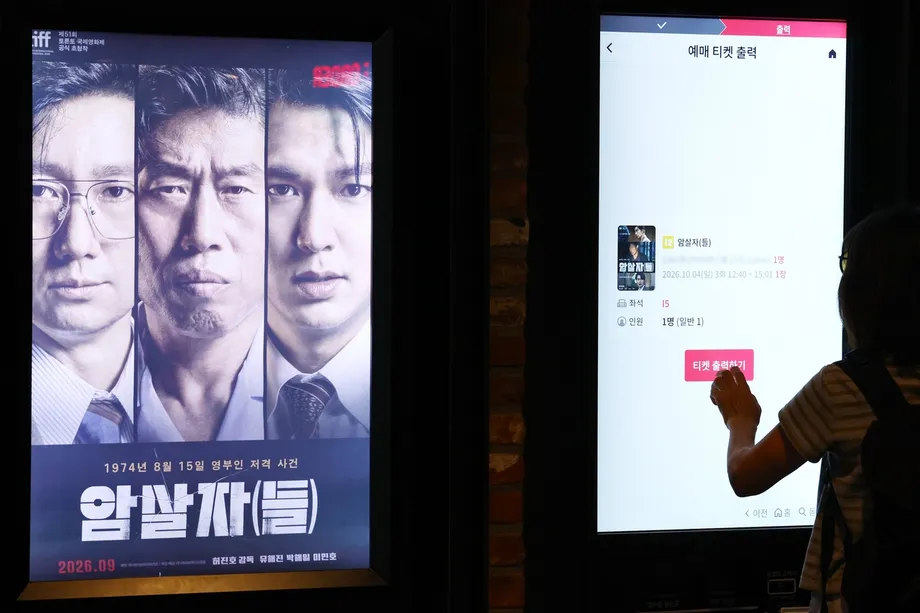
The film, released September 23, draws on the August 15, 1974 assassination attempt against President Park Chung-hee at a Liberation Day ceremony in Seoul. Park survived, but first lady Yuk Young-soo was fatally wounded. The filmmakers say their fictional investigation does not establish a new historical conclusion. Conservative critics argue that its suggestions of government involvement distort the event and damage the reputation of Yuk and her family.
What the film suggests, and what investigators concluded
The historical investigation concluded that gunman Mun Se-gwang, a Korean resident of Japan, acted under instructions linked to North Korea. Accounts describe him as 22 at the time of the shooting. He was arrested at the scene and executed months later.
The film follows a police detective played by Yoo, an experienced newspaper journalist played by Park Hae-il and a younger reporter played by Lee Min-ho. Their fictional inquiry considers whether other people, including figures within Park's government or the Korean Central Intelligence Agency, might have been involved.
That distinction is the core of the argument: the movie explores suspicions beyond the historical investigation's conclusion, while its critics say those suspicions can be understood by viewers as accusations against real people. Some descriptions of the film connect its suggested conspiracy to political pressure following the kidnapping of opposition figure Kim Dae-jung.
Hur has denied that the film portrays Park as the person behind the attack. Hive Media Corp., the production company, has also rejected the idea that it was made to settle the historical question. In a statement explaining the film's purpose, the company said:
It is not a film made to newly fix a specific historical conclusion or to distort established facts.
The filmmakers acknowledge that a work involving real historical figures invites competing interpretations and criticism. Their position does not mean its fictional theories have been verified, just as objections to those theories do not by themselves establish a legal violation.
Protests move from the screen to private life
About 50 people gathered near a house in Seoul's Seongbuk district believed to belong to Yoo, according to an unofficial police estimate. Protesters demanded an end to screenings and apologies from the cast and producers. Reports differ on the timing: several place the initial gathering on a Sunday, while others give October 4 and describe subsequent daily rallies.
The campaign expanded to Burger King's Korean headquarters, where protesters called for a boycott and demanded that the company end its advertising relationship with Yoo. Another group demonstrated outside Hive Media Corp. Reports place those protests on October 6, although other accounts describe them as taking place on Tuesday.
VAST Entertainment, Yoo's agency, said it was collecting online posts and other evidence involving alleged falsehoods, personal attacks, privacy violations and threats. Its statement distinguished those acts from criticism of the film itself:
We will take a firm stance against any actions that violate the actor's privacy, threaten his safety or tarnish his reputation.
No confirmed change to Yoo's advertising contract has been announced in these accounts. The documented development is the demand for cancellation, not a decision by the advertiser.
What the police measures actually involve
Seongbuk Police Station provided Yoo with a smartwatch capable of location tracking and emergency reporting, registered him with the 112 emergency response system and increased patrols around his residence. No dedicated protection officers were assigned. The measures therefore provide a way to summon assistance and a greater police presence, rather than continuous personal guarding.
Dated accounts place activation of the measures on October 6 after an application from his agency. Other accounts describe the action as occurring on Tuesday. The reports agree on the protection provided, but their calendar descriptions are inconsistent.
A police official explained that protection can be introduced before a crime occurs when there is a substantiated concern about potential harm. Seoul Metropolitan Police Commissioner Go Beom-seok also said police would take legal action against threats or acts of harm and could expand protection if necessary. Describing that approach, he said:
If we judge that safety issues could arise, we will take additional measures such as strengthened patrols or personal protection.
The decision does not establish that every protester committed an offense. It reflects a safety assessment prompted by gatherings near a private residence and threatening remarks online. No arrests or resulting court decisions are identified in the reports.
Naver separates a software error from automated abuse
Naver's response involves two problems that should not be treated as interchangeable. The company first disclosed on September 29 that some reviews had appeared more than once and that likes and dislikes had been counted in duplicate. It said it removed duplicate reviews and excluded duplicate reaction counts.
During its analysis, Naver said it separately detected abnormal traffic and automated abuse involving reactions to reviews of The Assassin(s). A notice published October 4 stated that the company had formally requested a police investigation on October 1. Those dates provide a more specific sequence than initial descriptions saying the referral was announced on Sunday.
One review reportedly accumulated more than 1.37 million likes before Naver's intervention, then fell below 50,000. That reduction illustrates the scale of the disputed count, but it cannot establish how much arose from the software error, automated activity or another cause.
Naver temporarily changed the film's default review order from most liked to most recent. It also changed the first movie information display in search results to prioritize expert ratings rather than user ratings, and said it was considering further safeguards and changes to review sorting.
Crucially, Naver's confirmation concerned review reactions. It did not establish that the film's numerical star ratings themselves had been manipulated. The identities of those responsible, their purpose and any connection to political organizations remain matters for investigation.
Political complaints widen the dispute
People Power Party leader Jang Dong-hyeok called for a boycott, while a party member filed a police complaint accusing the director, writer and producers of defamation. A complaint is a request for legal investigation, not a finding that the allegations are true. The President Park Chung-hee Foundation also demanded an official apology and suspension of screenings.
Members of Park's family expressed concern that the film appeared to target the former president or his presidential security service. The Korea Federation of Teachers' Associations joined the criticism, arguing that fictional entertainment can affect viewers' understanding of history and that creative freedom does not excuse distortion of historical facts.
People Power Party lawmaker Na Kyung-won challenged Naver's intervention, alleging selective control of opinion. She claimed that changing only this film's review order gave greater visibility to recent comments awarding a perfect score. Naver's stated explanation was that it had identified mechanical abuse on this film's review page. Na's allegation is not an established finding about the company's motives.
Na called for scrutiny during the National Assembly audit. The controversy was also expected to feature in the Ministry of Culture, Sports and Tourism's parliamentary audit on October 7, although no outcome of that proceeding is detailed here.
Other accusations have concerned financing. Claims of Chinese investment circulated online, but Hive Media Corp. denied them and said the film was independently planned and produced with domestic capital. Allegations about political pressure on investment have likewise not been established.
The minister and filmmakers draw a line at intimidation
Culture Minister Chae Hwi-young asked police and other authorities to protect the cast and crew and enforce laws against threats and intimidation. Some reports render the minister's surname as Choi rather than Chae. In the statement attributed to Chae, he defended public debate over the film while condemning threats to its creators:
People are free to judge a film, but threatening the safety of its creators destroys democracy.
The minister also described the principle that government can support the arts without directing their content. He argued that alleged defamation or other legal problems should be addressed through civil suits or criminal proceedings after release, rather than administrative intervention to suppress a disliked work.
A coalition of 19 film organizations expressed concern that the controversy had reached individuals' daily lives and safety. It recognized legitimate historical debate and the pain of bereaved families, while distinguishing criticism of a work from pressure on people who participated in it.
At a separate Busan press conference, about 20 directors and industry representatives, including Chung Ji-young and Lee Myung-se, warned against judging a film's intentions without watching it thoroughly. Their statement said:
Audiences, not politicians, should judge.
Their intervention defended the ability to create and evaluate a film without intimidation. It did not resolve whether its treatment of the historical event was accurate.
Canceled appearances, but Singapore keeps its selection
Hive Media Corp. canceled promotional stage greetings in the Seoul area and Busan, citing safety concerns. Planned appearances at the Busan International Film Festival, an outdoor photo session and a free public screening were also canceled. Lee Min-ho withdrew from a public talk, and Yoo canceled festival appearances.
The disruption extended beyond this film. Yoo was also set to miss the Buil Film Awards, where he had separately been nominated for best actor for The King's Warden. Park Hae-il nevertheless attended a Busan event concerning Waikiki Brothers, showing that canceled promotion for The Assassin(s) did not mean every cast member withdrew from every festival activity.
The People Power Party sent an official letter asking the Singapore International Film Festival to withdraw The Assassin(s) as its opening film. Festival organizers declined to change the selection, saying it had been chosen independently for artistic merit. Their statement said:
SGIFF respects the creative vision of the filmmakers behind 'The Assassin(s),' which remains the Festival Opening film of our 37th edition.
The film's public exposure has therefore moved in different directions: promotional events in South Korea were curtailed, while its international opening slot remained intact. No subsequent reversal by the Singapore festival is reported.
Ticket sales rise, but profit is a separate question
The film briefly lost its domestic box office lead in late September, drawing 67,406 admissions against 68,913 for Tazza: Song of Beelzebub. Reports differ on the precise date of that comparison. It later returned to first place and attracted 522,405 admissions during October 3 to 5.
Figures published October 6 put its cumulative audience at either 2,412,816 or 2,412,817, a difference of one admission. The same accounts give October 5 attendance as 178,853 or 178,854. Reported theatrical revenue stood at 23.6888 billion won, against a reported production cost of about 19 billion won.
Gross ticket revenue is not the producer's profit. Cinemas retain part of ticket receipts, and the remainder must cover investment, distribution and other costs. The reported estimate for covering costs was about 3.7 million admissions, leaving a gap of roughly 1.29 million at the October 6 tally.
By October 11, the reported total of 2,884,498 was about 471,700 above the earlier tally, an increase of roughly 19.5 percent. Against the same 3.7 million estimate, another 815,502 admissions would still be needed. The film attracted about 160,000 viewers on Hangeul Day, October 9, and was reported to have led advance bookings among Korean films for 27 consecutive days.
That Korean film ranking is narrower than the ranking across all releases. The film could lead domestic titles while placing third in total advance sales, as one October 6 account reported. Strong attendance also does not prove that the controversy caused its success.
Key dates and unresolved outcomes
The main developments show how a dispute over a historical premise became several separate controversies involving safety, online systems, legal complaints and film programming:
- September 23: The Assassin(s) opened in South Korean cinemas.
- September 29: Naver disclosed duplicate reviews and reaction counts.
- October 1: Naver formally requested a police investigation, according to its October 4 notice.
- October 4: Dated reports place a protest outside Yoo's reported residence on this date, while other accounts describe a Sunday gathering.
- October 6: Dated accounts place the start of police safety measures and protests at Burger King and Hive Media Corp. on this date.
- October 7: The controversy was expected to feature in the culture ministry's parliamentary audit.
- October 11: The reported cumulative audience reached 2,884,498.
A forecast suggested the film might pass 3 million admissions on October 11 or 12. That was a projection, not confirmation that the milestone had been reached. No deadline for completing Naver's police investigation, hearing date for the defamation complaint or confirmed financial result has been announced in these accounts.
The Bottom Line
- Yoo Hae-jin received an emergency smartwatch, emergency system registration and increased patrols, but no dedicated protection officers.
- Naver identified automated abuse involving review reactions, separately from duplicate counting errors.
- The filmmakers describe the movie as fiction, while critics demand apologies and an end to screenings.
- Safety concerns disrupted Korean promotional events, but Singapore retained the film as its festival opener.
- Admissions reached 2,884,498 by October 11, still below the reported 3.7 million estimate for covering costs.
- The operators behind the automated activity and the outcomes of legal complaints remain unknown.