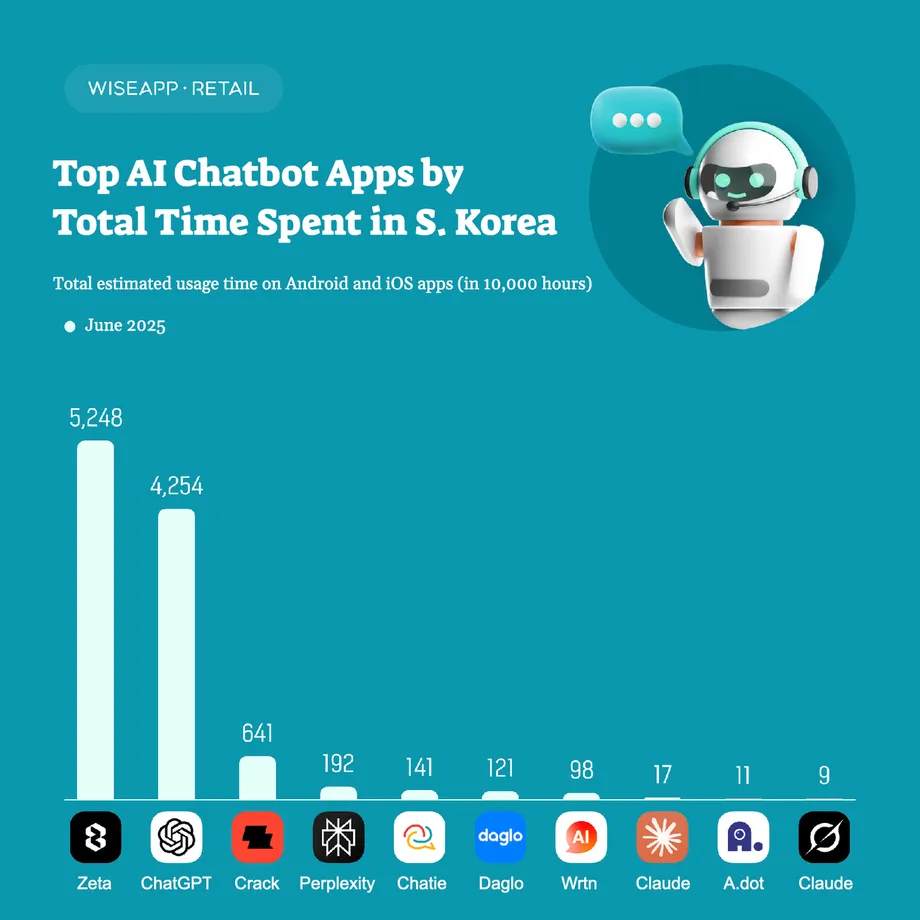
Nearly three hours a day with a virtual companion
Nearly one million people, most of them under 20, spend an average of 2 hours and 46 minutes a day on Zeta, a South Korean app that turns conversations with artificial intelligence into ongoing personal dramas. Some users have spent more than 1,000 hours talking to a single character.
Contents
- Nearly three hours a day with a virtual companion
- How users turn a chat into a story
- The technology behind the emotional pull
- Why simulated closeness can feel personal
- Psychologists and AI companies warn about dependence
- Age labels and the limits of filtering
- The privacy history behind Zeta
- Paying for conversations at scale
- From Japanese audiences to care for older adults
- What families and schools can address now
- What oversight could cover
- Highlights
As of September 27, 2025, Korean app analytics rank Zeta as the most heavily used AI chatbot by time spent. Its daily engagement exceeds the time many teenagers devote to YouTube, TikTok or Instagram. The appeal is less about getting an answer than receiving attention from a character who can act like a close friend, a rival or a crush.
Seoul startup Scatter Lab launched Zeta in 2024 as entertainment built around AI. The service combines chat, storytelling and role play, giving users conversations they can return to throughout the day. A teenager may open the app to advance a plot, revisit a shared joke or repair a virtual relationship.
Zeta carries a rating of 12 plus in app stores, while Scatter Lab says it applies a stricter standard of 15 plus to content. That difference is central to a wider concern: a service available to young users is built to make simulated relationships feel personal and worth returning to.
The characters do not have human feelings, yet their responses can feel attentive, playful or caring. For teenagers exploring friendship, identity and romance, that combination offers both creative freedom and a relationship whose demands are very different from those of another person.
How users turn a chat into a story
Zeta opens with a gallery of characters drawn in an anime style. Users can choose an existing persona or create one, setting a backstory, personality traits, preferences, speech patterns and a relationship with the person doing the typing.
A conversation then becomes a private, collaborative drama. The user supplies a scene and the AI improvises a response. A character might be a comforting friend, an intense school rival or a romantic lead who needs saving. The user determines the direction and emotional stakes while the software keeps the exchange moving.
Popular characters include Su hyeon, a high school bully who tests boundaries; Ha rin, a shy transfer student; and Kwon Seo hyuk, a brooding romantic lead. Their appeal comes from different emotional journeys. Su hyeon offers encounters involving resilience and control, Ha rin invites care and gentle guidance, and Kwon Seo hyuk provides yearning and romantic drama.
Users can refine personalities through feedback as well as the information they enter when creating a character. Conversations adapt to the tone they set, while remembered details help later exchanges feel connected to earlier ones.
Fans describe the attraction as intimacy without risk. A character is always available, does not tire of the conversation and returns messages. Even a tense or abrasive scene unfolds at a pace the user can influence. Repeated visits can turn that sense of control and attention into a daily ritual.
The technology behind the emotional pull
Scatter Lab uses a proprietary large language model, the software that generates Zeta's replies. Unlike a chatbot primarily designed to supply accurate information, Zeta is tuned for emotionally engaging conversations. Its central task is to sustain a story and respond in a way that feels right for the character.
User feedback helps retrain the model. The system learns styles and pacing that keep exchanges alive, including affectionate references to earlier conversations, humor at the right moment and a change of direction when a scene begins to drag.
Characters remember names, small details and shared moments. An unfinished storyline or an inside joke can carry into the next session. This memory is a software function, rather than human recollection, but it gives a conversation continuity and makes returning feel natural.
Notifications arrive at key moments, storylines branch and visual elements reinforce the mood. The teenager decides what happens next while the AI supplies quick replies and warm attention. Time in the app can therefore feel less like scrolling through a feed and more like continuing a relationship.
The combination also explains why engagement is so central to the business. Feedback improves the model's emotional timing, better timing encourages longer conversations, and those conversations generate further feedback. Some users' records of more than 1,000 hours with one character show how far that cycle can extend.
Why simulated closeness can feel personal
Teenagers are learning how to express themselves, interpret reactions and build relationships. Zeta gives them a private place to try a different role, practice being assertive, rehearse an apology or experiment with flirting. The character responds immediately, and a difficult scene can be redirected.
A young person facing social anxiety or pressure at school may find relief in an exchange that feels forgiving and manageable. Human relationships involve competing needs and unpredictable reactions. A virtual character offers a much more convenient form of attention.
The pattern of rewards helps explain the pull. Praise, surprise and mild challenge arrive in changing combinations, making the next reply appealing. This is the idea behind variable rewards: the experience stays compelling because the user does not know exactly which satisfying response will come next.
Memory adds another layer. A character that brings up yesterday's worry may seem more considerate than a distracted classmate or a parent in a hurry. Repeated recognition can deepen attachment, even though the response comes from a trained model.
For a teenager, the difference between enjoying a fictional interaction and depending on it emotionally can become difficult to track. A character that seems encouraging or alluring may feel as though it understands and chooses the user, although it has no human intention or empathy.
Psychologists and AI companies warn about dependence
Kwak Keum joo, a psychology professor at Seoul National University, has studied relationships with AI companions and their effects on everyday life. She warns that constant availability can make an artificial companion an easier choice than the effort required by human relationships.
People can heavily rely on AI to fulfill their social desires without making much effort when the AI hears you out 24/7 and gives you answers you want to hear.
For adolescents spending two or three hours a day in a conversation presented as intimate, emotional boundaries can become blurred. A convincing character can encourage users to attribute care, intention and empathy to software that generates responses without possessing those qualities.
OpenAI also examined this concern in a model assessment in 2025, considering how people might respond to lifelike voice and chat tools. The company discussed anthropomorphism, the human tendency to see machines as having human qualities or intentions.
Users might form social relationships with the AI, reducing their need for human interaction, potentially benefiting lonely individuals but possibly affecting healthy relationships.
Teenagers face particular concerns because their brains are still developing, their experience of setting limits is more limited, and their expectations of relationships are still taking shape. Sexualized role play or abusive situations may appear within character stories even where explicit material is filtered. Repeated exposure can make some patterns seem normal.
A teenager who comes to expect instant reassurance or constant agreement may carry those expectations into school or family life. The practical concern is how much space a simulated relationship occupies, what behavior it presents as acceptable and whether it displaces more demanding contact with other people.
Age labels and the limits of filtering
Zeta's store rating of 12 plus and Scatter Lab's stated content standard of 15 plus serve different purposes. The store label indicates an age category for the app, while the company's standard governs what characters are allowed to say and do.
South Korea has no independent content rating system specifically for AI chat companions. Platforms therefore apply their own guidelines and filters. An interactive story also works differently from a video: a line directed personally at a user can have a different emotional impact from a scene watched at a distance.
Scatter Lab's safeguards include filters for illegal or explicit content, age guidelines and moderation of flagged transcripts. The model is also tuned to avoid harmful advice and steer away from illegal or harmful behavior. These measures operate within a product whose main attraction remains personal attention and simulated intimacy.
Romantic tension, aggression and abrasive dialogue can be part of a character's appeal even when explicit content is restricted. Safety therefore involves both the words a filter blocks and the relationship patterns a story encourages. Limits for minors need to be clear, visible and enforceable.
The privacy history behind Zeta
Scatter Lab faced scrutiny before Zeta. Its earlier chatbot, Lee Luda, attracted strong interest in 2020 and 2021, then encountered privacy concerns that led to a shutdown. That experience remains relevant because companion apps invite people to share personal details in conversations that feel private.
The company says it learned from the episode, changed its handling of training data and strengthened anonymization, the process of removing information that can identify a person. Zeta now relies on interactions within the app and curated sources rather than scraping personal content. Scatter Lab says those changes are intended to prevent the disclosures and risks that affected its earlier service.
The sequence places Zeta's rapid growth within a short history of development and scrutiny:
- 2020 and 2021: Lee Luda drew strong interest before privacy concerns led to its shutdown.
- 2024: Scatter Lab launched Zeta, combining character conversations, storytelling and role play.
- September 27, 2025: Zeta's reported audience was approaching one million, with average daily use of 2 hours and 46 minutes and growing interest beyond South Korea.
Training data and conversation histories matter for different reasons. Training data shapes how a model responds, while chat histories can contain personal experiences and details shared by users. Strong anonymization, secure storage and records that can be checked are therefore part of the proposed safeguards for this kind of service.
Paying for conversations at scale
Hundreds of thousands of active users create substantial computing costs. Every generated reply requires processing power, and a service built around long conversations must provide those replies quickly enough to preserve the flow of the story.
Korean AI startups have turned to specialized inference platforms and technical optimization to reduce costs and delays while handling surges in traffic. Inference means running a trained model to produce a response. Graphics processing units, or GPUs, provide computing power for that work.
Scatter Lab has said it reduced GPU costs through these approaches. Lower costs help keep Zeta responsive when a character or storyline attracts sudden attention. A slow exchange would interrupt the immediate, attentive experience that makes the app appealing.
Long engagement also creates opportunities for revenue through optional purchases. Scatter Lab presents the product as entertainment rather than education or productivity. Its commercial challenge is to sustain an expensive conversational service while maintaining the experience that brings users back.
From Japanese audiences to care for older adults
Zeta is gaining traction in Japan, where anime aesthetics and interactive fiction already have established audiences. Its expansion brings the same model of a companion that remembers past exchanges to another market where messaging is a major part of social life.
Other services offer related experiences. Replika focuses on lasting bonds and memory, while Character AI offers personas such as mentors and therapists that are always available. Across these products, companionship can overlap with advice, creating relationships with software that responds warmly for hours.
Eugenia Kuyda, CEO of Replika, describes AI partners as a distinct category of relationship rather than substitutes for people.
They are not replacing real life humans but are creating a completely new relationship category.
South Korean officials also see possible uses for AI companionship outside teenage entertainment. Some regional programs lend conversational robots to older adults living alone, aiming to reduce isolation and provide medication reminders.
Oh Myeong sook, a health promotion director in Gyeonggi Province, has described the purpose of those programs in terms of gaps in care.
With AI robots, we expect to address gaps in support for vulnerable populations and help prevent lonely deaths.
The examples show how the same capacity for conversation can serve different purposes. A fictional romance, a persistent companion and a robot offering reminders all use responsive dialogue, but the needs of their users and the responsibilities of their providers differ.
What families and schools can address now
Parents can begin with the difference between attention and affection. An AI can respond at any hour without feeling concern or remembering in the human sense. Naming that difference gives teenagers a clearer way to describe an experience that may still feel emotionally powerful.
Families can agree on periods for using the app that leave room for sleep, homework and friendships outside it. Reviewing content settings together can also make clear that the company, rather than the fictional character, determines the rules and filters.
Discussion can focus on concrete moments: which response made the teenager feel understood, which behavior crossed a boundary, and whether the same language would be acceptable from a friend at school. The aim is to build judgment without shaming a young person for enjoying an interactive story.
Schools can include AI companions in digital citizenship lessons. Students can learn to recognize persuasive design, understand how changing rewards encourage continued use and identify when software is imitating care. Practicing how to refuse a character's request or leave an uncomfortable scene gives them language for setting limits.
What oversight could cover
App store age labels were developed for products such as games and video, rather than interactive romance or simulated therapy. Privacy rules address the collection of information, while persistent emotional engagement presents another set of concerns, particularly when leaving a chat can feel socially uncomfortable.
Proposals for stronger safeguards include independent assessments of age suitability that examine more than explicit content. Platforms could disclose when a model is designed to encourage emotional engagement and provide visible session timers, prompts to take breaks and optional daily limits for users under 18.
Other suggested controls include recording and showing when a character moves into romance or role play involving aggression, alongside optional controls for guardians. Auditable records, stronger anonymization and secure handling of chat histories would address the information users share.
South Korea's privacy and communications regulators could extend their oversight to safety practices in relational AI, while industry groups could publish transparent safety frameworks. These are proposals rather than announced requirements; no decision or implementation date is given. The central issue is how to preserve creative play while setting greater responsibilities for services whose main audience includes minors.
Highlights
- Zeta has nearly one million users, most under 20, averaging 2 hours and 46 minutes a day.
- Korean analytics rank it first among AI chatbots by time spent, exceeding video app use among many teenagers.
- Scatter Lab launched the app in 2024, using customizable characters and remembered conversations to sustain stories.
- Some users have spent more than 1,000 hours with one character.
- The app carries a store rating of 12 plus; the company says its content standard is 15 plus.
- Psychologists and AI developers warn that constant simulated attention can affect human relationships.
- Scatter Lab says it changed data practices after privacy concerns led to the shutdown of Lee Luda.
- Zeta is expanding into Japan as families, schools and regulators consider safeguards for AI companionship.