Why Is the India-Middle East-Europe Corridor Still Far From Running?
The India-Middle East-Europe Economic Corridor, known as IMEC, still matters for trade, but it cannot yet move goods from India to Europe in one smooth journey. Experts say missing rail links and political uncertainty in West Asia are the biggest problems. The corridor's future also depends on ties between Israel and Arab countries, especially Saudi Arabia.
Contents
- Why Is the India-Middle East-Europe Corridor Still Far From Running?
- What Did Countries Sign in 2023?
- Which Part of the Route Is Hardest to Build?
- Why Does Saudi Arabia Hold the Key?
- Can IMEC Compete With the Suez Canal?
- What Cargo Could Actually Use the Route?
- What Is Happening in the Eastern Mediterranean?
- What Does Cyprus Want From IMEC?
- What Does Joe Biden Say About IMEC?
- Where Do Italy and ASEAN Fit In?
- What Is Still Undecided?
- Key Points
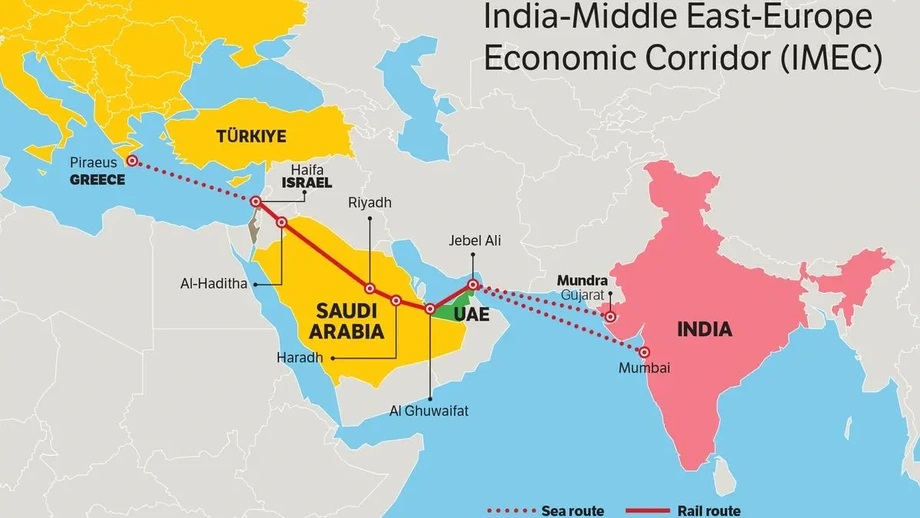
The plan works like a relay race. Ships would carry goods from Indian ports to the UAE, trains would then cross Saudi Arabia, Jordan and Israel, and ships would carry the cargo on to European ports. Planners also want electricity cables, data cables and pipelines for clean hydrogen along the same route. The rail links that tie the relay together have yet to be built.
What Did Countries Sign in 2023?
IMEC was announced at the G20 Summit in New Delhi in September 2023. It was then formalised through a memorandum of understanding, a written agreement that sets out shared goals and steps for working together. A Saudi Press Agency statement lists the signatories as Saudi Arabia, the United States, India, the UAE, France, Germany, Italy and the European Union, and dates the signing to September 10, 2023.
The statement describes three kinds of infrastructure. Railways and port links would move goods and services, electricity lines and pipelines would carry electricity and hydrogen, and data transmission cables would create a cross-border network for information. It also says the project should create new quality jobs and reflects Saudi Arabia's role as a link between East and West. The statement says the project needs mechanisms for implementation within an agreed timeframe, but it does not give that timeframe.
Since the signing, the route has faced a series of setbacks. The Hamas attack on Israel on October 7, 2023 slowed the project, and the US and Israeli military operations against Iran that began on February 28 disrupted shipping further.
The first part of the plan has moved faster than the rest. Sources describe the India and UAE segment as well advanced, while the links across the Arabian Peninsula and into Israel remain stalled.
Which Part of the Route Is Hardest to Build?
John Calabrese, an assistant professor at American University in Washington, told PTI that IMEC is a sound plan on paper but far from working in practice. He said the hardest section lies between the Gulf and Europe.
"The biggest obstacles lie along the Gulf-to-Europe leg," he said, pointing to the proposed rail connections through Saudi Arabia, Jordan and Israel, which have yet to materialise.
Calabrese described the India and UAE segment as "considerably more advanced". He also said regional conflict had strengthened the case for alternative trade routes but had made financing, insurance and political commitments harder to secure.
The main milestones so far are:
- September 2023: IMEC announced at the G20 Summit in New Delhi
- September 10, 2023: memorandum of understanding signed by eight parties
- October 7, 2023: Hamas attack on Israel, followed by conflicts across West Asia
- February 28: US and Israeli military operations against Iran begin, severely disrupting the Strait of Hormuz
- August 2026: Saudi Arabia, Turkey and Pakistan sign the Mecca Joint Defence Agreement
Why Does Saudi Arabia Hold the Key?
Israel has diplomatic relations with the UAE and Bahrain, which normalised ties under the 2020 Abraham Accords. Israel also has peace treaties with Jordan and Egypt. Saudi Arabia, a key transit country for IMEC, has no diplomatic relations with Israel and has linked any normalisation to a credible pathway towards Palestinian statehood. The Palestinian question remains central to the kingdom's position.
Calabrese said IMEC needs a degree of accommodation between Israel and Arab countries, though this need not take the form of formal normalisation. He warned that a land route would face more pressure than trade by sea.
"Commercial ties can survive political tensions. But an integrated land corridor, with multiple border crossings and customs arrangements? That would be less forgiving," Calabrese said.
Without progress on this front, he said, IMEC could develop in separate parts, but its full potential would remain out of reach.
Danni Reches speaks for EcoPeace Middle East, an environmental peacebuilding organisation based in Israel. She said normalisation between Israel and Arab countries would be necessary for the corridor to pass through Saudi Arabia and Jordan towards Israel. She added that Saudi Arabia had conditioned cooperation with Israel on a viable pathway towards a Palestinian state, which would require the Israeli government to be open to discussing the issue.
"Connecting India, the Gulf, Israel, Jordan, the Palestinians, and Europe through mutually beneficial projects could help build incentives for cooperation," she said.
Reches also wants Palestinian economic development and the reconstruction of Gaza included in the corridor's regional vision, alongside renewable energy exports and water-energy cooperation.
Can IMEC Compete With the Suez Canal?
Calabrese said IMEC is unlikely to beat the Suez Canal route on cost, especially for bulk cargo and goods where price matters most. Extra transfers between rail and sea would raise handling costs and add logistical complications. Ships on the Suez route benefit from economies of scale, meaning bigger ships spread costs across more cargo.
He said the corridor's appeal would lie elsewhere, in faster movement of valuable goods with tight deadlines and in offering an alternative when established routes are disrupted.
"Its value is therefore more strategic than strictly commercial," Calabrese said.
Reches said IMEC was never meant to replace the Suez route. She said the corridor could cut transit time by up to 40 per cent compared with routes through the Suez Canal. The sources give no baseline or calculation behind that figure.
"The volume of trade will be nowhere near competing with shipping," she said.
The two routes face separate security problems. The Strait of Hormuz, a narrow waterway between Iran and the Arabian Peninsula, carries a large share of global oil and gas shipments and suffered severe disruption after the February 28 operations. Houthi attacks and threats in and around the Bab el-Mandeb Strait, which links the Red Sea with the Gulf of Aden, have added to security concerns.
What Cargo Could Actually Use the Route?
Rajeev Agarwal, a New Delhi based strategic affairs and security analyst, argues that IMEC should not be seen mainly as a tool for India's energy security. He says crude oil will likely keep moving through existing routes, including the Red Sea and the Strait of Hormuz. He sees a bigger role in other goods.
"Where IMEC can be extremely useful and efficient is in the movement of fast-moving goods, especially food, medicines, electronics, textiles, MSME products, etc," Agarwal said.
Cauvery Ganapathy, a climate and energy fellow at the Observer Research Foundation Middle East in Dubai, says the corridor's long term potential should be judged apart from its near term feasibility during the regional conflict. She says private investment would be essential, but investors would need assured demand and political stability.
"IMEC is, in fact, far more feasible as a long-term component of India's energy and supply-chain security than any assessment of its near-term viability in the shadow of kinetic conflict in the region would at the moment suggest," she said.
A policy analysis by Sreeram Chaulia, dean of the Jindal School of International Affairs, offers trade figures for the Eastern side of the corridor. India and the UAE traded $43 billion in goods in 2021 and more than $101 billion in 2026, a rise of about 135 per cent. The same analysis points to Fujairah in the UAE and the Omani ports of Salalah, Sohar and Duqm as possible landing points that could bypass instability in the region. It also argues that India now carries more of the responsibility for keeping the corridor moving, because the US under President Donald Trump is not backing the project.
What Is Happening in the Eastern Mediterranean?
The Western leg of IMEC depends on three energy and data projects that Israel is developing with Greece and Cyprus. Each route avoids Turkish territory, and each has met resistance from Ankara.
- Great Sea Interconnector: a planned 900 kilometre, 1,000 megawatt subsea high voltage cable linking the electricity grids of Israel, Cyprus and Greece, with EU backing
- East to Med Data Corridor: a subsea and land fibre optic system to route Asian data through Saudi Arabia, Cyprus and Greece into Europe
- EastMed Pipeline: a proposed 1,900 kilometre offshore gas pipeline to carry Israeli and Cypriot gas to Greece and Italy, which remains stalled without a final investment decision
The cable project has already run into a legal dispute at sea. On November 10, Turkey issued NAVTEX 1127/26, a navigational warning broadcast to ships, after the French flagged survey vessel Abeille Marengo began seabed surveys. Turkey said the work required its consent on its continental shelf. Greece declared the notice null and void and asserted Greek and Cypriot jurisdiction. Survey work on the data corridor has also faced repeated Turkish NAVTEX challenges.
What Does Cyprus Want From IMEC?
Marina Hadjimanolis, Cyprus Deputy Minister of Shipping, said her government had told New Delhi it wants to move from indirect to direct involvement. Cyprus is part of IMEC through its membership of the European Union, but it wants a formal seat as the Republic of Cyprus. She spoke at a press conference in New Delhi and argued that recent disruptions were an opening, not a setback.
"I would not say that there is a setback. I would see this as an opportunity to create a corridor that will give access to other routes. We have seen that as many options as we have, it strengthens the freedom of navigation," she said.
She hopes Cyprus will join at the next expansion of the corridor, but no date for that expansion was given.
The commercial side of the relationship was on show at the Cyprus-India Maritime Business Forum in Mumbai on November 23. Shyam Jagannathan, Director General of Maritime Administration under India's Ministry of Ports, Shipping and Waterways, addressed the forum with Hadjimanolis. India promoted a package worth Rs 69,725 crore covering shipbuilding assistance, financing and capacity development. Talks also covered more Indian seafarers on Cyprus-managed vessels, and an agreement between the Cyprus Chamber of Commerce and Industry and the Council of EU Chambers of Commerce in India.
Hadjimanolis also raised the safety of crews on ships in conflict zones.
"Our main concern basically goes to the freedom of navigation. As Cyprus, we are not so much impacted by what has happened. But we are very much concerned not only about freedom of navigation but also about the human factor, because we have seen that seafarers have suffered mainly because of what is happening geopolitically," she said.
The first Cyprus-India Joint Maritime Committee met in Limassol on September 29, 2026. Both sides agreed to hold the next meeting in India, but no date has been set.
What Does Joe Biden Say About IMEC?
Former US President Joe Biden praises the corridor in his memoir, Promise Me, America. He wrote that IMEC was a practical trade route linking Indian and European markets, and he described it in these words:
"It was brilliant in its simplicity. With IMEC, we would plan a trade route, alternating ships and trains to move goods from Mumbai in northwestern India through the Arabian Peninsula and across the Middle East toward the Israeli port of Haifa. From there, ships could take goods to the ports of southern Europe. If IMEC could be built, it would not only help us to compete with China. It would bring India, Saudi Arabia, the other Gulf States, Jordan, the West Bank, and Israel into a real trade network and perhaps reverse the famous adage, 'When goods don't cross borders, soldiers will,' Biden wrote.
Biden also proposed a "Pacific community" of the United States, the European Union, Australia, Canada, India, Japan, South Korea, Mexico and New Zealand. He put their combined economy at around $60 trillion, compared with about $19 trillion for China. That makes the group roughly three times the size of China's economy, by his figures.
A Stimson Center analysis published in September 2024 noted that US policy towards South Asia had moved from India-Pakistan tensions and nuclear concerns towards countering China. It said the Biden administration had deepened the partnership with India while ties with Pakistan had broadly deteriorated after the US withdrawal from Afghanistan in 2021. In his memoir, Biden defends that withdrawal and says he "would make the same decision again".
Where Do Italy and ASEAN Fit In?
Italy is building its own link between Asia and Europe through the Middle Corridor, a route that combines rail and sea transport across Central Asia, the Caspian Sea and the Caucasus. Deputy Prime Minister and Foreign Minister Antonio Tajani led a mission to Baku in November, and he said Italian exports to Azerbaijan grew by 14 per cent in the first eight months of 2026. Italian sources say the Middle Corridor sits alongside IMEC in Rome's plans. In the first half of 2026, Azerbaijan supplied 16 per cent of Italy's gas imports and 13 per cent of its oil imports.
Southeast Asia could also connect to the project. India's Act East Policy, upgraded from the Look East Policy in 2014, aims to deepen ties with ASEAN, and 2026 has been designated the ASEAN-India Year of Maritime Cooperation. The Malacca Strait, which links the Indian Ocean with the South China Sea, carries a large share of global maritime trade. ASEAN is not a formal participant in IMEC, so any link would be an added arrangement rather than an existing one.
What Is Still Undecided?
No date has been given for when IMEC will become operational. The sources also give no date for Cyprus joining, for the second Cyprus-India Joint Maritime Committee meeting in India, or for any Saudi move towards normalising ties with Israel. The East to Med Data Corridor and the EastMed Pipeline have no confirmed timetable, and the pipeline still lacks a final investment decision. Biden's Pacific community is a proposal in his memoir, not a grouping that governments have adopted.
Key Points
- IMEC was signed by eight parties on September 10, 2023, with the rail links through Saudi Arabia, Jordan and Israel still unbuilt.
- Saudi Arabia has not established diplomatic relations with Israel and has tied normalisation to a pathway towards Palestinian statehood.
- Experts see the corridor as more useful for fast moving goods than for bulk cargo, which will likely stay on the Suez route.
- India and the UAE trade rose from $43 billion in 2021 to more than $101 billion in 2026.
- Turkey issued NAVTEX 1127/26 on November 10 to contest the Great Sea Interconnector survey work.
- Cyprus wants a formal role in IMEC and hopes to join at the next expansion, with no date set.