Singapore animation reaches the Oscar list
The Academy of Motion Picture Arts and Sciences named The Violinist among 38 animated features eligible for the best animated feature prize at the 99th Academy Awards, publishing the list on Nov 23. The film, a joint production between Singapore, Spain and Italy, enters a category that also holds Pixar's Toy Story 5 and Hoppers, Disney's Hexed, Laika's Wildwood and Brad Bird's Ray Gunn.
Contents
- Singapore animation reaches the Oscar list
- A record field of 38, and the rules behind it
- Two violinists, one war, eight decades
- How a short film without dialogue became a feature
- Why the score had to come before the drawing
- A second race, decided on the music
- Two trophies in five minutes in Taipei
- From Annecy to the National Day Rally
- What stands between the film and a nomination
- The Bottom Line
Eligibility is the doorway, not the room. Academy voters will cut the 38 down to five nominees, to be announced on Jan 21, 2027, ahead of the ceremony at the Dolby Theatre at Ovation Hollywood on Mar 14, 2027. The Academy said some titles on the list must still complete the theatrical release the category rules require before they can advance.
For the team behind the film, the announcement extends a year that began with a win in France. The Violinist opened in Singapore cinemas on Sep 17 after a gala premiere at the Capitol Theatre on Sep 3, and reached cinemas in Spain on Nov 13.
Ervin Han, who directed with Spanish animator Raul Garcia, said the listing told the team something about where its story belongs.
We have always believed that a story rooted in Singapore can resonate with audiences anywhere in the world. This recognition is encouraging because it tells us that stories from our part of the world can stand alongside some of the best animated films internationally.
A record field of 38, and the rules behind it
The 38 qualifiers are the most the animated category has recorded, beating the previous record of 35 set a year earlier. The same announcement counted 190 documentary features and 104 international features, both records as well. Netflix holds the largest distributor slate, with Ray Gunn, Steps, Swapped, In Waves and I Am Frankelda, and seven anime titles made the list, from Mobile Suit Gundam Hathaway: The Sorcery of Nymph Circe to Jinsei and Grotesqqque.
Members of the Academy's Animation Branch vote automatically in the category. Members from other branches can opt in if they meet a minimum viewing requirement, a rule meant to keep the vote with people who have watched the films. An animated feature can also be entered in other categories, including best picture, and a film chosen as a country's international feature submission stays eligible in animation.
Singapore's entry in that international category this year is a different film, Anthony Chen's We Are All Strangers, which won best original film score at the Golden Horse Awards. The Violinist carries the country's animation hopes on its own, though the work behind it was shared among three studios: Robot Playground Media in Singapore, TV ON Producciones in Spain and Altri Occhi in Italy.
Two violinists, one war, eight decades
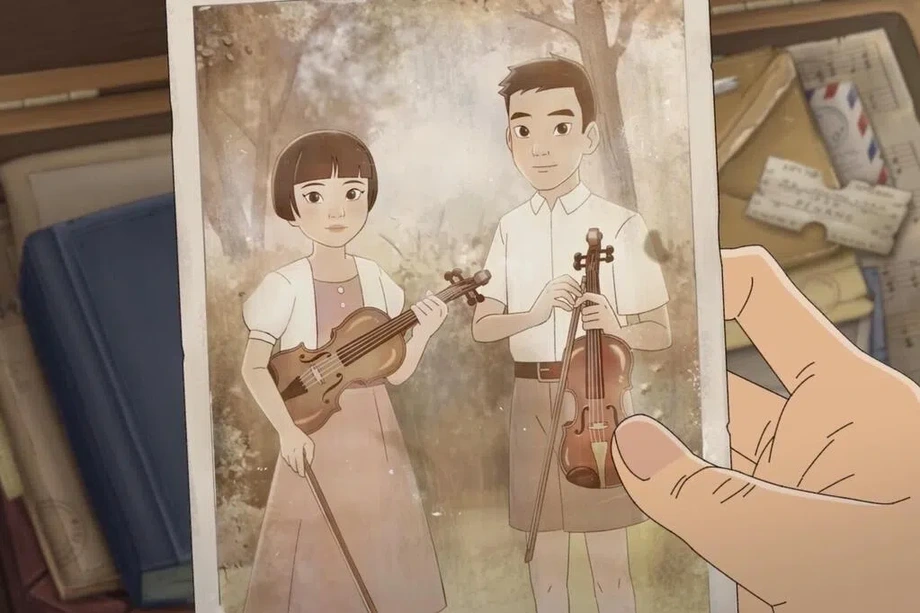
The Violinist opens in 1932 in a Peranakan household in Singapore. Fei, a Chinese Peranakan girl, plays the violin, and Kai, an orphaned boy, learns the instrument by watching her. Peranakan communities formed over generations of cultural exchange between Chinese settlers and the Malay world, and the film places Fei's family and her shophouse at the centre of its drama.
The two become a touring duo across Asia, and their friendship turns into something deeper as they grow up. War arrives, and the film's colours change with it: the warm yellow of Fei's home gives way to the greys of bombing and occupation. Kai enlists and is separated from Fei, ending up with the resistance in Perak, in what is now Malaysia, while Fei stays in occupied Singapore and faces rationing, death and the question of what she wants to leave behind.
The story is framed from the present. Hugo Fernandez, a Spanish journalist played by Enrique Arce, approaches Madam Lee, a celebrated violinist played by Tan Kheng Hua, with a photograph from her childhood and a question about the instrument she has never replaced. The cast also includes Ayden Sng as Kai, Fang Rong as the young Fei, Adrian Pang and Kazuya Tanabe.
How a short film without dialogue became a feature
The project began as The Violin, a short of 15 minutes that Han made in 2015 for the Singapore Memory Project, which marked 50 years of independence. A meeting with Garcia in Singapore turned the idea into a feature, with new characters and a new plot built on the same notion: the violin as the vessel for a person's memory.
Han wrote the screenplay with Jordan Katherine See, and the film cost about S$6 million. It was produced by Robot Playground Media and was Han's first feature as a director, with artists from across Southeast Asia and Europe working on a production that stretched over ten years.
The look was made by hand. The animation is mostly 2D, drawn with the controlled movement of anime and a graphic style closer to a comic book, with computer generated environments and the largest camera moves saved for battle sequences such as the opening air raid. Han gave the production team a single line of direction for how the past should look.
I told the production team that I wanted the film to look like it was remembered rather than reconstructed. That was a very specific artistic direction. A certain memory chooses you, you don't really choose the memory.
Garcia, who spent decades as a senior animator at Disney before directing the Edgar Allan Poe anthology Extraordinary Tales, described the release as a fight over who animation is for.
One of the major battles that we have in this movie is to convince the audience to leave the prejudice aside, thinking that animation is only for kids.
Why the score had to come before the drawing
Music runs through the film as plot rather than decoration. The score was written by Singaporean composer Ricky Ho and Spanish composer Isabel Latorre, built around a piece called Sunset Sonata that Kai starts and Fei completes decades later. Animating violinists means animating fingers, so the music had to be recorded before the animation could be drawn.
We needed a reference of the music to properly animate the playing of the music, so the finger position will be in the proper place, and everything will be believable.
Singaporean violinist Joy Yong played the lead violin parts. The music heard when Fei plays as a child was performed by Anastasha Suchin, who was 12 when she recorded Paganini and Mendelssohn alongside the original pieces. The score collected the SACEM Award for best original soundtrack at Annecy and a nomination at the Hollywood Music in Media Awards.
A second race, decided on the music
The Violinist has also been shortlisted for best score at the Critics Choice Awards, handed out by the Critics Choice Association, an organisation of roughly 600 broadcast, film and television critics and journalists from the United States and Canada. Nominations will be announced on Dec 4, which puts the film's music in front of a separate group of voters a month before the Oscar nominations.
The Hollywood Music in Media Awards nomination went to Ho in the category for original score in an animated film, placing the soundtrack among the honours the film gathered on its festival run.
Two trophies in five minutes in Taipei
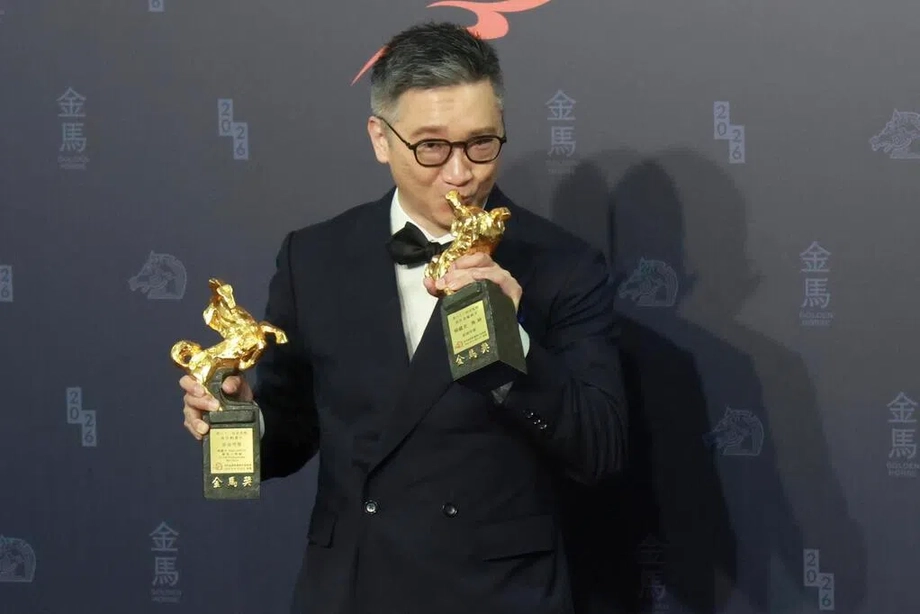
The 63rd Golden Horse Awards at the Taipei Music Centre on Nov 22 brought the film two wins, for best animated feature and best adapted screenplay, the writing prize shared by Han and See. The film was also nominated for best original film score and lost to We Are All Strangers, scored by Kin Leonn and Thomas Foguenne. Singapore productions gathered a record 15 nominations across five films that year and went home with three wins.
Han, who is 51, called the film a "love letter to Singapore" as he accepted the screenplay award, then returned to the stage minutes later for the animation prize. He thanked collaborators, investors and the composers, telling the hall: "Without your music, there would not be The Violinist." He finished with the two people watching the broadcast at home.
My last 'thank you' is to my mum and dad, who are watching me at home on TV. Thank you for your love and support, I hope you can be proud of me tonight.
Speaking on television the next day, Han said the two awards landed faster than he could absorb them.
Everything happened within five minutes. Both categories were announced and we won both. It was quite a surreal moment.
He also set the win against the size of the local industry, noting that this was the first animated film from Singapore in more than 15 years and describing the project as uncharted waters and "wildly and creatively ambitious".
From Annecy to the National Day Rally
Annecy, the French festival regarded as the most important in animation, gave The Violinist its Cristal for best feature in June along with the SACEM Award for its soundtrack. The festival ran from June 21 to 27 in Annecy, France, and drew more than 4,000 entries across its categories.
The 19th Asia Pacific Screen Awards added best animated film on Oct 30. In Singapore, the Infocomm Media Development Authority backed the production, and Prime Minister Lawrence Wong singled the film out at the 2026 National Day Rally, praising Han's perseverance through setbacks over a decade and saying he had "done Singapore proud".
Other honours are still open. According to the film's entry, it is nominated at Spain's Lola Gaos Awards for best animation film and best original score, and at the 32nd Forque Awards for best animation film. Cao Zhongming, China's ambassador to Singapore, attended the Mandarin premiere and described the film as having "a moving story, sincere emotions, and delicate execution", adding that its background music was "particularly well-produced and impressive".
What stands between the film and a nomination
The animated field is crowded with studio power. Prognosticators tracked by Gold Derby put Laika's Wildwood at 97.7% and Pixar's Toy Story 5 at 95.4%, with France's Iron Boy at 74.7%, Hoppers at 69.4% and Canada's Tangles at 63.9%. Netflix's Ray Gunn sits at 44.3%. The list also holds Coyote vs. Acme, a mix of live action and animation that Ketchup Entertainment released after Warner Bros. Discovery shelved it.
Independent and international work fills out the rest, including Cartoon Saloon's Julian from Ireland, Aardman's Shaun the Sheep: The Beast of Mossy Bottom and Kid Koala's Space Cadet from Canada. The Violinist sits in that group, carrying a story about Singapore's occupation years into a contest usually dominated by American studios.
The calendar ahead is short and crowded.
- Nov 22, 2026: The Violinist wins best animated feature and best adapted screenplay at the 63rd Golden Horse Awards in Taipei.
- Nov 23, 2026: The Academy names the film among 38 animated features eligible for the 99th Academy Awards.
- Dec 4, 2026: Critics Choice Awards nominations are announced, with the score on the shortlist.
- Dec 15, 2026: The Academy announces its shortlists, including 15 documentary and 15 international titles.
- Jan 21, 2027: Oscar nominations are announced.
- Mar 14, 2027: The 99th Academy Awards ceremony takes place at the Dolby Theatre.
The Bottom Line
- The Violinist is one of a record 38 animated features eligible for best animated feature at the 99th Academy Awards, announced on Nov 23 by the Academy of Motion Picture Arts and Sciences.
- Five nominees will be named on Jan 21, 2027, with the ceremony set for Mar 14, 2027 at the Dolby Theatre at Ovation Hollywood.
- The film, directed by Ervin Han and Raul Garcia, is a production between Robot Playground Media in Singapore, TV ON Producciones in Spain and Altri Occhi in Italy, made over ten years for about S$6 million.
- It grew from The Violin, a short of 15 minutes made in 2015 for Singapore's 50th anniversary of independence, and follows violinists Fei and Kai through war and the Japanese Occupation.
- At the 63rd Golden Horse Awards on Nov 22 it won best animated feature and best adapted screenplay, shared by Han and Jordan Katherine See.
- The score by Ricky Ho and Isabel Latorre won the SACEM Award at Annecy and is shortlisted for best score at the Critics Choice Awards, with nominations due on Dec 4.
- Singapore's entry for best international feature is a different film, Anthony Chen's We Are All Strangers.