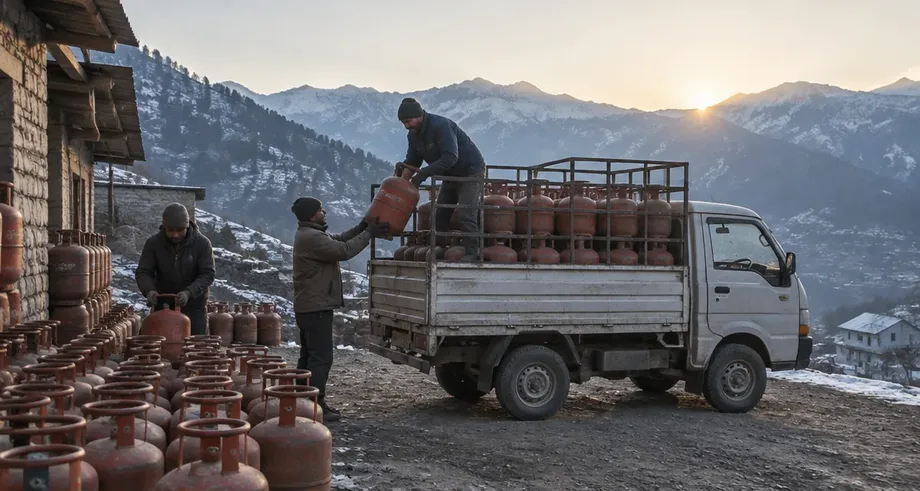
Cold Weather and Empty Gas Pipes Push Households to the Brink
Peshawar and districts across Khyber Pakhtunkhwa entered late November 2026 with household kitchens running cold as prolonged natural gas outages coincided with liquefied petroleum gas (LPG) prices climbing past Rs 600 per kilogram. Rural areas of the province reported retail rates reaching Rs 620 per kilogram by November 23, up from roughly Rs 380 per kilogram just one month earlier.
Contents
- Cold Weather and Empty Gas Pipes Push Households to the Brink
- Official Rates Versus Street Prices: Why Cylinders Cost Twice the Notified Rate
- From Peshawar to Karachi: How the Fuel Crunch Hit Classrooms and Kitchens
- Six Hours of Gas a Day: Major Cities Feel the Autumn Squeeze
- Global Chokepoints and Border Closures Behind the Domestic Scarcity
- Record Port Arrivals and a $200 Million Energy Deal With Oman
- Timeline of Pakistan's 2026 Gas and LPG Crisis
- What Remains Unresolved as Peak Winter Approaches
- Key Points
That surge of at least Rs 220 per kilogram, an increase of nearly 58 percent in four weeks, struck families who had bought LPG cylinders after pipeline gas from the national grid became unreliable. Long lines of vehicles stretched outside compressed natural gas (CNG) stations in Peshawar and other cities as temperatures dropped, while domestic gas lines stayed dry for hours at a time.
Rickshaw drivers deepened the supply crunch when CNG pumps ran dry or shut down. Large numbers of three wheeled transport operators converted their vehicles to run on LPG, pulling scarce fuel supplies away from kitchens and pushing retail market prices upward.
Residents across the province say the combined shock of empty pipelines and costly cylinders has disrupted monthly family budgets and created daily anxiety over how to cook basic meals. Consumers have called on provincial and federal authorities to restore steady pipeline pressure, monitor retail shops, and penalize dealers charging arbitrary rates.
Official Rates Versus Street Prices: Why Cylinders Cost Twice the Notified Rate
Oil and Gas Regulatory Authority (OGRA) records reveal a wide divide between official prices and what households actually pay at retail shops. Effective November 1, 2026, OGRA set the official consumer rate for LPG at Rs 294.08 per kilogram, listed as Rs 294.07 on some retail schedules, marking a rise of Rs 14.74 from October's notified price of Rs 279.34 per kilogram.
Under OGRA's November pricing schedule, a domestic cylinder holding 11.8 kilograms carries an official tag of Rs 3,470.09, while a commercial cylinder holding 45.4 kilograms is fixed at Rs 13,350.78. Open market prices in Punjab and Khyber Pakhtunkhwa during October and November climbed to Rs 6,000 to Rs 7,200 for domestic cylinders and Rs 22,700 to Rs 27,240 for commercial cylinders, more than double the official ceiling.
OGRA determines monthly LPG rates through Pakistan's Petroleum Products Pricing Mechanism, which weighs the Platts Arab Gulf international benchmark, the currency exchange rate, the petroleum levy, customs duties, and approved margins. One year earlier, in November 2025, OGRA's official rate stood at Rs 201.60 per kilogram, showing an official increase of Rs 92.48, or nearly 46 percent, over twelve months.
Street rates climbed far beyond those regulated adjustments, prompting OGRA to issue an official statement refuting rumours of an unscheduled price increase and confirming that government rates remained unchanged. The authority called on the public to assist enforcement efforts by reporting unauthorized markups.
Instances of overcharging or price manipulation should be reported for immediate action.
Trade representatives have pointed to hoarding and black marketing as major drivers of the gap between official and retail costs. Sajid Khan, general secretary of the LPG Association, alleged earlier in 2026 that importers created an artificial shortage to boost profits, warning that prices would keep rising unless authorities stepped in.
From Peshawar to Karachi: How the Fuel Crunch Hit Classrooms and Kitchens
Natural gas shortages disrupted daily life across Pakistan well before winter arrived, hitting schools, commuters, and neighborhood bakeries in April 2026. On April 5, CNG filling stations in Peshawar and nearby areas stayed closed for a second consecutive day because of acute natural gas shortages.
School van and Suzuki bus operators suspended services across Peshawar because running vehicles on petrol proved far beyond their financial reach. Public transport drivers who switched from CNG to petrol raised passenger fares sharply and warned they would halt operations completely unless gas pumps reopened.
Karachi residents faced simultaneous price shocks during the April squeeze as tandoor oven owners raised flatbread prices by Rs 5 to cover costlier LPG. Lighter roti rose to Rs 25, heavier roti climbed to Rs 30, and chapati hit Rs 20, while school van fees in the city increased by Rs 1,000 to Rs 2,000 per month.
Bus and minibus operators in Karachi doubled fares on short trips despite an official fare freeze ordered by the Sindh provincial government. Rising fuel costs and inflation sparked protests and hunger strikes across Sindh, with the Sindh United Party staging a hunger strike in Sukkur alongside demonstrations by Pakistan Tehreek-e-Insaf and Awami Tehreek.
Worker groups in Karachi, including the National Trade Union Federation Pakistan and the Home-Based Women Workers Federation, also rallied to demand higher wages and the abolition of the petroleum levy. Those spring disruptions previewed the sharper household crisis that struck northern provinces in the final quarter of the year.
Six Hours of Gas a Day: Major Cities Feel the Autumn Squeeze
Islamabad and Rawalpindi experienced severe cooking fuel shortages in October 2026 when piped natural gas availability dropped to roughly six hours a day, forcing many families to cook with wood and coal. Sui Northern Gas Pipelines Limited (SNGPL) had not supplied LPG cylinders to domestic or commercial customers for two months, leaving private companies to sell 11 kilogram cylinders for Rs 6,500 and commercial cylinders for more than Rs 25,000 against OGRA's October rate of Rs 279.34 per kilogram.
Mohammad Sajjad, a resident living in the twin cities, described how low gas pressure and limited supply windows pushed households into buying expensive cylinders.
I have bought LPG cylinders as Sui gas is available only from 7 am to 9 am, 12 noon to 2 pm and from 6 pm to 9 pm.
High prices persisted across major northern and western cities even after overland LPG supplies from Iran resumed in the middle of November. Market checks on November 19, 2026 recorded retail rates of Rs 500 to Rs 580 per kilogram in Lahore, Rs 550 to Rs 600 in Peshawar, and Rs 550 to Rs 580 inside Quetta city, while suburban parts of Quetta paid Rs 600 to Rs 630 per kilogram.
Karachi was the only major urban market to register substantial price relief once Iranian flows resumed and new sea shipments arrived, falling by Rs 80 per kilogram from Rs 530 down to Rs 450. Even after that reduction, Karachi buyers still paid Rs 155.92 per kilogram above OGRA's Rs 294.08 official price.
Global Chokepoints and Border Closures Behind the Domestic Scarcity
Pakistan imports nearly 80 to 85 percent of its petroleum requirements, leaving domestic supplies exposed whenever global sea lanes or border crossings face disruption. Most imported fuel shipments historically travel through a single maritime passage, the Strait of Hormuz, before reaching terminals at Karachi and Port Qasim.
Regional warfare has choked those traditional routes throughout 2026. The conflict between the United States and Iran, now in its ninth month, severely disrupted vessel movements through the Strait of Hormuz, where key suppliers including Saudi Arabia, Kuwait, the United Arab Emirates, and Qatar operate export ports.
Alternative Red Sea lanes have simultaneously been blocked by Houthi attacks in Yemen, leaving Pakistani importers with few viable ocean corridors. Periodic border closures added further strain on LPG inflows just as cooler weather arrived and winter demand accelerated across mountainous districts.
Currency pressure amplified the impact of international supply shocks because oil and gas imports must be settled in US dollars. Rising global fuel costs increase domestic demand for dollars, weakening the rupee and inflating the local price of every imported shipment.
Record Port Arrivals and a $200 Million Energy Deal With Oman
Maritime deliveries accelerated in mid November as authorities and private buyers sought to stabilize supplies before peak winter cold arrived. According to the Port Qasim Authority, six LPG cargo vessels reached Port Bin Qasim between November 12 and November 18, 2026, including the vessel Sea Shine carrying 21,866 tons of LPG.
On November 18, 2026, Pakistan also received a 15,000 metric ton LPG shipment at Port Qasim, described by officials as the largest cargo delivered under a new arrangement allowing companies owned by the state to import LPG after prior regulatory barriers were removed. Special Secretary Petroleum Mirza Nasiruddin Mashhood attended the arrival ceremony as chief guest, stating that the government was acting to make LPG affordable across the country and that additional vessels would arrive over the coming weeks.
Islamabad simultaneously secured a bypass route around regional conflict zones by signing a Sale and Purchase Agreement between Pakistan State Oil (PSO) and Oman's commodity trading firm owned by the state, OQ Trading (OQT). Finalized in Muscat during a meeting between Petroleum Minister Ali Pervaiz Malik and Oman's Minister of Energy and Minerals Salim Bin Nasser Al Aufi, the formal pact builds on an October 8 agreement and creates a Joint Working Group on Oil and Gas between Pakistan and Oman.
Oman sits outside both the Strait of Hormuz and the Bab al-Mandeb chokepoint, offering a short crossing across the Arabian Sea and serving as a transfer point for Gulf crude. Under the new partnership, OQT's LPG deliveries to Pakistan are expected to exceed 120,000 tonnes by the end of 2026, adding to more than one million tonnes of gasoline OQT supplied to PSO during the year.
OQT also extended a credit line of $200 million to PSO, giving Pakistan deferred payment relief similar to Kuwait's financing of three monthly oil cargoes on deferred terms of 90 days. Pakistan's petroleum division described the commercial deal as a stabilizing anchor amid turbulent energy markets.
The agreement marks an important milestone in the commercial relationship between the two companies and provides a structured arrangement for petroleum product supplies from OQT to PSO, supporting supply reliability amid continued volatility in regional energy markets.
Timeline of Pakistan's 2026 Gas and LPG Crisis
- April 5, 2026: CNG stations in Peshawar remain closed for a second day, halting school vans while Karachi experiences flatbread and school transport fee increases alongside protests across Sindh.
- June 1, 2026: OGRA's official LPG rate reaches its 2026 peak of Rs 308.76 per kilogram before easing to Rs 241.43 in July.
- October 2026: Natural gas supply in Islamabad and Rawalpindi drops to six hours daily as market LPG hits Rs 600 per kilogram against OGRA's Rs 279.34 rate; PSO and OQT reach an initial agreement on October 8.
- November 1, 2026: OGRA increases the official LPG rate by Rs 14.74 to Rs 294.08 per kilogram, setting domestic cylinders at Rs 3,470.09.
- November 12 to 18, 2026: Six LPG cargo vessels reach Port Bin Qasim, including the Sea Shine carrying 21,866 tons, while a record 15,000 metric ton state shipment docks on November 18.
- November 19, 2026: Karachi LPG prices drop by Rs 80 to Rs 450 per kilogram after Iranian flows resume, while Peshawar, Lahore, and Quetta stay between Rs 500 and Rs 630.
- November 23, 2026: Rural areas of Khyber Pakhtunkhwa report LPG prices reaching Rs 620 per kilogram amid persistent gas outages.
What Remains Unresolved as Peak Winter Approaches
Price relief at Pakistan's southern ports has yet to reach consumers in Khyber Pakhtunkhwa, Punjab, or Balochistan, and authorities have not announced a target date for northern retail rates to fall toward OGRA's Rs 294.08 official price. Enforcement capacity at the district level remains untested as dealers continue selling cylinders well above government notifications while piped SNGPL pressure stays low.
Further LPG shipments expected in the coming weeks, alongside expanded flows from Oman and Iran, could ease physical scarcity if inland distribution catches up with port arrivals. Until steady natural gas returns to household pipelines or affordable cylinders reach rural shops, families across Khyber Pakhtunkhwa face mounting pressure to pay for basic daily cooking fuel through the winter months.
Key Points
- LPG prices in Khyber Pakhtunkhwa jumped from Rs 380 to over Rs 600 per kilogram within a month, reaching Rs 620 in rural areas amid severe piped natural gas outages.
- OGRA set the official November 2026 LPG rate at Rs 294.08 per kilogram, or Rs 3,470.09 per domestic cylinder holding 11.8 kilograms, less than half of market rates in northern cities.
- CNG station closures pushed Peshawar rickshaw drivers toward LPG and disrupted school vans across Khyber Pakhtunkhwa and Karachi earlier in 2026.
- Conflict disrupting the Strait of Hormuz and the Red Sea, combined with border closures, squeezed fuel supplies for a country importing 80 to 85 percent of its petroleum needs.
- Six LPG vessels docked at Port Bin Qasim between November 12 and 18, including a 15,000 metric ton shipment under new state import rules, while PSO signed a $200 million credit and supply deal with Oman's OQ Trading.
- Karachi market prices fell by Rs 80 to Rs 450 per kilogram after Iranian supplies resumed, though Peshawar, Lahore, and Quetta have yet to see similar drops.