Speed Skating Star Shines in Japan
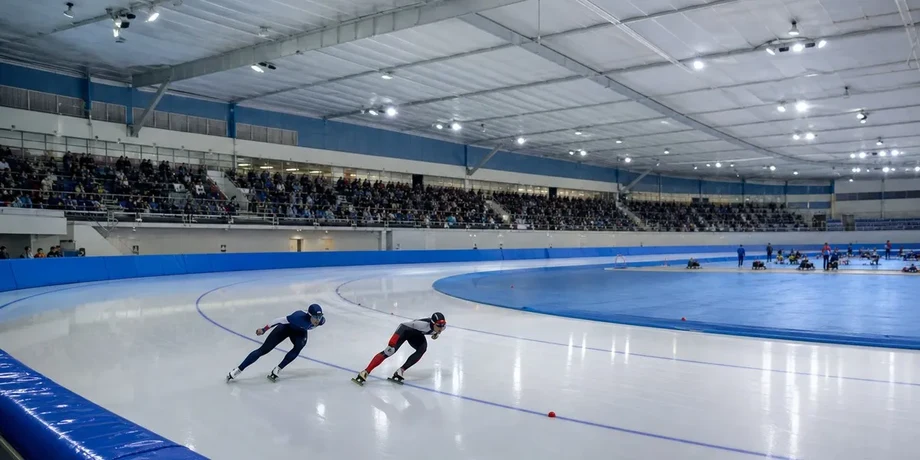
Chinese speed skater Ning Zhongyan claimed the men 1500 meters gold medal at the International Skating Union Speed Skating World Cup in Obihiro, Japan. Skating in the eighth group from the outer lane, Ning clocked a time of 1 minute, 43.587 seconds on November 21, 2026. This performance allowed him to surpass the previous track record and secure his second consecutive World Cup victory in this distance.
Contents
American competitor Jordan Stolz finished as the runner-up with a time of 1 minute, 43.79 seconds, while Italian athlete Daniele Di Stefano earned the bronze medal. The Obihiro venue, featuring a standard 400 meter speed skating oval, hosted a competitive field of ten groups in the A division final. Ning held a narrow deficit of 0.44 seconds at the 700 meter split before accelerating through the final lap to win by a margin of 0.21 seconds.
A Tactical Victory Over a Formidable Rival
Jordan Stolz had earlier set a fast pace by skating in the first group and registering 1 minute, 43.79 seconds to break the existing track record. Speed skating operates differently from short track events, as competitors race against the clock in pairs rather than engaging in direct tactical contact or elimination heats. Skaters must alternate between inner and outer lanes at designated exchange zones, requiring precise timing to avoid penalties or lost momentum.
Ning Zhongyan maintained a controlled pace during the opening half of the race rather than forcing an early lead. His strategy relied on preserving aerobic endurance and explosive anaerobic capacity for the final 400 meters, where he recorded a lap time of 26.75 seconds. By holding his speed steady when competitors typically experience fatigue, Ning overcame the early deficit and captured the top step of the podium.
Building Momentum Across the World Cup Circuit
The victory in Obihiro marks Ning Zhongyan's third gold medal of the season, following a strong performance at the opening World Cup leg in Beijing. During the Beijing stop where Jordan Stolz did not compete, Ning swept both the 1000 meter and 1500 meter events, also breaking a track record in the shorter distance. His back-to-back triumphs in the 1500 meter discipline demonstrate exceptional consistency and physical conditioning early in the international calendar.
Beyond the 1500 meter triumph, Chinese athletes delivered multiple notable results across various disciplines during the Obihiro weekend. Lian Ziwen secured a gold medal and set a new track record in the men 1000 meter A division final with a time of 1 minute, 07.48 seconds, while Ning Zhongyan claimed the silver medal in the same race. In the first men 500 meter competition, Lian captured a silver medal with a time of 34.71 seconds, finishing 0.45 seconds behind Jordan Stolz, and teammate Gao Tingyu placed fourth.
Understanding Track Records and Group Formats
Speed skating distinguishes clearly between world records set across global competitions and track records established within specific venues during sanctioned events. A track record remains valid only for the arena where it was skated and requires official electronic timing, approved equipment, and confirmation from referees and technical delegates. When Ning Zhongyan improved upon the mark set minutes earlier by Jordan Stolz, the new time was officially logged into the Obihiro venue records.
The competition structure utilizes a tiered system where skaters qualify for the A or B divisions based on accumulated World Cup points from prior events and previous standings. Athletes who perform well in the B division can earn promotion to the top tier in subsequent competitions, ensuring a dynamic ranking system throughout the season. Points awarded in A division finals accumulate toward the overall season standings and determine seeding positions for upcoming international championships.
Broader Team Performances in Obihiro
The women squad also contributed competitive results to the Chinese delegation during the four-day event in Japan. In the women 1500 meter contest, Yang Bingyu and Han Mei finished in fourth and fifth places respectively, demonstrating strong depth in middle-distance events. The final day of competition at the Obihiro venue featured secondary 500 meter races, team pursuit events, and mixed relay races, which emphasize collaborative tactics and team coordination.
Jordan Stolz acknowledged Ning Zhongyan's performance after the race, offering praise for his competitor's relentless training ethic and speed on the ice. The rivalry between the two skaters has established the men 1500 meter event as a primary focal point of the current international speed skating calendar, combining tactical endurance with high-speed execution.
At a Glance
- Ning Zhongyan won the men 1500 meter A division final with a time of 1 minute, 43.587 seconds.
- Jordan Stolz finished second with 1 minute, 43.79 seconds, and Daniele Di Stefano took third place.
- Lian Ziwen and Ning Zhongyan previously secured gold and silver in the men 1000 meter event.
- The Obihiro World Cup leg concluded on November 22, 2026, following events in individual distances and team disciplines.