Less DRAM, with a measurable trade in speed
AMD says its MEXT memory software can reduce the DRAM required by server workloads by 20% to 75%, with a test involving five AI agents retaining 99% of its original performance after physical DRAM capacity was cut in half. At a 75% reduction, performance fell to 85%, showing both the potential savings and the cost in speed.
Contents
- Less DRAM, with a measurable trade in speed
- Why server operators are looking for alternatives
- How MEXT decides what stays in fast memory
- What the performance tests actually measured
- Inside AMD's memory expansion figures
- From a startup to AMD's data center portfolio
- Which applications could benefit?
- SSDs bring their own costs and limits
- What changes for Samsung and SK hynix?
- Key Points
The company presented the results at AMD In Depth 2026 in Las Vegas as rising memory prices make server upgrades more expensive. MEXT uses solid state drives, or SSDs, to hold data that applications rarely access, then predicts which data should return to fast DRAM before it is needed.
AMD's internal deployment case study documents an initial rollout across 86 hosts, adding approximately 58 terabytes of usable capacity at a claimed 82% saving against equivalent DRAM expansion. At the Las Vegas presentation, AMD gave a larger deployment figure of 145 servers and about $4.9 million in savings, or 83%.
For businesses, the attraction is practical: run larger workloads without buying enough expensive DRAM to keep every piece of data in the fastest memory. AMD plans to reach approximately 700 servers by March 2027 and 2,000 by the end of 2027, turning an internal deployment into a much larger test of the approach.
Why server operators are looking for alternatives
Counterpoint Research put global DRAM revenue growth in the third quarter of 2026 at 369% compared with a year earlier, while shipment volume increased just 4%. Prices, rather than a similar surge in the amount shipped, drove the revenue increase.
TrendForce forecast that conventional DRAM contract prices would rise another 10% to 15% in the fourth quarter compared with the previous quarter. For operators buying memory across hundreds of machines, even a modest increase per server can become a large expense.
Hasmukh Ranjan, AMD's chief information officer, described the purchasing pressure in the company's case study:
Rising memory prices are a real challenge for every IT organization,
AMD says spending on additional memory modules competes with spending on graphics processors and other infrastructure. Its engineering servers use fourth and fifth generation EPYC processors, and the company wants to increase the memory available to engineers while preserving money for other equipment.
Server operators also buy spare capacity to handle sudden peaks. A database may temporarily need extra memory while copying data, accepting more connections or clearing unused objects. Buying for those peaks protects service reliability, but leaves some expensive capacity lightly used during normal operation.
How MEXT decides what stays in fast memory
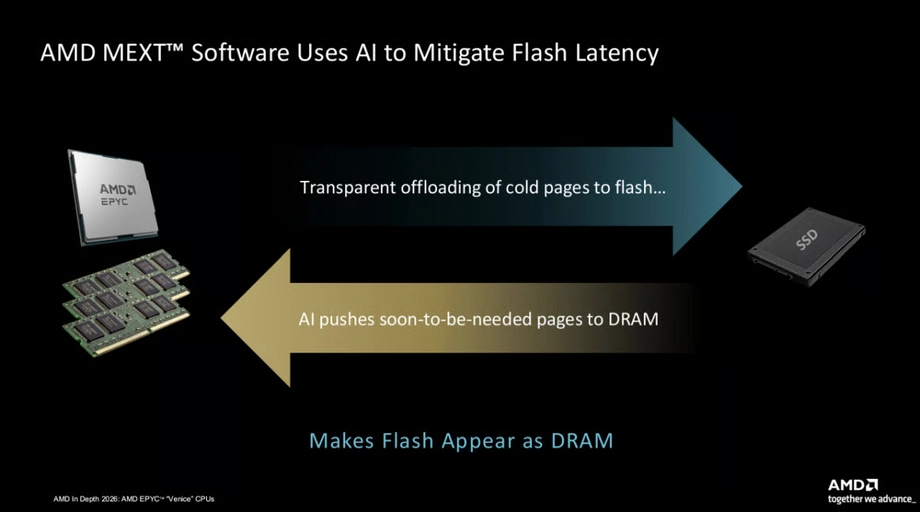
DRAM is a server's fast working space. An SSD stores much more data for the money, but takes longer to retrieve it. MEXT's Predictive Memory Engine tries to combine those strengths by keeping frequently needed data in DRAM and moving less active data to flash storage.
AMD cites research from Meta and Microsoft indicating that 50% to 80% of memory data becomes rarely used over time. Those less active portions are candidates for storage on SSDs, leaving DRAM available for work that needs its speed.
Operating systems already move small blocks of memory, called pages, between DRAM and storage. The difficult part is fetching a page quickly when an application needs it again. If the data is still on an SSD, the application can face a delay while it is retrieved.
MEXT learns access patterns and predicts which pages will be needed next. It then brings those pages back into DRAM ahead of the request. Successful prediction means the application finds its data in fast memory rather than waiting for storage.
The software runs alongside enterprise applications without requiring changes to their code or a modified operating system kernel. MEXT also claimed that a proof of concept could be deployed in under five minutes without hardware modifications, a claim that describes the initial trial rather than a full production rollout.
What the performance tests actually measured
AMD's test running five AI agents simultaneously provides two useful points on the cost and performance curve. With half the original DRAM, the system retained 99% of its baseline performance. With only one quarter of the original DRAM, it retained 85%.
The second configuration delivered 3.4 times the performance per dollar spent on DRAM, according to AMD. The calculation follows from keeping 85% of performance while using 25% of the DRAM: 0.85 divided by 0.25 equals 3.4. A complete operating budget would also include SSDs, software, power and maintenance.
AMD also tested Synopsys PrimeTime, software used to check whether a chip design meets its timing requirements. Reducing DRAM from 512GB to 256GB, with MEXT providing the remaining usable capacity, retained 95% of performance.
Those results give buyers a concrete choice. A workload that can tolerate a small reduction in speed may run with substantially less physical memory. An application with strict response deadlines may need a larger DRAM allocation, especially if its data access patterns are difficult to predict.
Inside AMD's memory expansion figures
AMD's official case study describes expanding usable memory, rather than removing three quarters of the installed DRAM. Across the initial 86 hosts, MEXT supplied approximately 58TB of additional capacity, giving the servers 20% more usable memory.
AMD estimated that equivalent physical DRAM would cost approximately $3.3 million, compared with approximately $601,000 for the MEXT deployment. The case study states savings of nearly $2.78 million, or 82%, and describes the expansion as costing 18% of the equivalent DRAM purchase.
The financial figures are AMD's estimates for its own engineering environment. Its later presentation put deployment at 145 servers, with savings of approximately $4.9 million. Businesses considering MEXT would need a comparison using their own memory prices, workloads and storage requirements.
AMD plans to install MEXT by default on new servers while upgrading existing production systems. Its target of approximately 700 servers by March 2027 carries projected cumulative savings of around $21 million. At 2,000 servers by the end of 2027, the company projects savings exceeding $60 million.
The expansion should also give AMD more experience with the software under routine engineering workloads. Ranjan described the deployment's current role in the company:
We have already deployed MEXT significantly in our engineering grid and continue to expand the deployment,
From a startup to AMD's data center portfolio
MEXT was founded in 2023 in Santa Clara, California, with venture backing that included Clear Ventures. Its technology was publicly discussed before its flagship Predictive Memory product launched in April 2026.
AMD announced the acquisition on June 15, 2026. In its MEXT acquisition announcement, Dan McNamara, senior vice president and general manager for Compute & Enterprise AI, said AMD expected to integrate the technology across its data center portfolio. Financial terms were not disclosed.
The sequence shows how quickly AMD moved from buying the technology to using it internally:
- 2023: MEXT was founded in Santa Clara.
- April 2026: Predictive Memory launched publicly.
- June 15, 2026: AMD announced the acquisition.
- September 2026: AMD IT began its production rollout.
- March 2027: AMD targets approximately 700 servers.
- End of 2027: AMD targets 2,000 servers.
Before the acquisition, subscriptions reportedly cost around $3.99 per gigabyte of managed memory per year. AMD has not set out a current customer price, a detailed commercial rollout schedule or whether future versions will carry restrictions tied to AMD hardware.
Which applications could benefit?
Redis, Memcached, Weaviate and SAP HANA illustrate why memory capacity can matter as much as processor power. Redis and Memcached keep frequently requested information readily accessible. Weaviate and SAP HANA can combine substantial computing demands with large datasets held in memory.
A sponsored discussion of MEXT published in April 2025 used a simple purchasing example: a server might contain a $3,000 processor and $6,000 of memory. Doubling the memory for safety could increase the system's cost by almost 50%, depending on its other components.
MEXT's commercial pitch was that software could provide two to four times the usable memory capacity and reduce infrastructure costs by up to 50%. Those were company claims; AMD's disclosed tests provide more specific examples of the capacity and speed available under particular conditions.
The strongest candidates are workloads with a sizeable pool of rarely accessed data and patterns the prediction engine can learn. Keeping that less active data on SSDs can allow a database, engineering task or AI application to fit on an existing server instead of requiring a memory upgrade.
AMD's PrimeTime result is especially relevant to its own operations because chip engineering is a real internal workload. The five agent test offers another example, though buyers would still need to measure their particular applications rather than assume the same percentage savings.
SSDs bring their own costs and limits
Prediction errors are a central technical risk. If an application suddenly requests data that MEXT has left on an SSD, it must wait for that data to return. Irregular access patterns can make such delays more frequent, while services with strict response targets may be sensitive to occasional slow requests.
NAND flash also has a finite writing life. Moving memory pages onto SSDs adds storage activity, making drive endurance and replacement costs part of the purchasing decision. Independent validation across a broad range of workloads and detailed evidence on long term flash wear remain limited.
Storage prices are rising too. TrendForce forecast a 23% to 28% quarterly increase in enterprise SSD contract prices for the fourth quarter, compared with its forecast of 10% to 15% for conventional DRAM. The relative price of the two resources will help determine the savings.
MEXT had described flash as roughly 50 times cheaper per gigabyte than DRAM. That was a company comparison, while an actual deployment depends on the drives purchased, software charges, endurance requirements and the amount of DRAM retained. The useful measure for an operator is the cost of meeting its workload's capacity and response targets.
What changes for Samsung and SK hynix?
Samsung Electronics and SK hynix could face a change in the mix of memory purchased for servers if software such as MEXT becomes widely used. A server configured with less DRAM needs fewer physical memory modules for the same application workload.
Both companies also manufacture NAND flash and enterprise SSDs. Moving rarely accessed memory data to storage could create additional demand for those products, giving the suppliers a role on both sides of the change.
AMD's deployment targets cover its own infrastructure, and customer adoption will determine the wider market effect. The immediate development is more concrete: AMD has published examples showing how much performance it retained with less DRAM and has attached server counts, dates and projected savings to its internal expansion.
For IT buyers, MEXT adds another option between leaving a server unchanged and purchasing more physical memory. The decision turns on whether the application can tolerate the measured loss of speed and whether the full deployment costs less than the DRAM it replaces or avoids.
Key Points
- AMD says MEXT can reduce DRAM requirements by 20% to 75%, depending on the workload.
- A test involving five AI agents retained 99% of performance with half the DRAM and 85% with one quarter.
- PrimeTime retained 95% of performance when physical DRAM fell from 512GB to 256GB.
- AMD's official case study covers 86 hosts; its presentation cited 145 servers and approximately $4.9 million in savings.
- AMD targets approximately 700 servers by March 2027 and 2,000 by the end of 2027.
- Workload predictability, SSD prices, software costs and flash endurance will shape the economics for customers.